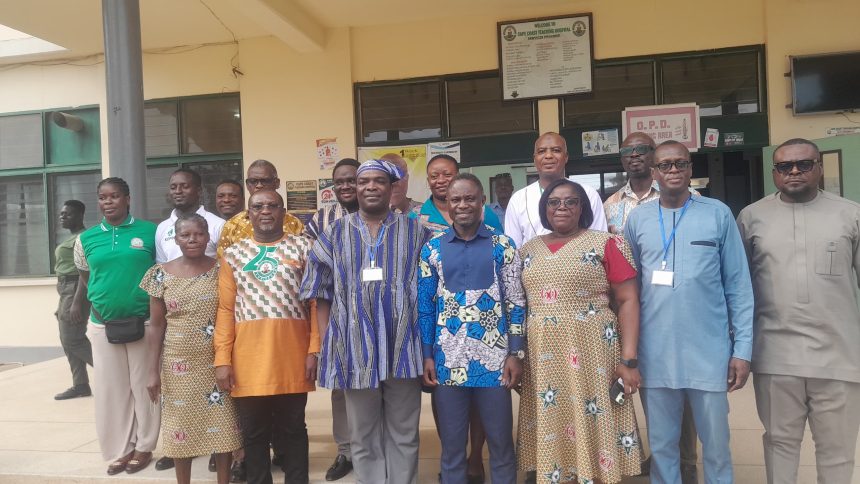
Mr Kwabena Mintah Akandoh, the Minister of Health, on Friday, November 14, paid a surprise working visit to the Cape Coast Teaching Hospital (CCTH) to assess the state of the facility and service delivery and explore ways to address its challenges.
The minister’s visit coincided with the facility’s deployment of the newly procured Ghana Health Information Management System (GHIMS) which was active across the various departments.
It was gleaned from the minister’s interactions with the staff that there were no major challenges with the system itself, but the staff were struggling to acclimatise to it since it was new, resulting in some delays.
Mr Akandoh, together with some members of the hospital’s management, visited several areas of the facility including CCTH’s polyclinic, the paediatric ward and Neonatal Intensive Care Unit of the child health facility, and the network server room.
The team also visited the OPD and inspected some ongoing projects at the facility as the minister interacted with patients, relatives, caregivers and staff of the hospital.
The minister acknowledged that every new system was bound to face some challenges in the initial stages but was confident that the it was an improvement on the old system, that was the Lightwave Health Information Management System.
He justified the introduction of the new system, insisting that it was unconscionable for a private vendor to host and manage the data of the state.
He said government deemed it fit to own the software, and was working to procure a middleware that would make it easy for future vendors to plug in while government continued to have full control over the data.
Mr Akandoh entreated the hospital to treat patients with respect and dignity while expressing government’s commitment to creating a conducive atmosphere for them to carry out their work smoothly.
He reiterated government’s commitment to implementing the Free Primary Health Care latest by January, indicating that the policy framework was ready.
He disclosed that President John Dramani Mahama had engaged the World Health Organisation on the policy, and very soon, government would embark on a broader stakeholder engagement before escalating it to cabinet.
He emphasised the need to pay more attention to the promotive and preventive health care to prevent illnesses in the first place.
For Ghana Medical Trust Fund also known as the MahamaCares, Mr Akandoh said a Board had been inaugurated and the secretariat established and in operation.
It would be dedicated to the treatment of non-communicable diseases and the training of more specialists to mitigate the incidence of such conditions and their attendant mortalities.
He clarified that there would be no competition between the National Health Insurance Scheme (NHIS) and MahamaCares because conditions covered by the NHIS would not be covered by MahamaCares.
The Minister reiterated the pledge to extend the subsidy for dialysis treatment to private health facilities to reduce the burden on citizens who accessed those facilities.
He said his Ministry was undertaking massive reforms in the health sector to address various challenges including the lopsided deployment of medical doctors across the country.
“One of such reforms is the decision to post not less than 80 per cent of new doctors in the districts and underserved communities because almost 50 per cent of medical doctors are in Accra alone, leaving the rural areas to suffer,” he said.
Dr Eric Kofi Ngyedu, the Chief Executive Officer of the hospital, brought the minister up to speed on some developments and challenges at the facility and thanked him for his visit and positive assurances.
He said the hospital, in partnership with the Ghana Gas Company, had constructed a decent accommodation for the relatives of patients to protect them from the harsh weather and mosquitoes as had been the case for decades.
“We are constructing an ultramodern eye centre which is about 90 per cent complete and we expect to commission it in March 2026,” he said.
However, an expansion project for the emergency unit which was about 60 per cent complete had stalled and needed the support of government to expedite completion.
Additionally, all the 16 dialysis machines of the hospital were old and overburdened with 10 of them completely obsolete.
Dr Ngyedu was hopeful of receiving new dialysis machines through the Ghana Medical Trust Fund as the hospital explored other avenues to enhance dialysis services.
Earlier, the Health Minister addressed the 67th annual conference of the Ghana Medical Association where he championed stronger partnerships between the public and private sectors to enhance the country’s health care system.