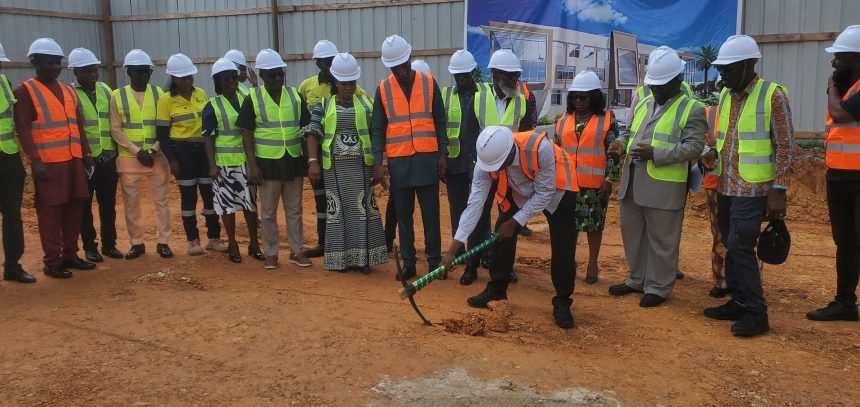
The Ghana Chamber of Mines (GCM) has performed a sod cutting ceremony for the construction of a Mining Artificial Intelligence(AI), Robotics and Minerals Testing Laboratory for the University of Mines and Technology (UMaT), Tarkwa.
The state-of-the-art facility, estimated at a cost of US$1,257,193.47, when completed, would shape the future of Ghana’s mining industry, making it more competitive and sustainable.
Speaking at the ceremony, Dr Kenneth Ashigbey, Chief Executive Officer (CEO) of GCM, said the initiative was part of the continuing legacy of the Chamber’s Tertiary Education Fund (TEF), a visionary industry-driven mechanism, established in 2019 to support higher education, research, and innovation in Ghana’s mining and allied sectors.
He said their member companies decided to fund the facility because they recognised that technological innovation and digital transformation were the new frontier of mining competitiveness.
“The world is in the midst of the Fourth Industrial Revolution, and for Ghana’s mining sector to remain relevant and resilient, we must not only build local capacity in AI, robotics, data analytics, and materials science, but we should also develop and contribute to these technologies, considering our local and African perspectives.”
Dr Ashigbey said it was imperative to study and develop the mathematics and algorithms that underpinned these digital transformation technologies.
The CEO indicated that “The overall impact will be a paradigm shift: The ‘new thing is’ not just individual technologies, but the shift towards an integrated, intelligent, and autonomous operation. Instead of reacting to breakdowns and problems, mines can now predict and prevent them.”
He also said it would serve as a centre for materials testing, providing essential services to the mining, petroleum, manufacturing, and construction industries, adding, “The ability to test and certify materials locally will not only improve safety and reduce operational costs, but also retain value within the country, fostering growth and development.”
Mr Frederick Attakumah, Chairman of the Governing Board of the Ghana Chamber of Mines Tertiary Education Fund (GCM TEF), in his remarks, reaffirmed the unwavering commitment of the GCM’s to work together with the UMaT.
He stated that the Chamber recognised that a strong and well-resourced University system was the foundation upon which the future of their industry rested.
“We believe the GCM Mining AI/Robotics and Materials Testing Laboratory will serve as a hub where brilliant ideas meet practical applications, where the next generation of engineers and scientists will design tools and systems that transform mining operations and safeguard our natural environment,” Mr Attakumah added.
Mr Roger Adamah, the Chairman for the Tender Committee, provided an overview of the project, and said the ground-breaking ceremony to construct the building was the initial phase of the project.
He outlined what they anticipated would be in the building after its completion and revealed that the second phase of the project involved equipping the build.
Mr Adamah said although they had considered many things for the building, they had not proceeded with that aspect of work because they wanted more consultations on that.
He explained that the Testing Laboratory would be situated on the ground floor of the building and would have a sitting capacity of about 103 people and include offices, a 54-person open area for discussion, a power room, storerooms, and sanitation facilities.
The first floor would feature the Robotics and AI laboratory, accommodating 178 people, with offices and storage.
The second floor would also feature a Computer laboratory for 125 sitting capacity, along with offices, a server room, and sanitary facilities. The building had been designed to accommodate the physically challenged too.
In terms of equipping, Mr Adamah said, six areas were being considered and it included AI Computer and Data Infrastructure, AI Enabled Robotics Platforms, AI Vision and Sensor Laboratories, AI Autonomy and Simulation systems, AI Enabled Drone Systems and AI Testing and Development tools.
He pointed out that “As a committee, these are the six main areas we have identified, l can say that maybe it is not part of our reference now, but we are thinking ahead based on our experience in the mining industry.”
Mr Issah Salifu Taylor, Member of Parliament for Tarkwa Nsuaem constituency, commended the GCM and its member companies for the effort, saying it would bring expertise and improve the accuracy of decisions made across the various mining companies.
Professor Grace Ofori-Sarpong Akuffo, the Pro Vice Chancellor of the University, on her part, expressed gratitude to the GCM for funding the transformative project, which would strengthen innovation, research, and training within the mining sector.