
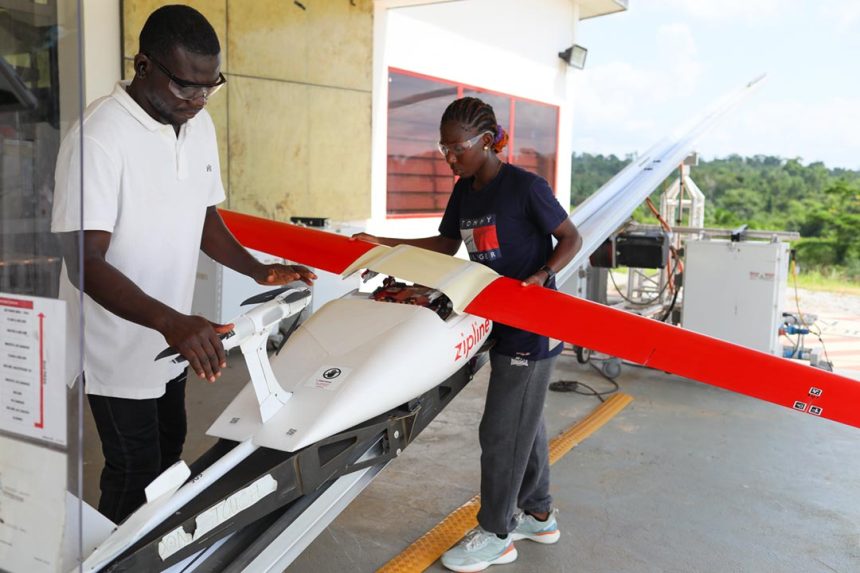
Imagine you’re in a remote village in Ghana, waiting anxiously, hoping a drone will swoop in with life-saving blood or vaccines. Instead, it drops off a school textbook — or worse, a pack of condoms and a mosquito net. That, according to the Health Minister, is what’s been happening. And now the government says it’s reconsidering whether Zipline deserves to stay airborne.
Yes, the same drones once hailed as the saviours of rural health, zooming through Ghana’s skies to deliver urgent medical supplies, are now accused of moonlighting as airborne parcel service for everyday items. According to the Minister’s December 1, 2025 statement, only 4 percent of Zipline’s flights in recent months were for emergency medical services, and just 12 percent for “hard-to-reach” areas. The rest (a staggering 84 percent) were deliveries of condoms, mosquito nets, textbooks, syringes, needles, even uniforms.
It paints a surreal picture: expensive, high-tech drones, built to extend Ghana’s health-care reach, are instead being used like flying courier bikes. Imagine a woman in a remote district waiting on blood for a transfusion, only to find a textbook in the package box. It’s a twist that looks like a satire on policy gone wrong.
The timing couldn’t be worse. The government reportedly owes Zipline hundreds of millions of cedis, and some of its drone centres have already shut down. The risk, the Minister argues, is wasting taxpayers’ money on “luxury drone deliveries” when ground transport could do.
In response, Mahama Ayariga, the Majority Leader in Parliament, has demanded cancellation of the contract. It’s not just about mis-delivered condoms; it’s about cost, efficiency and whether Ghana should have invested in owning its own drones rather than renting from a private company.
He argued that for the price currently paid to Zipline, the country could have bought drones for every district. Or better yet, spent it upgrading rural roads so trucks — arguably more reliable and cheaper than sky-ping drones — could deliver blood and medicine directly.
The irony is rich. At launch, drone delivery was praised as a high-tech solution for hard-to-reach Ghana. Now those same drones are accused of being glorified delivery vans. Some critics have started calling the drone programme a “flying supermarket” rather than a lifesaver.
Of course, there is a defence. Supporters, including some in public health, warn that drones flying mosquito nets, textbooks or blood-donation cards isn’t necessarily bad. If those items contribute to prevention, education and health awareness, then maybe the drones are still serving a public-health purpose.
But the optics remain awkward: drones meant to carry blood pouches are allegedly dropping school uniforms. In a country where rural clinics struggle with logistics, that mismatch has drawn scorn.
As of now, the government says the contract with Zipline is under review. It has held several meetings with the company, purportedly to ensure “value for money.” What will come out of those talks is unclear. Will Zipline be forced to stick strictly to medical deliveries, or will Ghana find a cheaper, perhaps more grounded way to deliver essential supplies?
Drone technicians better start poliishing up their CVs because after this week, the skies over Ghana might start looking a lot quieter — especially if those drones are no longer dropping off condoms at 30,000 feet.