
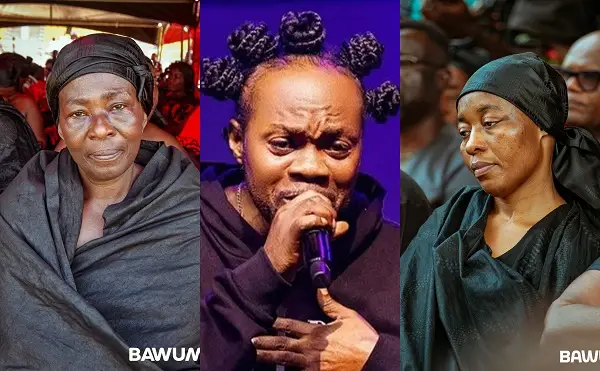
The High Court in Kumasi has done what many observers thought impossible: it has brought legal order to the sentimental chaos surrounding one of the Ghana’s most beloved musicians. In a sweeping 49-page judgment, the court ruled that Charles Kwadwo Fosuh (better known as Daddy Lumba) died not with one wife, nor with an ex-wife, but with two legally recognised surviving spouses.
For nearly three months the case transfixed the country. At issue was not a fortune or a will, but who had the right to call herself the late musician’s widow and perform the rites required under Ashanti custom. Lumba’s German-based partner, Akosua Serwaah Fosuh, insisted she was the only lawful spouse, citing a 2004 civil marriage in Germany. In Ghana, however, another woman, Priscilla Ofori (known popularly as “Odo Broni”) had lived with the musician for over a decade, borne him six children and, by all public appearances, was treated as his wife.
The judge cut through the emotion with calm precision. Her conclusion was blunt: both women are spouses, and the customary law of Ghana, not the disputed civil certificate from Germany, governs the question of widowhood.
The plaintiff’s case hinged on one thing: proving that the German civil marriage was valid and still subsisted at the time of Lumba’s death. This turned out to be the weakest link.
For a foreign marriage to be recognised in Ghana, a party must prove the foreign law as a matter of fact, usually through an expert witness. The plaintiff called none. Under Ghana’s Evidence Act, when foreign law is not proven, a court simply presumes it is the same as Ghanaian law.
That still left the marriage certificate, which, in theory, should have been the plaintiff’s strongest piece of evidence. Instead, it collapsed spectacularly.
The certificate tendered in court had multiple problems. It was not authenticated as required under Ghanaian evidence rules for foreign documents; it bore unexplained signatures and dates; and what was later presented as the “original” turned out, embarrassingly, to be just an extract from a private family book. Faced with contradictions and a lack of proper certification, the judge rejected the marriage documents entirely as lacking “probative value.”
Without a recognised civil marriage, Serwaah was left with only one legally solid claim: her customary marriage of 1991, which the court accepted without hesitation.
The judgment, though presented in careful legal language, offers a gentle warning to Ghanaians who imagine that foreign paperwork automatically trumps local custom. In Ghana, customary marriages exist alongside civil ones — and crucially, they are potentially polygamous. A man may marry more than one woman unless he has converted his marriage into a statutory monogamous ordinance marriage. Lumba never did.
So once the civil marriage failed for lack of proof, the case was governed by the rules of customary law. On this terrain, Odo Broni’s claim was formidable.
Her witness provided a coherent narrative: a customary marriage in 2010, witnessed by family elders; years of cohabitation; six children; and repeated public appearances in which Lumba introduced her as his wife. The court found this testimony credible and, importantly, unchallenged. Customary marriage, the judge noted, does not require elaborate paperwork; it can even be inferred from conduct. In effect, the court concluded that by 2010 Lumba had two wives, one earlier and one later.
Even if the plaintiff had been able to prove the German marriage, she faced another hurdle: her long physical separation from the musician. She had lived in Germany for nearly two decades while Lumba lived in Ghana with Odo Broni and their children. The judge acknowledged tensions in the relationship, but found no convincing proof that Serwaah ever completed a customary divorce.
A letter written by her lawyers in 2018 threatening divorce was, in the court’s view, evidence only of frustration, not actual dissolution. Under Ashanti custom, both families must meet, attempt reconciliation and formally return the marriage drinks for dissolution to occur. No such procedure was proven. “Intention to dissolve,” the judge wrote, “is not dissolution.”
Thus both customary marriages — the early one in 1991 and the later one in 2010 — stood intact when the musician died.
Much of the public debate surrounding the case focused on Lumba’s German citizenship. But citizenship was irrelevant. Under conflict-of-laws principles, the court looks to a person’s domicile — their true permanent home. Despite his years in Germany, Lumba had relocated to Ghana nearly two decades before his death, lived here continuously, and died here. His domicile of origin, the judge wrote, had revived. That meant Ghanaian customary law governed his personal status at death.
And under customary law, a man may have more than one wife unless expressly restricted by statute — which he was not.
The judgment does not glorify polygamy. It merely acknowledges a social reality and applies the law as written. More importantly, it delivers clarity in a deeply emotive case.
Both women are now recognised as legitimate widows. Both must be permitted to perform widowhood rites. And the family may proceed with burial arrangements without legal obstruction.
In an era when global mobility mixes legal systems, the ruling is a reminder that identity on paper — even a foreign marriage certificate — is not always the identity that matters in court. It also reaffirms the resilience of customary law in Ghana’s plural legal landscape.
In the end, the judge invoked scripture — “We can do nothing against the truth, but for the truth” — to close a case in which truth had been fiercely contested. The solution, as it turned out, was not to choose between the two women, but to recognise the lives each had shared with the man they both called husband.