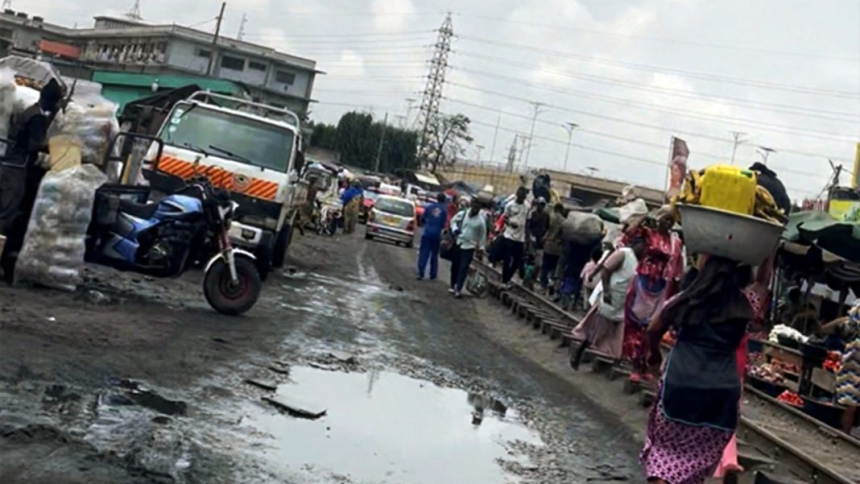
Every morning, long before the sun burns through Accra’s haze, Doris Tey opens her stall here among a street of traders. She sells plastic basins and buckets, stacking them high in neat, colourful towers that brighten the grey air around her.
By noon, the market is alive with the noise of hawkers, the heat of engines and the smoke that never seems to lift.
Doris ties a cloth over her nose, but it doesn’t help much. She points to the steady stream of trucks and taxis that never seems to thin. The dust they kick-up, mixed with fine soot from burning, coats everything.
“By the time I go home, my nose is black from the dust,” Doris says, speaking in the Twi language. “Sometimes we cough until our ribs hurt.”
Across Ghana’s crowded slums, the struggle to breathe is part of daily life. Waste burning, black soot from crowded traffic and smoke from dirty cooking stoves choke their lungs increasing their risk of serious diseases.
In wealthier parts of the city this is not happening. Waste is taken away for burning. People live at a distance from toxic traffic emissions and people cook with electricity and clean fuels.
But experts say Ghana’s growing air pollution crisis – sickening and killing a growing number of people every year – is a burden carried unevenly. It is mostly Ghana’s poor who suffer.
A 2023 study by the National Institute of Health found people living in low-income communities breathe far more polluted air than wealthier residents.
A major study by Researchers from the University of Ghana and Columbia University found that low-income communities in Accra recorded some of the highest pollution levels in the entire city because of their closeness to busy roads, markets and burning sites.
“The effect is more felt among the poor than the rich,” according to Dr Benson Owusu, a public health specialist and lecturer at the School of Nursing and Midwifery, Central University.
He says it is a matter of justice. While wealthy neighborhoods benefit from proper waste management, clean water systems and healthier environments, slum residents face constant exposure to smoke, dirty air and unsanitary conditions that lead to a greater incidence of illness.
Air pollution in Ghana’s informal settlements is “a silent public health crisis”, says Dr. Owusu. The toxic mix of e-waste smoke, vehicular fumes, open fires, overcrowding and poor sanitation has turned the air residents breathe into “a daily poison” putting people at greater risk of asthma, heart disease, stroke, cancer, eyesight loss and early death.
Women like Doris, he says, are particularly at risk because they spend long hours near cooking fires in small, poorly ventilated spaces. The illnesses they battle because of the toxic air trap people in a cycle of poverty.
A few meters away, in the Accra Central Market where Agbogbloshie’s dust and fumes drift, trader Esi Koomson, sells a colorful array of vegetables that she brings from Kasoa. Her business keeps her two children in school.
“As I speak, I have a cold. Yesterday I went to the hospital because I am really sick,” she says in Twi. “The doctors even warned me that if I am not careful, the smoke could affect my heart.”
The smoke from traffic around the market has bothered her since she began trading here three years ago. The dust that settles on her vegetables drives customers away.
“Most of the time the vegetables doesn’t look clean, so people don’t buy. We are making losses instead of profit.”
For many traders, there is no escape: they have the choice to move away and lose income, or stay and breathe the danger. Doris and Esi have watched neighbors develop chronic health problems. One has already battled breast cancer, an illness linked to air pollution.
Air pollution remains one of Ghana’s deadliest public health threats, claiming over 32,000 lives in 2023, according to the State of Global Air 2025 report.
In Accra alone, traffic accounts for roughly 39 percent of air pollution, while open waste burning often from dumpsites such as Agbogbloshie adds another 5 percent.
Studies show that Accra’s annual average concentration of fine particulate matter (PM₂.₅) hovers around 36 µg/m³, more than seven times the World Health Organisation’s safe limit of 5 µg/m³ (IQAir, 2025).
To confront Accra’s worsening air quality, the Accra Metropolitan Assembly (AMA) has launched a 2030 Air Quality Response Plan aiming to cut emissions by 40 percent. Cutting transport emissions – the largest source of air pollution – will be a central goal.
Nearly half of Accra’s residents walk to work or the market – many of them women traders from low-income areas – where they are heavily exposed to vehicle emissions.
“The irony is that those who contribute least to air pollution are the ones breathing the most fumes,” says Alex Johnson, Head of Transport Planning at AMA. He says that slum communities must be prioritised in transport and waste-management reforms in order to see an impact on overall health.
Waste management is also prioritised in the plan. Agbogbloshie’s e-waste burning exposes women and children to toxic chemicals daily, including heavy metals, and endocrine-disrupting compounds that contaminate both air and soil, with poor people at a greater risk.
Poor sanitation and air pollution are inseparable threats, “When sanitation fails, pollution takes over,” says Lily Ama Appiagyei, Vice Lead of Clean Air One Atmosphere.
“The burning of plastics and refuse releases fine particulate matter that damages lungs and disrupts hormones. Improving sanitation systems, enforcing bans on open-air burning, and promoting safer recycling methods would drastically reduce community exposure in slum communities like Agbogbloshie.”
Unhealthy environment in many low-income communities is worsening the city’s disease burden, according to experts.
“Poor sanitation and pollution go hand in hand. When refuse is not properly managed and people burn waste close to where they live and trade, they end up inhaling toxins that harm their lungs and weaken their immune systems,” says Dr Nana Ama Wadee, an Oncologist at Korle Bu Teaching Hospital.
She says public education is crucial. People can do a lot to protect themselves – starting with wearing nose masks – if they have the information.
“Awareness creation is always key. People must understand that cleaner surroundings are not a luxury they are essential for healthy living. Sometimes, it’s not that residents don’t care, but that they lack the resources or information to act differently,” Dr Wadee says.
For now, experts say, women like Doris, and for thousands of others living and working in Ghana’s crowded slums, the burden of dirty air remains a daily threat to their health and a burden government and wealthier Ghanaians must address as a matter of fairness.