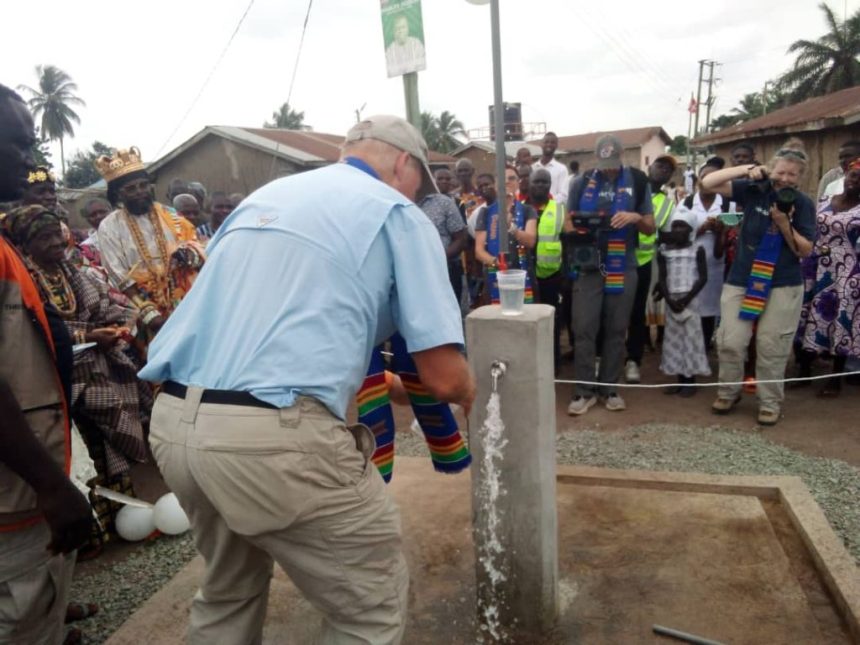
World Vision Ghana has inaugurated a solar-powered mechanized water system for residents of Jang in the Sawla-Tuna-Kalba District of the Savannah Region.
This is to enhance access to safe and reliable water and strengthen climate resilience.
The facility is expected to improve household water security, promote dry-season farming and livelihoods, reduce the burden on women and children, and contribute to improved health outcomes in the community.
It was funded by the European Union (EU) through the Deutsche Gesellschaft für Internationale Zusammenarbeit (GIZ), and implemented under the Water for Life Project and the GIZ-led Resilience Against Climate Change (REACH) Project.
Mr Rexford Bugre, Northern Operations Manager of World Vision Ghana, speaking during the inauguration of the facility in the community, said it symbolized hope, dignity and opportunity for Jang and surrounding communities.
He said climate change continued to threaten livelihoods in northern Ghana through erratic rainfall, prolonged dry spells and land degradation putting pressure on agriculture, food security and household incomes.
He said “In response to these challenges, World Vision Ghana, with generous funding from the EU through GIZ, designed the Water for Life Project to empower vulnerable households to adapt and thrive amid climate uncertainty.”
He explained that the project focused on sustainable water management, landscape restoration and climate-smart agriculture delivering 28 climate resilience interventions across 27 communities and benefiting more than 36,000 people including women and vulnerable households.
Mr Bugre said the Jang facility was one of seven such water systems under construction with three located in the Sawla-Tuna-Kalba District including Porkon, Jelinkon and Jang communities.
He underscored the need for community ownership and sustainability of the facility to ensure that its intended purpose was achieved.
He expressed appreciation to the EU, GIZ and the Ministry of Food and Agriculture for their support and said the project contributed to World Vision Ghana’s 2030 Universal Service Coverage agenda aimed at reaching vulnerable “last-mile” communities with safe water.
Mr Simon Kunyangna, Deputy Project Manager of the GIZ-REACH Project, said the mechanized borehole was a symbol of resilience, partnership and community-driven development.
He explained that REACH formed part of the Market-Oriented Value Chains for Jobs and Growth in the ECOWAS Region Programme under the European Union Ghana Agriculture Programme, jointly supported by the EU and the German Federal Ministry for Economic Cooperation and Development (BMZ).
Mr Kunyangna said REACH operated in climate-vulnerable areas of the Upper West, Savannah and North East Regions supporting communities and local governments to plan and adapt through participatory Community Action Planning.
He said “It was through this process that the people of Jang identified the need for this water facility. Today, we are witnessing the result of your own priorities, perseverance and partnership.”
Mr Saaka Sinkina, Sawla-Tuna-Kalba District Chief Executive commended World Vision Ghana and its partners for complementing government’s efforts to improve water access in rural communities.
He urged residents to protect the facility and charged particularly members of the Water Facility Management Committee in the community to discharge their duties effectively to ensure the longevity and proper maintenance of the system.
Choriwrai Essunga Dramani Kabasagya, Chief of Choru, who was represented at the ceremony, expressed gratitude to World Vision Ghana and its partners saying the facility would significantly reduce the hardships women and children faced in searching for water.
He said “This borehole will bring relief to families and free women and children from long hours of walking for water.”
Madam Bodua Tanee, a resident of Jang, also thanked World Vision Ghana, the EU and GIZ saying the community’s long struggle for water had come to an end.
She said the availability of water would improve the productivity of women as time previously spent searching for water could now be used for farming, trading and other income generating activities.