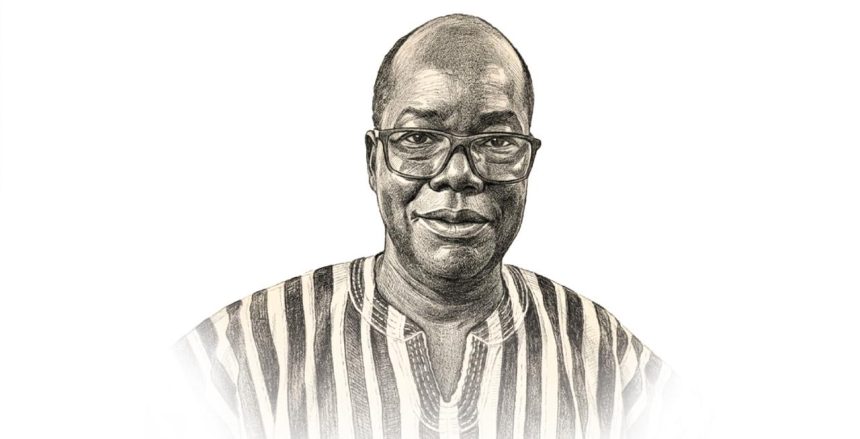
Professor Thomas Mba Akabzaa passed away on Thursday, 17 April 2025, at the University of Ghana Medical Centre. He was widely respected for a life defined by intellectual rigor, public service, and deep commitment to social justice.
Born in the Bongo District of the Upper East Region, Professor Akabzaa was the first of seven children of the late Akabzaa Akunyake of Dua and Madam Akurigo Ayeltige of Yorogo, near Bolgatanga. He grew up in a household shaped by discipline, hard work, and service. His mother was a trader who travelled across northern Ghana and into Burkina Faso to support the family, while his father, a former soldier who later became a community leader, instilled in him a strong belief in education as a path out of hardship.
Nothing in his early life suggested privilege. He worked on farms from a young age to supplement his parents’ income, an experience that left him with lifelong empathy for the poor and a firm conviction that place of birth should never determine destiny.
Professor Akabzaa began his schooling at Dua Local Authority Primary School in 1963, studying under trees with stones for seats and sand for writing. He completed primary school in 1969 and middle school at Bongo Middle School in 1973, before attending Bawku Secondary School from 1974 to 1978, where he served as Independence House Prefect.
He went on to the University of Ghana, Legon, graduating in 1990 with a Bachelor of Science degree in Geology with Physics. Drawn to the social and economic consequences of resource extraction, he pursued a Master of Engineering in Mineral Economics at McGill University in Canada, completing the programme in 1994. He later returned to Legon, earning a PhD in Geology in 2004.
His academic journey did not end there. Over the years, he obtained numerous postgraduate diplomas and executive certificates in public policy, public sector financial management, project management, monitoring and evaluation, mining project evaluation, environmental geochemistry, petroleum economics, and risk management. Colleagues often recalled his half-joking refrain to staff and students alike: “You don’t read,” a line that captured both his impatience with intellectual laziness and his deep belief in disciplined study.
In 1995, Professor Akabzaa joined the University of Ghana as a lecturer in the Department of Geology, later renamed the Department of Earth Science. He rose to Associate Professor and became a central figure on campus, known simply as “Prof. Akabzaa.”
From 2008 to 2010, he served as Head of Department, leading a major expansion of academic programmes. Under his leadership, new graduate degrees were introduced in Petroleum Geosciences, Water Resources, and Mineral Exploration, and the department was repositioned to better serve Ghana’s development needs.
His teaching and research focused on mining investment appraisal, mining and the environment, sustainable development, petroleum systems, extractive sector policy, and the political economy of natural resources. He paid particular attention to the lived experiences of communities affected by mining, often grounding theory in field realities.
Beyond the university, he was a leading researcher with Third World Network–Africa from 1996 to 2010. There, he became a prominent voice in debates on mining contracts, mineral rent distribution, and extractive sector governance in Africa. His work informed national and regional discussions around the Extractive Industries Transparency Initiative and resource justice.
He authored more than fifty publications, including two widely cited books, Boom and Dislocation: Environmental and Social Impacts of Mining in the Wassa West District of Ghana and The Glittering Façade: Environmental and Health Impacts of Mining in the Obuasi Area. These texts remain foundational for understanding the environmental and social costs of large-scale mining in Ghana.
Professor Akabzaa also trained parliamentarians in Ghana, Mali, and Sierra Leone, worked with the ECOWAS Mining Department, and served as a resource person and course convener for the Revenue Watch Summer School on Oil and Gas at GIMPA. Internationally, he collaborated with the Africa Mining Research Group at the University of Quebec in Montreal, contributing chapters to several influential edited volumes.
In January 2011, Professor Akabzaa was appointed Chief Director of the Ministry of Energy, a position he held until July 2017. His tenure coincided with a demanding period marked by rising oil production, power sector reforms, and intense public debate over tariffs and outages.
Within the ministry, he was known for intellectual rigor, ethical firmness, and meticulous attention to detail. He insisted that policy advice be thoroughly researched and clearly justified. His approach earned him recognition as the best-performing Chief Director in 2013 and 2014, and consistently high rankings in subsequent years.
He served on several ministerial advisory boards, chaired the West African Gas Pipeline Authority, and sat on multiple national and international boards linking Ghana’s energy policy to regional and global frameworks. Just weeks before his death, he was appointed Board Chairman of the Public Utilities Regulatory Commission.
Despite his national and international stature, Professor Akabzaa remained deeply rooted in family, faith, and community. He was married with children and mentored many young people who were not related to him by blood but whom he regarded as his own.
In his hometown of Dua, he was remembered not for his titles but for his generosity. He supported rural electrification, street lighting, and the establishment of an ICT centre at the local junior high school. Requests from home, he believed, were obligations, not inconveniences.
He was active in community and cultural organisations, including BONABOTO, where he served as National President from 2004 to 2006, promoting peace, mediating disputes, and strengthening unity through cultural exchange.
A committed Catholic, he was a member of the St. John of God Society at Amrahia. He lived his faith quietly, through discipline, generosity, and respect for others. Even in illness, he remained thoughtful and reassuring to those around him.
Professor Akabzaa’s life bridged worlds: academia and activism, policy and community, technical expertise and moral conviction. He leaves behind a legacy as a scholar who reshaped debates on extractive governance, a public servant who demonstrated integrity in office, a mentor who invested deeply in people, and a community leader who never forgot his roots.
He will be remembered not only for what he achieved, but for who he was: principled, humble, intellectually demanding, and profoundly humane.