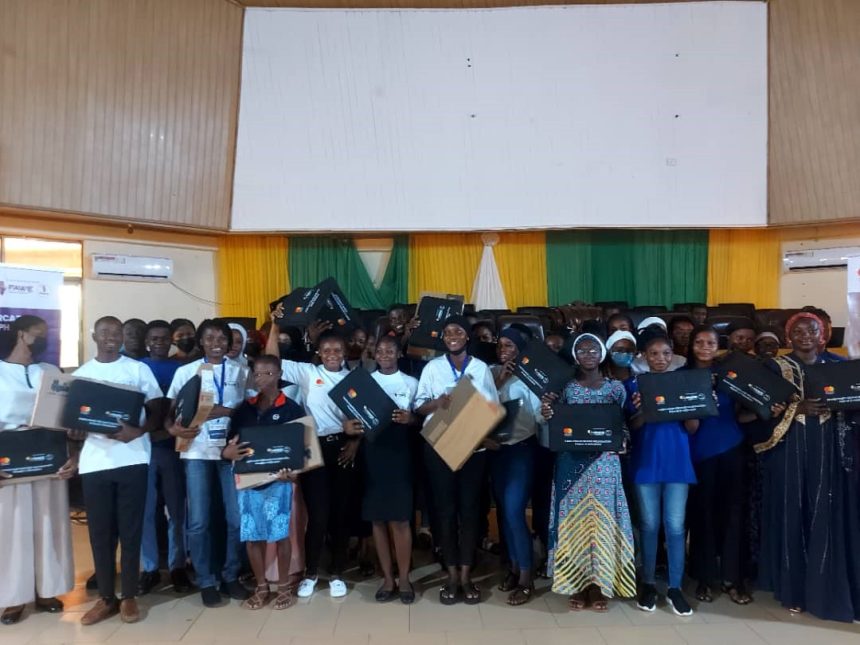
A total of two hundred students from six technical universities across the country have received laptop computers under the Forum for Africa Women Educationalists (FAWE) Ghana–Mastercard Foundation Phase II Project.
The initiative was intended to support their academic work and improve access to tertiary education for marginalized and needy students.
The laptops were presented to the first cohort of beneficiaries of the Technical and Vocational Education and Training (TVET) Programme, aimed at enabling students to actively participate in digital learning, research and skills development throughout their academic journey.
The intervention forms part of FAWE Ghana’s efforts to bridge the financial and technological gap that often prevents students from disadvantaged backgrounds from succeeding in tertiary education.
The beneficiary institutions were Bolgatanga Technical University, Dr Hilla Limann Technical University, Ho Technical University, Apaminka University of Skills and Development, Cape Coast Technical University, and Takoradi Technical University.
Speaking at the closing ceremony of a convening workshop held in Tamale, the Executive Director of FAWE Ghana, Mr Richard Amoani, said the laptop distribution was part of a broader support package designed to ensure students remained in school and successfully transitioned into the world of work.
He indicated that the convening marked the completion of one academic year for the first cohort of the TVET programme and provided an opportunity to assess progress, gather feedback, and introduce elements of FAWE’s extended orientation model.
“The aim is to ensure that as we move forward with implementation, students enjoy staying in school, complete successfully, and transition into their chosen fields of work,” he said.
Mr Amoani noted that the project was being implemented in 10 African countries, targeting 10,550 participants, with 1,100 students expected to benefit in Ghana.
He explained that 600 students would be enrolled under the TVET model in three cohorts of 200 each, with 80 per cent female participation, 20 per cent male, and between five and 15 per cent reserved for persons with disabilities, refugees and displaced persons.
He added that the remaining 500 beneficiaries would be supported under a bridging programme for Science, Technology, Engineering and Mathematics (STEM) students who did not meet the required grades for direct university admission.
“The bridging programme will provide up to one year of academic reinforcement before students transition into full degree programmes,” he said.
Mr Amoani encouraged the beneficiaries to make effective use of the laptops and take full advantage of the opportunity, noting that the support was meant to enhance learning, research, and overall academic performance.
“I want you to remain focused and committed so that the investment made in you will yield positive results for your communities and the country at large,” he said.
The project, funded by the Mastercard Foundation, is expected to expand in subsequent cohorts to include Sunyani Technical University, Kumasi Technical University, and Tamale Technical University.
Miss Abdulia Hikmat, a student of Dr Hilla Limann Technical University, expressed gratitude to FAWE Ghana and the Mastercard Foundation for the support.
She described the laptop as a vital tool that would significantly enhance her academic work and motivate students from disadvantaged backgrounds to strive for excellence.
She pledged to make good use of the device and encouraged her colleagues to do the same.