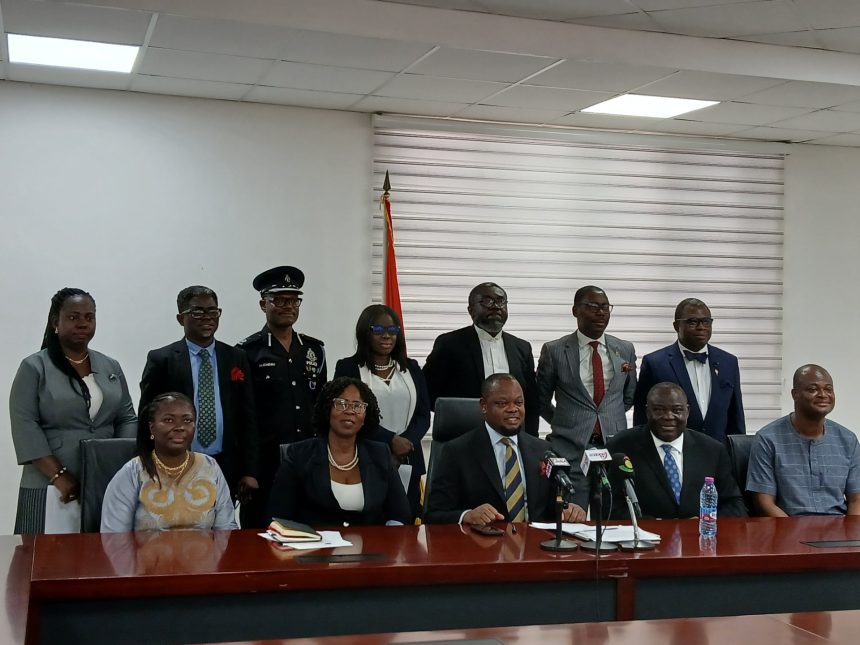
A nine-member Ministerial Advisory Board of the Ministry of Justice has been sworn into office and tasked to apply its expertise to support the Ministry’s mandate.
The Board is chaired by Mr Dominic Akuritinga Ayine, Minister of Justice and Attorney-General, with Justice Srem-Sai, Deputy Minister of Justice and Deputy Attorney-General, as a member.
The other members are Mrs Fati Bodua Seidu, Ms Alic Priscilla Chnayireh, Dr Martin Yamborigya, Mr Ahmed Musah, Ms Rosemary B. Sahnoon, Dr Kweku Ainuson and Mr Obed Hoyay.
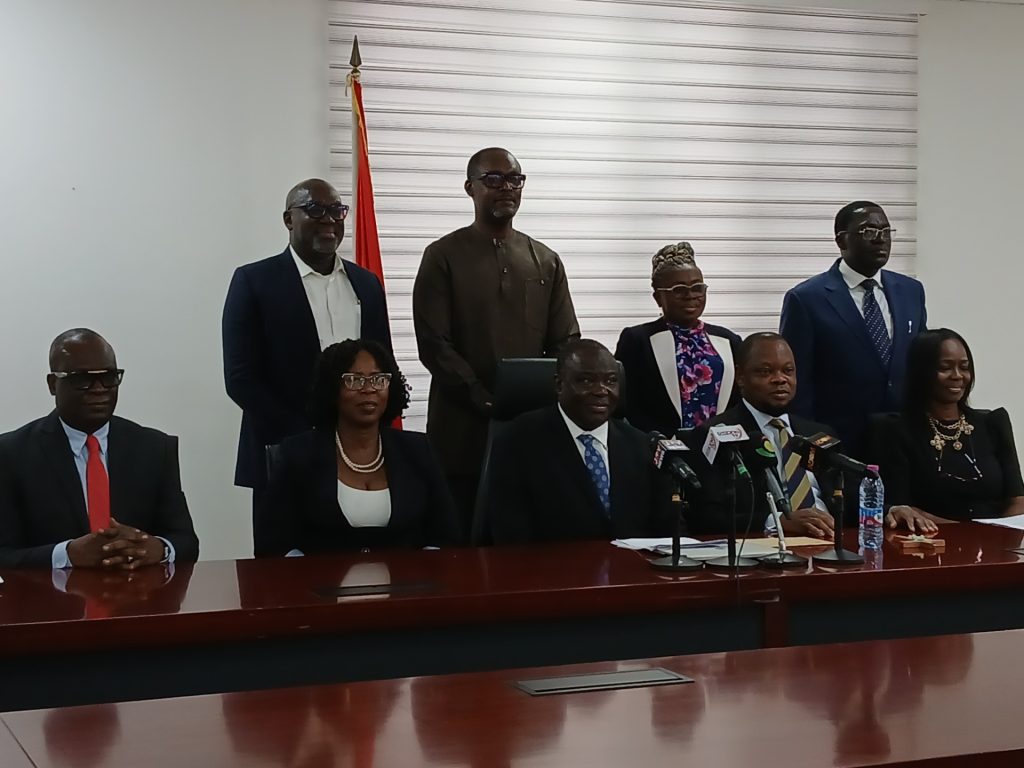
Administering the oath of office and oath of secrecy, Justice Gabriel Scott Pwamang, a Justice of the Supreme Court, said the Ministry of Justice had a broad responsibility to ensure justice for all citizens, regardless of status.
Justice Pwamang noted that the governing board played a critical role in the Ministry’s operations and urged members to deploy their competence and expertise to help achieve its mandate.
Justice Srem-Sai later swore in the governing boards of the Council for Law Reporting and the Legal Aid Commission.
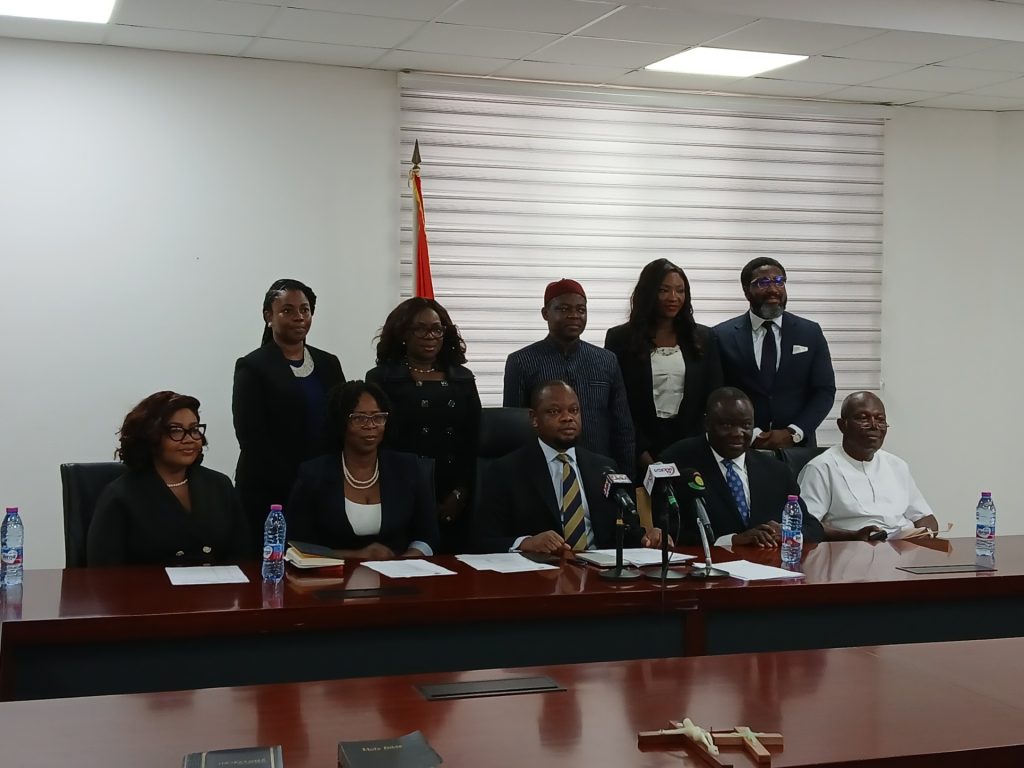
Addressing the eight-member Council for Law Reporting, Justice Srem-Sai charged the board to ensure that law reports were up to date and accessible online, noting that hard copies were no longer the most efficient means of accessing knowledge.
“We should be able to bring the work we have done, which is the law reports are up to date and are online and also there are other ways of accessing them. Not just for persons without disability but those with disability, so that we can bring ourselves to the same level as our counterparts in another jurisdiction,” he said
Turning to the Legal Aid Commission Governing Board, Justice Srem-Sai said the Commission’s core mandate was to enhance access to justice and ensure equality before the law.
He outlined four key challenges for the board’s attention, including funding constraints and the misconception that the Commission handled only criminal cases.
Justice Srem-Sai said the Commission must also support civil matters such as divorce and constitutional enforcement.
“Your charge is to move beyond paying attention to only criminal matters, include civil matters in your work.”
Justice Srem-Sai urged the board to be proactive in identifying communities and individuals in need of legal assistance.
“It is not everybody who knows that his or her solutions to their problem could be found at the law courts.”
He observed that about 95 per cent of Legal Aid lawyers were based in Accra and Kumasi, leaving other regions underserved, and called for a more equitable distribution across all 16 regions.
Professor Raymond Atuguba, Director of the Ghana School of Law and a member of the Legal Aid Commission Governing Board, thanked the appointing authority on behalf of the Board.
He said members would apply their “physical, mental, spiritual” capacities to ensure quality legal services for all.
Speaking on behalf of the Council for Law Reporting, Justice Pwamang said the confidence reposed in the board would not be abused.
“We promise ourselves to work diligently and lift the Council for Law Reporting from where it is to a higher level,” he said.
Other members of the Council for Law Reporting are Justice Victor Jones Dotse, Nuhela Seidu, Enam Korkor Antonio, Margaret Awuku-Gyekye, Professor Peter Atudiwe, Justice Sedinam Awo Kwadam and Lorn Nuku Ahlijah.
The Legal Aid Commission Governing Board is chaired by Justice Samuel Kwame Adibu Asiedu, a Justice of the Supreme Court.
Its other members are Mr Edmund Amarkwei Foley, Executive Director of the Legal Aid Commission, Ms Stella Ohene Appiah, Ms Florence Ayisi Quartey, Mr Prince Boamah Abrah, Ms Frieda Aniwaah Boateng, Mr Frederick Gurah Sampson, Chief Superintendent Abdulai Amadu Alichewu and Mr Oliver Barker-Vormawor.