For more than four decades, Mr Silivi Francis Etsey, affectionately called Efo Tsey, has lived with a disability that has shaped and tested every aspect of his life.
Through hardship, isolation, and profound personal loss, the 50-year-old shoemaker from Ave-Havi in the Akatsi North District continues to persevere with remarkable resilience.
Since 1995, Efo Tsey has been crafting and repairing footwear — a skill that remains his sole source of livelihood. But for a man living with disability and limited family support, the work is far from easy.
His life changed dramatically in 1983 when, as a Primary One pupil at Ave-Dzadzepe, a mild illness developed into measles. Although he was rushed to the hospital on time, complications left him paralysed.
A year later, his father passed away, leaving his mother, Madam Sonyamede Nyake, to shoulder the burden of raising him alone. She encouraged him to stay in school even when he nearly gave up.
“My mother pushed me to continue my education. She provided everything I needed, even when it was difficult,” he recalled.
But tragedy struck again when his mother died, shattering his hopes of completing school. By 1995, with no financial or emotional support, he dropped out entirely. His elder sister became his only caregiver, and shoemaking became his lifeline.
Today, Efo Tsey earns between GH¢20 and GH¢30 daily, money that barely covers his personal needs. His sister provides food, while he supplements his income by sewing car seats and bags.
“There were five of us, but everyone is gone now, including our parents. It’s only me and my sister,” he said quietly.
“When I get work, maybe I make GH¢20. Some people don’t pay when I repair their shoes. Instead, they insult me.”
For years, he worked under the shade of a large tree beside the Ave-Havi Basic School, along the busy Ho–Aflao Highway. The tree shielded him from the scorching sun and heavy rains. But recent road construction led to its removal, leaving him exposed to the elements.
Local residents have expressed concern. Madam Comfort Vifa, a shop owner opposite his workstation, said: “He has been working here for a long time, but now he has no shade. I was even talking to his sister that they should get him an umbrella because the sun is too much.”
His friend, Mr Moses Ahiave, explained how Efo Tsey has had to relocate several times due to community activities.
“He started at another place but was asked to move because of a funeral. Later, the headteacher of the Havi Basic School gave him permission to sit by the roadside,” he said.
Although the Akatsi North District Assembly has provided roofing sheets, no structure exists to mount them.
“He drags his chair in and out by himself. He has no children to help him,” Mr Ahiave added.
Despite these challenges, Efo Tsey remains determined. He appeals for minimal support — an umbrella, a small kiosk, a chair, or basic tools — to improve his safety and dignity.
His story reflects the silent struggles of many persons with disabilities across Ghana, who, despite daunting circumstances, continue to fight for survival, dignity, and a place in society.
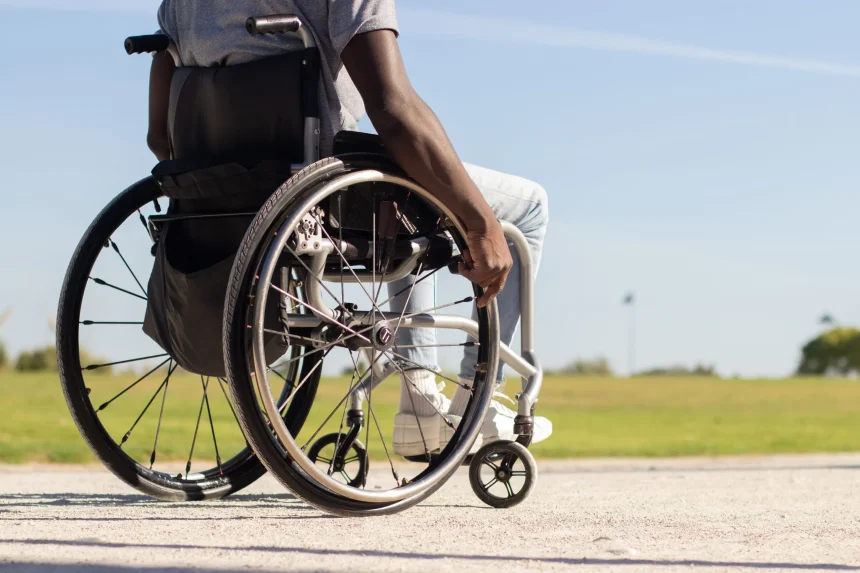
In Efo Tsey’s case, the District Assembly has previously supported him with a wheelchair and roofing sheets.
Mr Abanga Anda, Director of Social Welfare at the Assembly, explained that assistance for persons with disabilities is guided by the national Disability Common Fund, noting that while resources are limited, the Assembly is considering constructing a small permanent shed for Efo Tsey, similar to a passenger waiting shed, to provide shade and protection.
“We were initially planning to support him with a small container, but given his condition, it may not be suitable for him to climb in and out. Now that the tree has been cut, we need to find a better option,” Mr Anda said.
He added that while shoe-grinding machines may pose safety risks for Efo Tsey, the Assembly is exploring other ways to support him and his sister.
For Efo Tsey, however, shoemaking remains more than just a livelihood — it is a testament to his determination to live with dignity, despite the odds stacked against him.