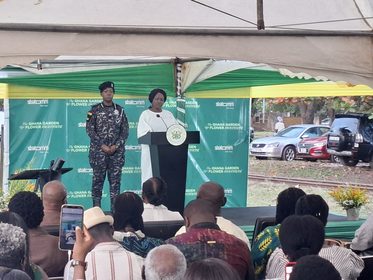

The National Peace Council (NPC) has launched the Development and Resilience Index against Violent Extremism (DRIVE) to strengthen Ghana’s prevention of violent extremist influences.
The evidence-based tool will be piloted in Ghana until June 2026, with initial focus on the northern border areas, particularly the northern regions.
Most Reverend Emmanuel Kofi Fianu, Chairman of the National Peace Council, said the initiative reflected Ghana’s enduring commitment to peace, stability and democratic resilience.

He said Ghana remained a beacon of peace in a region facing complex and evolving security challenges, noting that pressures along the northern borders and underlying social stressors showed that peace could not be taken for granted.
“While we have so far prevented large-scale violent extremist attacks, the pressures along our northern borders and the underlying social stressors within our communities remind us of the undeniable fact that peace cannot be taken for granted.
“This is why the Government and the NPC are committed to efforts to deepen understanding, measuring the risk, strengthening and sustaining efforts to promote peace at all levels,” he said.
Most Rev. Fianu explained that DRIVE was not merely a research exercise but a cutting-edge, evidence-based decision-making tool to help the State and its partners understand community resilience and vulnerability to violent extremist influence.
“By combining community perceptions, psychosocial factors, governance indicators, and development realities, DRIVE gives us a clear, localised, and actionable data to guide prevention efforts,” he said.
Most Rev. Fianu said lessons from Côte d’Ivoire, where DRIVE had been successfully piloted in border regions at risk of extremist infiltration, demonstrated the effectiveness of the approach.

He said the findings showed that resilience varied across communities, influenced by factors such as trust in institutions, the inclusion of youth and women, the quality of public services, freedom of worship, and the relations between civilians and security forces.
“These insights allowed national authorities and partners to target interventions more precisely and more effectively.
“For Ghana, this presents a timely opportunity. While northern Ghana faces direct cross-border risks, challenges such as intergroup tensions, institutional mistrust, and uneven service delivery affect the nation as a whole,” he emphasised.
Most Rev. Fianu noted that the DRIVE Index offered dual benefits by enabling targeted prevention in at-risk areas while serving as a national tool for monitoring social cohesion, democratic confidence, and early warning signs of instability.
“DRIVE aligns seamlessly with Ghana’s existing frameworks, including the National Framework for Preventing and Countering Violent Extremism and Terrorism.
“By embedding its indicators into national and local planning processes, we can strengthen coordination among institutions, optimise resource allocation, and ensure that evidence rather than assumptions guide policies,” he said.
Most Rev. Fianu said the pilot phase emphasised co-creation, national ownership and institutional participation, with government institutions, security agencies, civil society and community actors involved throughout the process.
“From survey design to data interpretation, government institutions, security agencies, civil society, and community actors will be actively involved. This ensures that the outcomes are not only credible but usable.
“Peace is strongest when it is proactive, inclusive, and informed by evidence. The DRIVE Index offers Ghana a chance to consolidate its strengths, address its vulnerabilities, and lead by example in data-driven peacebuilding in West Africa,” he stated.
Mr Mirko Hoff, Programmes Coordinator for Resilience for Peace, Côte d’Ivoire, said Ghanaian state institutions and civil society organisations were making significant efforts in the north to build resilience to violent extremism.
He said the DRIVE Index complemented existing initiatives by measuring social dynamics that either pushed individuals and communities towards violent extremism or enabled them to resist it and cooperate with the State.
Mr Hoff said the data collected would enable Ghanaian actors to design more effective interventions by identifying specific stressors, vulnerabilities, resilience capacities and groups most at risk or most resilient.
He noted that Ghana had adopted a whole-of-society approach in the north, with DRIVE adding value by providing robust statistical evidence to better identify priority areas and target groups.
Mr Hoff said the launch marked the start of data collection to determine districts most vulnerable to extremist influence and those most resilient, with resilient communities serving as models for others.
He said that although the pilot would focus on the northern border areas, particularly the northern regions, the tool could be adapted in future should analysis show that extremist threats were moving further into the country.