Ghanaians across the country have turned out en masse to wear the country’s colourful traditional outfit, the fugu, after the government designated Wednesdays “Fugu Day”.
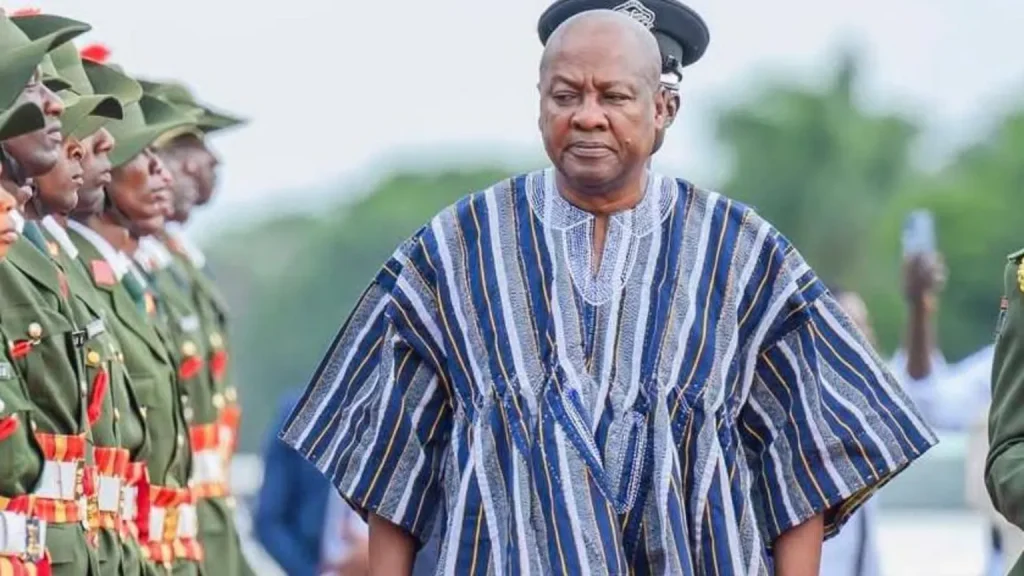
The move comes after President John Dramani Mahama’s state visit to Zambia last week when he wore the garment. Some mockingly called it a “blouse”, prompting a fierce response from Ghanaians online.
Ghana’s Tourism Minister Abla Dzifa Gomashie said on Tuesday that wearing the outfit every week would help project the country’s identity “with pride on the global stage”.
She encouraged wearing the outfit “in all its diverse forms, designs, and expressions, complemented by its distinctive and beautiful accessories”.
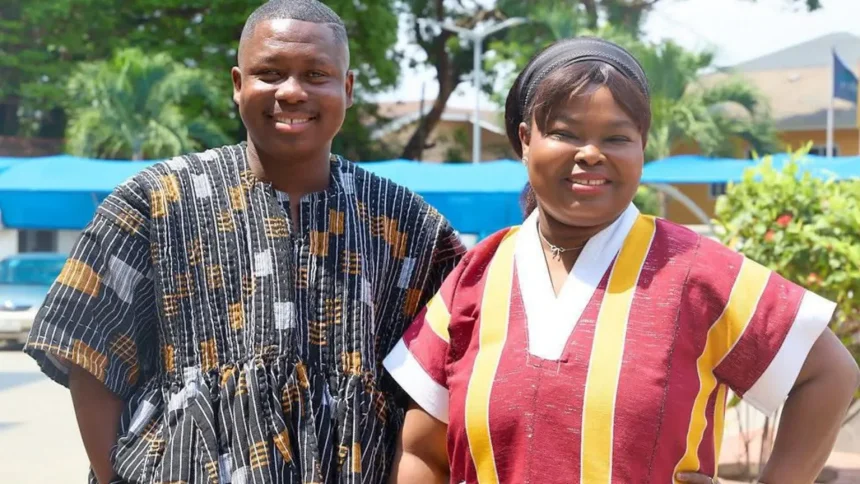
The fugu, also known as batakari, is a traditional northern Ghanaian top made from hand‑woven, narrow strips of thick cotton fabric stitched together to form a structured, poncho‑style garment.
It is worn by traditional leaders in northern Ghana, as well as ordinary citizens, and is a symbol of royalty and authority.
The traditional fugu top is more often associated with men, who sometimes wear trousers and a hat in matching material, but women also wear a version of it, which can be styled longer or as a dress.
When Ghana became the first sub-Saharan nation to break free from colonial rule in 1957, its founding father – the pan-Africanist Kwame Nkrumah – and five others wore fugus at the celebrations that marked the country’s independence from the UK.
Beyond its cultural importance, Gomashie said the outfit’s weekly display would “generate far-reaching social and economic benefits” especially for local weavers, designers, artisans and traders.
“The government hopes that this collective embrace of fugu will strengthen national unity, stimulate the creative economy, and serve as a powerful symbol of Ghana’s cultural confidence and self-expression,” the minister added.
Following the announcement, many Ghanaians on Wednesday heeded the minister’s call, wearing the outfit in a variety of colours across the country.
Bismark Owusu Sarpong told the BBC in the capital, Accra, that he was proud to wear his blue, white and black striped fugu, which he had received as a gift, to put “Ghana on the map” – plus he said the outfit came with the added bonus of being comfortable.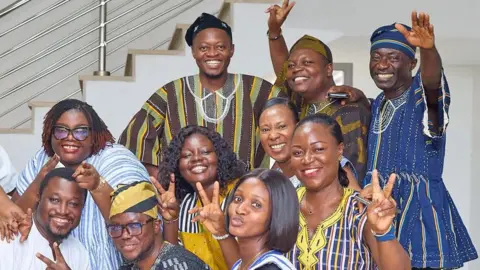
Workers at Ghana’s National Health Insurance Scheme (NHIS) all made an effort to turn up in fugusAndrews Tetteh Zutah owns more than seven fugus – and says it his favourite style
Raymond Avenor, also in Accra, agreed wholeheartedly with this: ”Fugu is an easy wear.
“You pick it and off you go. You don’t have to iron it, we don’t wash it often as it should be,” the civil servant told the BBC, sporting a blue fugu with white stitching.
“Significantly it’s the northern people of Ghana that use this and it depicts, according to my understanding, royalty. I feel good when I wear it.”
For Andrews Tetteh Zutah, who owns more than seven of the tops, “Fugu Day” should not only be restricted to Wednesdays.
“I wish to have more,” said the Accra office worker in his stripped red, khaki and black fugu.
“I wish I will be allowed to wear it anytime to the office but because of office constraints I’m unable to wear it every day. Personally, it’s one of the outfits I love most.”
The attention has been great for fugu makers and sellers too.
Elijah Sulemana Musah, owner of a fugu factory, says business is booming – adding that he has received lots of orders from Ghanaian celebrities such as popular musicians Okyeame Kwame and Kwabena Kwabena.
”I’ve had calls coming in from several places both within and outside Ghana. I just met someone who said Zambians have called her and they are interested in the fugu and so she would wants me to supply to her,” he told the BBC.
The iconic outfit has been trending on social media for days following the banter between Ghanaians and Zambians.
This revived a cultural movement on social media, with Ghanaians informally declaring “Fugu Friday” to showcase the outfits. Fridays had been designated by the previous government as a day where people were encouraged to wear traditional clothes.
The debate prompted Ghanaians, including MPs, to flood social media proudly showcasing their fugus, while Zambians featured wearing their traditional outfits known as siziba.
The online exchange attracted the attention of Zambian President Hakainde Hichilema, who announced that his country would order fugus from Ghana.
President Mahama also suggested exporting the smock in bulk to Zambia.
While emphasising the fugu’s cultural and political significance, Mahama gave a nod to Nkrumah and how he had worn it in 1957 and said that he himself had recently worn it proudly to the UN.
Other presidents, including Nana Akufo-Addo, John Kufuor and Jerry John Rawlings, have also embraced and publicly promoted the outfit.