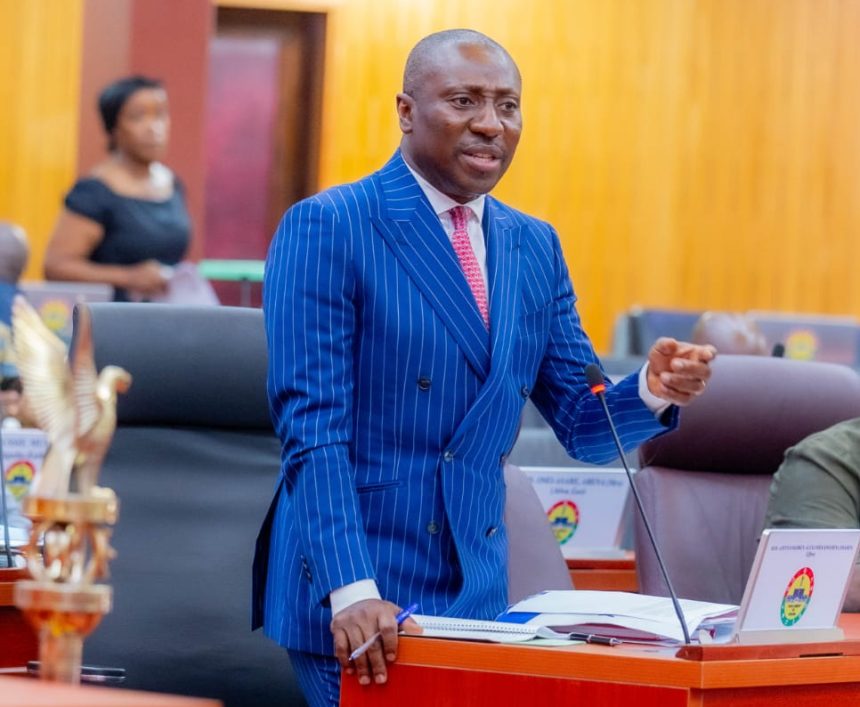
Minority Leader, Mr Alexander Kwamena Afenyo-Markin, has criticised the government’s decision to reduce the cocoa producer price from GH¢3,625 to GH¢2,587 per bag, describing it as “illegal” and an attempt to “shortchange” Ghanaian cocoa farmers.
Making a statement on the Floor of Parliament on Tuesday, Mr Afenyo-Markin argued that the GH¢3,625 producer price was a minimum guaranteed price legally established for the entire 2025/2026 crop season.
He said the downward review breached contractual obligations and would further disadvantage farmers who had already suffered delayed payments.
“Mr Speaker, the producer price of GH¢3,625 is a minimum guaranteed price and legally destined to run the full course of the 2025/2026 crop season,” he said.
“The government cannot vary the minimum guaranteed price to the disadvantage of cocoa farmers or any of the parties with a share in the achieved FOB price.”
The Effutu MP, therefore, called for the immediate restoration of the GH¢3,625 price and compensation for farmers for losses incurred.
Responding to the claims, Majority Leader Mr Mahama Ayariga dismissed assertions of illegality, describing them as unfounded and misleading.
He explained that reviewing the producer price, whether upward or downward, did not constitute a breach of law or industry practice.
“Mr Speaker, there is no illegality in reviewing the price downwards, just as there is no illegality when the price is reviewed upwards. To suggest that the review itself is illegal has no basis in law or in established practice,” he stated.
Mr Ayariga, the MP for Bawku Central, also rejected claims that forward sales arrangements prevented the government from paying farmers after price adjustments.
He clarified that forward sales typically cover up to 70 per cent of annual cocoa output, leaving a significant proportion unsold in advance.
“Mr Speaker, a significant portion of cocoa is sold forward every year, but it is never the entire output. So the claim that farmers could not be paid because cocoa had already been sold forward is simply inaccurate,” he added.
Contributing to the discussion, Dr Godfred Seidu Jasaw, MP for Wa East, raised concerns over COCOBOD’s finances.
He noted that after 32 years of relying on syndicated loans, the Board’s default in the 2023–2024 season eroded investor confidence, making it difficult to raise funds.
He said the government’s reforms, including the introduction of domestic cocoa bonds, were aimed at building a more sustainable financing model and reducing reliance on external capital.
Dr Jasaw, who chairs the Committee on Food, Agriculture and Cocoa Affairs, added that efforts were underway to convert GH¢5.8 billion in legacy debt to help restore COCOBOD’s balance sheet.
He further disclosed that most of the country’s cocoa production had already been sold, with 530,000 tonnes purchased, leaving about 70,000 tonnes available.
The government recently reduced the farm‑gate price of cocoa from GH¢3,625 to GH¢2,587 per bag as part of reforms within the cocoa sector.