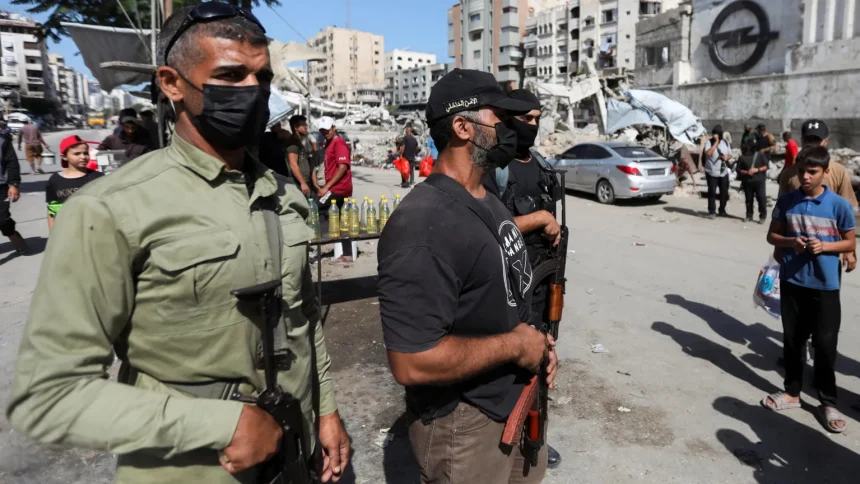
When a US-imposed ceasefire halted the Gaza War last October, Hamas’s war for survival against Israel switched into a battle for control at home.
The war had left the group’s disciplined military units shattered into guerrilla forces, and most of its leaders killed; Gaza’s buildings and infrastructure were largely destroyed, its population displaced, and its economic life in ruins. More than 72,000 Gazans were killed by Israeli attacks during the conflict, the Hamas-run health ministry says.
Four months on, Gazans say Hamas is again extending its control over security, tax revenue, and government services, raising questions about its long-term strategy, and whether it is prepared to give up its weapons and authority, as now required under the second stage of Donald Trump’s peace plan.
“Hamas regained control of more than 90% of the areas where it is present,” said Mohammed Diab, an activist in Gaza.
“Its police and security agencies have returned, and are now present in the streets, controlling crime and pursuing those it labels as collaborators and people with opinions. Citizens must go to the Hamas authorities for identity cards or health procedures, and it is also reasserting control over the judiciary and courts.”
At markets across Gaza, stallholders describe regular police patrols – and a renewed iron grip on official fees and taxes.
“The markets are quiet, but the municipality keeps pursuing us for rent,” one stallholder said. All those we spoke to there about Hamas control in Gaza asked that we hide their identity.
“Every single day they come to us aggressively, with the same demands and the same determination, saying if we don’t pay they’ll throw us and our goods into the street. They’re asking for 700 shekels ($225; £167) – none of us can afford that.”
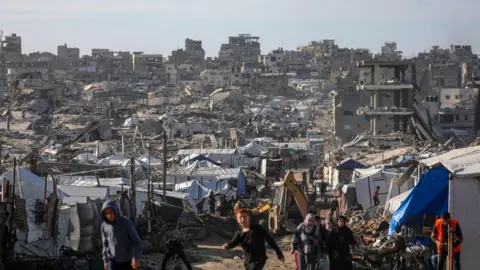
The stallholder, who spoke to our colleague in Gaza City, said he and his family of 12 had been displaced from Shujaiya to the east of the city, where he used to run a shop. Shujaiya today is a flat wasteland of rubble.
“Every day, the municipality comes,” said another man selling cigarettes nearby. “Let them count the stock and the sales, cigarette by cigarette, and tell me: should I pay them, or feed my children?”
Since the ceasefire, food and some other basic goods are flowing into Gaza more freely. The few key traders with a licence to bring them in from Israel say Hamas have reimposed strict control over taxing the imports.
One trader, who agreed to share details anonymously, told us force was used against those who refused to pay.
“The taxes imposed by Hamas depend on the type and quantity of goods, but prices start at 20,000 shekels and above,” he said. “If a trader refuses to pay, force is used and in some cases he is kidnapped or threatened. No one can avoid paying taxes on goods.”
He told us that traders used a code-word for Hamas when discussing tax payments, so that Israel wouldn’t learn that money was being siphoned off to the group.
“Hamas now has a database of all the traders who import goods into the Gaza Strip,” said the activist Mohammed Diab. “The trader pays in cash, not through bank transfers, so that the flow of funds cannot be traced. It is gradually restoring the system that was in place in the past, but away from the spotlight so it can’t be monitored.”
A Hamas spokesman, Hazem Qassem, said the Gaza Strip was in a state of emergency and that “exceptional measures” were required.
“Some traders maintain links with the [Israeli] occupation and attempt to generate excessive profits, so administrative bodies sometimes need to act firmly with traders who refuse to cooperate or meet required obligations,” he said. “This is purely a governmental matter and has no relation to Hamas.”
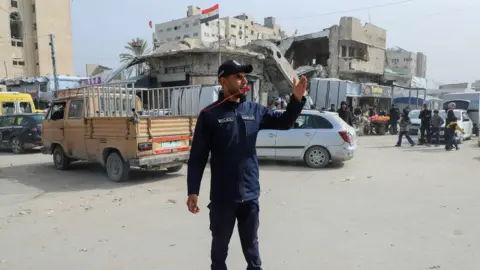
Gaza’s government has been run by Hamas since 2007. Money is crucial to the group’s grip on power: to pay salaries – and, the Israeli army alleges, for its ultimate goal of rebuilding its war machine.
“Hamas looks at the ceasefire as a time to regroup, to fight against us,” said Lt Col Nadav Shoshani, spokesman for the Israel Defence Forces (IDF). “This is why it’s crucial to see them disarmed because they’ve made it clear that if they have weapons, they will use them sometime in the future.”
The Israeli army says there are daily attacks against its forces by Hamas. Four Israeli soldiers have been killed since the ceasefire began.
Hamas, in turn, points to repeated Israeli attacks, which Gaza’s Health Ministry says have killed 603 Palestinians.
The IDF recently released grainy footage of several figures running through Gaza’s debris, who it identified as “armed terrorists” approaching troops in the area of Gaza temporarily controlled by Israel under Trump’s peace plan.
Asked whether two years of intense military conflict had failed to achieve the destruction of Hamas’s military capabilities – a key Israeli war goal – Lt Col Shoshani said the group had been heavily diminished, but was now trying to rebuild.
“This war is not done until Hamas is disarmed,” he said. “There is an agreement now in place [and] we expect that to happen. If not, there are a lot of tools on the table to make sure that does happen.”
Trump’s new Board of Peace, comprising the heads of state from many countries with a stake in Gaza’s future, will hold its first meeting in Washington on Thursday.
The next stage of Trump’s plan for Gaza – including its reconstruction – hinges on Hamas disarmament, but negotiators are still inching through the detail of what the handover of weapons would mean in practice – who would Hamas hand weapons over to, which weapons would they hand over, and how would that be verified.
“I believe we are capable of addressing the issue of weapons in a way that removes the Occupation’s pretext to renew the war and is also compatible with President Trump’s plan,” Hamas spokesman Hazem Qassem told the BBC.
But Hamas, ideologically committed to fighting Israel, has a deeply-rooted and well-armed membership across the Gaza Strip. Verifying its full disarmament will be difficult, and some in the group have reportedly demanded they be allowed to keep personal weapons to defend themselves against enemies at home.
When the fighting with Israel stopped in October, Hamas immediately turned its guns on rival clans who had begun to take advantage of the chaos to extend their power in Gaza City, Rafah and elsewhere.
Footage of the crackdown, including summary executions of blindfolded rivals in the streets, was released to the public.
Israel’s leaders have rejected the idea of Hamas keeping personal arms, and have applied pressure on the group to disarm by threatening a return to war.
In the meantime, an International Stabilisation Force to take over security in Gaza remains in limbo, and the new Palestinian technocratic council meant to take over the running of Gaza’s civilian affairs is waiting in Egypt.
Earlier this month Hamas said it was ready to “transfer authority and governance in all fields” to the new technocratic council.
But the Gaza activist, Mohammed Diab, said there were few signs that Hamas was preparing to hand over power.
“On the contrary,” he said, “we heard last week that Hamas carried out large-scale appointments to vacant positions in the government sector, and announced them on social media and official platforms.”
Hazem Qassem denied any new government recruitment, saying that any appointments would have been technical, low-level positions that did not interfere with the handover of power.
Critics have questioned whether they are an attempt to retain influence inside any future Gaza administration.
The recent transfer of medical cases out of Gaza through the newly-reopened Rafah Crossing also signalled the intention of Hamas to remain in control, despite the new process being designed without the group’s involvement.
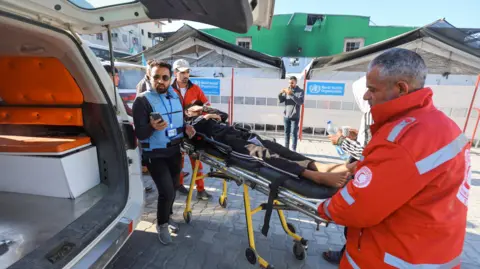
One of those present at an evacuation point run by international aid organisations near Nasser Hospital reported that Hamas ministry officials had shown up on the second day of evacuations to help supervise.
This is now the make-or-break moment for Trump’s plan, which has so far kept on track by relentlessly pushing forward, past hiccups and delays.
Despite repeated threats of a return to renewed fighting if Hamas does not fully disarm, some in Israel believe the most effective pressure on Hamas leadership might actually come from moving forward with the plan without them.
Ground has already been cleared in Israeli-held areas around Rafah, ahead of a reported US plan to build new housing facilities for some 200,000 Gazans, with the promise of food, water and medical support to tempt people across the yellow line from Hamas-controlled areas.
Crossing into the large swathe of Israeli-held territory around Gaza’s perimeter is seen by many in Gaza as siding with the enemy, and very few have so far made the journey.
But Gaza’s population is a key source of Hamas’s revenue and control. After two years fighting Israel for control of the land, the battle for Gaza’s people might just be starting.