The White House has warned Iran would be “very wise” to make a deal with the US, amid reports that President Donald Trump is weighing fresh military action against the Islamic Republic.
Press secretary Karoline Leavitt told a news briefing that Trump was still hoping for a diplomatic resolution over Tehran’s nuclear programme.
Her comments come as the US moves a second battleship into the region, and a day after progress was reported at US-Iran talks in Switzerland.
US media reported on Wednesday that Trump had discussed attack options with advisers, and that a US strike could take place as early as Saturday. Last summer the US military launched strikes on three Iranian nuclear facilities.
Trump had not yet made a final decision about whether to attack and ongoing conversations were described as fluid, sources have told the BBC’s US partner CBS News.
Leavitt told reporters on Wednesday there were “many reasons and arguments that one could make for a strike against Iran”.
She referred to US strikes in June, adding: “Iran would be very wise to make a deal with President Trump and with his administration.”
Although no breakthrough seemed to have emerged from Tuesday’s indirect talks in Geneva, both sides indicated that there had been steps in the right direction.
Iran said an understanding had been reached with the US on the main “guiding principles” that will frame efforts to resolve the dispute around Tehran’s nuclear programme. Foreign Minister Abbas Araghchi added that work still needed to be done.
The US said “progress was made” and Badr Albusaidi, the foreign minister of Oman, which is mediating the talks, said the negotiations “concluded with good progress” on common aims and technical issues.
Asked about the Geneva negotiations, the White House press secretary said that Washington and Tehran were still “far apart” on some key issues.
“I think you heard from the administration and the state department yesterday that there was a little bit of progress made, but we’re still very far apart on some issues,” Leavitt said.
“I believe the Iranians are expected to come back to us with some more detail in the next couple of weeks, and so the president will continue to watch how this plays out.”
Leavitt declined to say whether Israel would be involved in the US decision.
Earlier in the week, Iran said it had reached an understanding with the US on the main “guiding principles” to resolve their dispute over Tehran’s nuclear programme.
Iran has said it wants to focus discussions on its nuclear programme and the potential lifting of economic sanctions, while Washington indicated previously it wanted Iran’s missile development to be part of any talks.
The US and its European allies suspect that Iran is moving towards the development of a nuclear weapon, something that Tehran has always denied.
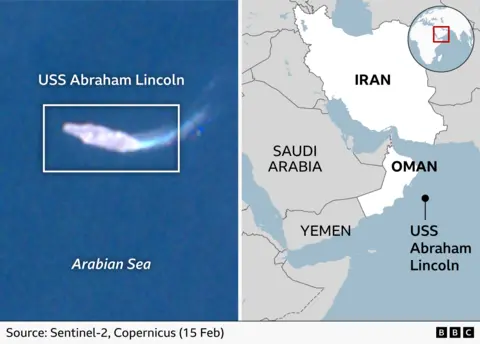
The US has been ramping up its military presence in the waters near Iran, and as satellite images show the Islamic Republic fortifying sensitive military sites.
BBC Verify has confirmed the location of the US aircraft carrier USS Abraham Lincoln – equipped with guided missile destroyers and dozens of fighter jets – near Iran.
The US has also reportedly sent the USS Gerald R Ford, the world’s largest warship, to the Middle East. It is expected to arrive in the region within the next three weeks.
All US military forces deployed to the region were expected to be in place by mid-March, a US official and a senior military official told CBS.
Iran’s Supreme Leader Ayatollah Ali Khamenei posted on X on Tuesday an AI-generated image of the Ford at the bottom of the ocean.
“The US President constantly says that the US has sent a warship toward Iran. Of course, a warship is a dangerous piece of military hardware,” Khamenei’s post said.
“However, more dangerous than that warship is the weapon that can send that warship to the bottom of the sea.”
Khamenei also accused the US of attempting to predetermine the outcome of negotiations and said that would be a “wrong and foolish thing to do”.
Iran’s Islamic Revolutionary Guard Corps has responded to the US build up by launching a maritime drill in the Strait of Hormuz, located in the Gulf between Oman and Iran, on Monday.
The Strait is considered a vital international waterway and oil export route from Gulf Arab states.
Follow the twists and turns of Trump’s second term with North America correspondent Anthony Zurcher’s weekly US Politics Unspunnewsletter. Readers in the UK can sign up here. Those outside the UK can sign up here.