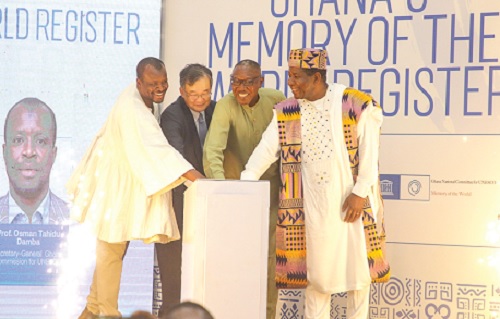
Deputy Minister of Education Dr. Clement Abas Apaak has officially launched the National Memory of the World Register, a major step toward preserving and promoting country’s documentary heritage.
The new register will identify and recognize documentary materials of national significance, including the original copies of the country’s 1957 independence documents, speeches and writings of Kwame Nkrumah, records from the 1960 Republican Constitution, and archival material on major political transitions and military regimes.
The initiative also positions Ghanaian heritage for possible inclusion on regional and international registers, contributing to the preservation of the world’s collective memory.
It forms part of the global UNESCO Memory of the World Programme, which aims to safeguard and disseminate valuable archival holdings, library collections, and museum materials worldwide.
Dr. Clement Abas Apaak described the move as a critical moment in the nation’s historical preservation efforts.
“Ghana’s story must be preserved. From the rise of our ancient kingdoms, through our hard-won independence, to the progress we continue to make, our journey deserves to be protected and remembered,” he said.
Dr. Apaak noted that the country’s history is embedded in various records across institutions and communities, in books, monographs, archives, photographs, and audiovisual materials held in institutions, within communities, in homes, and even beyond Ghana’s borders.
“Each record carries a voice from the past and offers insight into who we are and where we came from,” he added.
The deputy minister commended the Public Records and Archives Administration Department (PRAAD) for its role in preserving the nation’s archives and acknowledged contributions from universities, libraries, museums, and cultural institutions.
He urged public and private institutions to support the initiative by nominating materials, backing digitization efforts, and participating in training programs.
“This is a shared responsibility, and together we can achieve lasting results,” he said.
Dr. Apaak reaffirmed the government’s commitment to modernizing archival systems, training professionals, and investing in digital infrastructure to meet current and future demands.
He also emphasized the broader value of documentary heritage as a tool for education and research.
“It provides students, researchers, and citizens with reliable sources to explore Ghana’s past, draw lessons from it, and find inspiration for the future,” he said. “Ghana’s story is one of resilience, great culture, and continuity. Through this register, we present our collective memory and connect our heritage to the broader story of our common humanity.”
Helena Asamoah-Hassan, Chairperson of the Ghana National Committee for the Memory of the World Programme, said the national register carries the same weight for Ghana as the international register does for the world.
She explained that the register plays a central role in shaping national identity, adding that documentary materials, whether historical manuscripts, digital archives, or audiovisual records, provide a clear record of the country’s origins, present state, and future direction.
Ms. Asamoah-Hassan stressed that the focus must now shift from listing items to ensuring their preservation and accessibility.
“We now need to protect these physical and digital objects from decay and loss. We must take serious action in their preservation, make sure they are accessible for research and general use, and keep them in safe custody so future generations can connect to their ancestors,” she said.
She warned that failure to take urgent action would defeat the purpose of establishing the register.
Japanese Ambassador to Ghana, Hiroshi Yoshimoto, called for stronger collaboration among institutions and development partners to protect Ghana’s documentary heritage. He described the initiative as an important step in preserving the country’s history and ensuring that future generations have access to reliable records.
Mr. Yoshimoto said Japan continues to support UNESCO’s work in education, culture, and science through dedicated funding arrangements, which have helped drive projects in heritage preservation, literacy, and institutional development. The Ghana register is being supported through one such funding mechanism in partnership with UNESCO.
He added that Japan places a high value on documentary preservation, drawing inspiration from its own experience with natural disasters and major historical changes, experiences that have reinforced the need to protect records as a way of safeguarding national identity and culture.
“Ghana’s effort to document and include its heritage in the Memory of the World Register will raise awareness across Africa and signal the country’s commitment to preserving its history,” Ambassador Yoshimoto said.