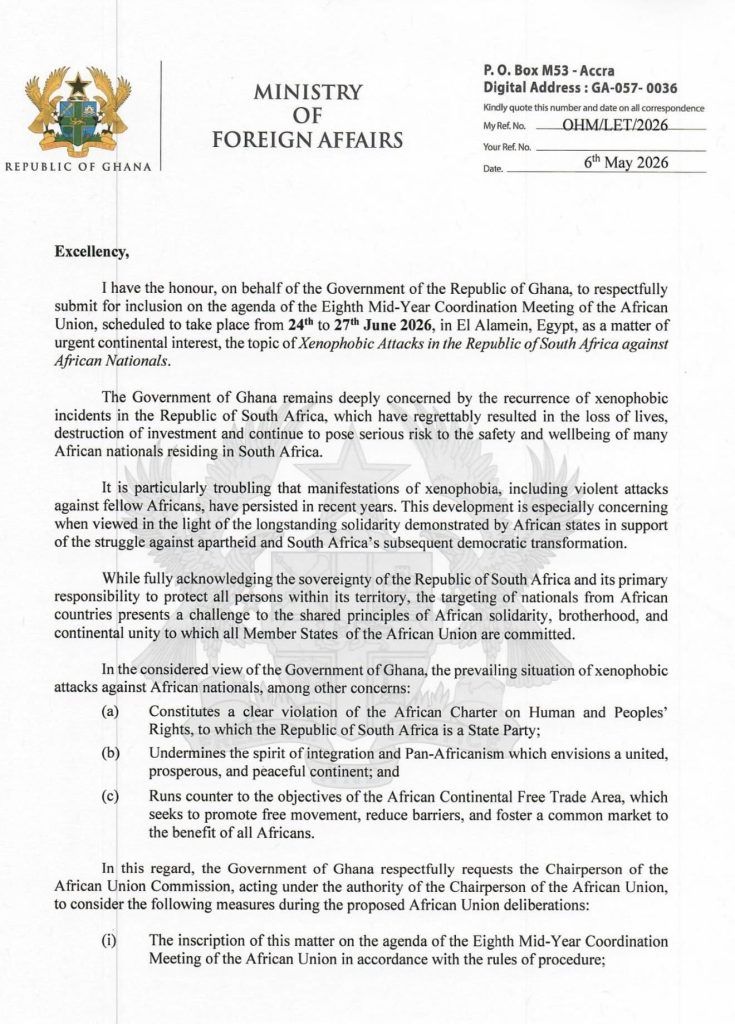
Ghana has formally petitioned the African Union (AU) to include the recurring xenophobic attacks on African nationals in South Africa on the agenda of the upcoming Eighth Mid-Year Coordination Meeting of the continental body.
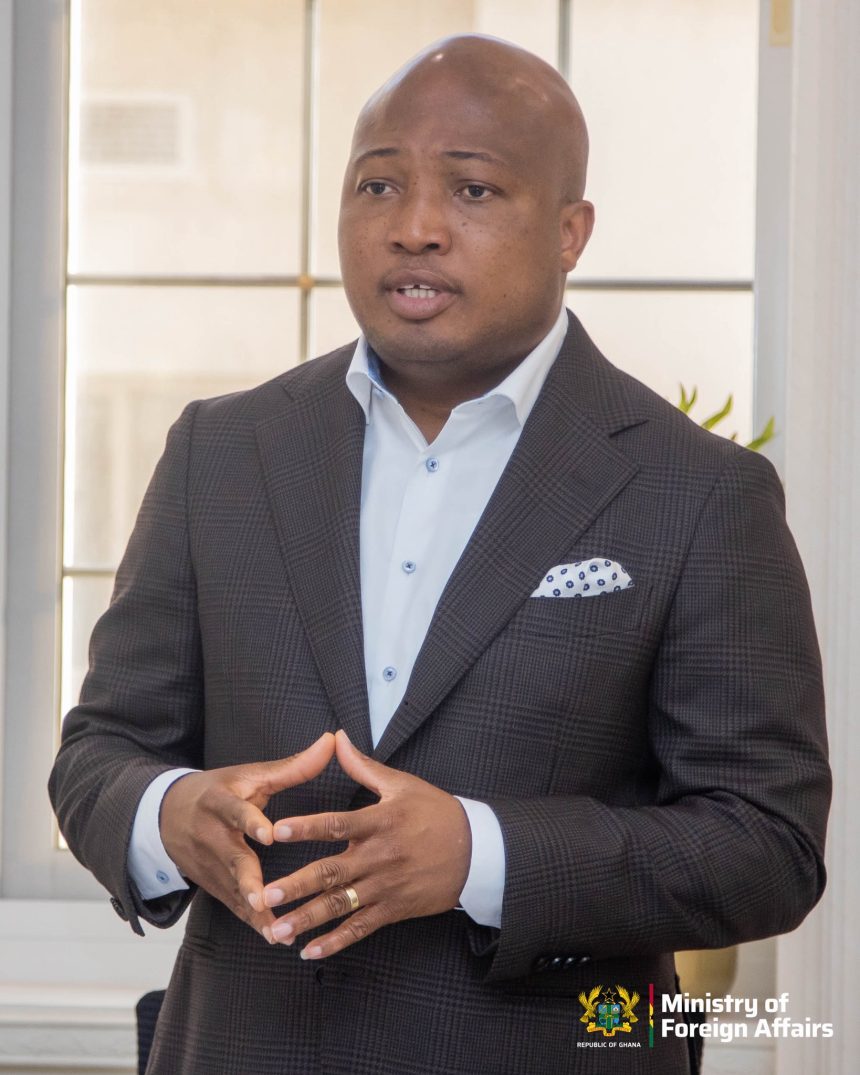
The request was made in a letter dated May 6, 2026, from Ghana’s Minister for Foreign Affairs, Samuel Okudzeto Ablakwa, addressed to the Chairperson of the African Union Commission in Addis Ababa.
In the letter, Ghana urges the AU to treat the matter as “a pressing continental concern” during the meeting, scheduled to take place in El Alamein, Egypt, from June 24 to 27, 2026.
Expressing deep concern over repeated xenophobic incidents in South Africa, Ghana’s government noted that the attacks have led to loss of life, destruction of investments, and threats to the safety and well-being of numerous African nationals living in the country.
“It is particularly troubling that manifestations of xenophobia, including violent attacks against fellow Africans, have persisted in recent years,” the letter states.
Ghana further argues that such attacks undermine the very principles of African solidarity, brotherhood, and continental unity championed by the AU and the Pan-African movement.
According to the letter, the violence violates the African Charter on Human and Peoples’ Rights and contradicts the objectives of the African Continental Free Trade Area (AfCFTA), which aims to promote free movement, reduce trade barriers, and foster a common African market.
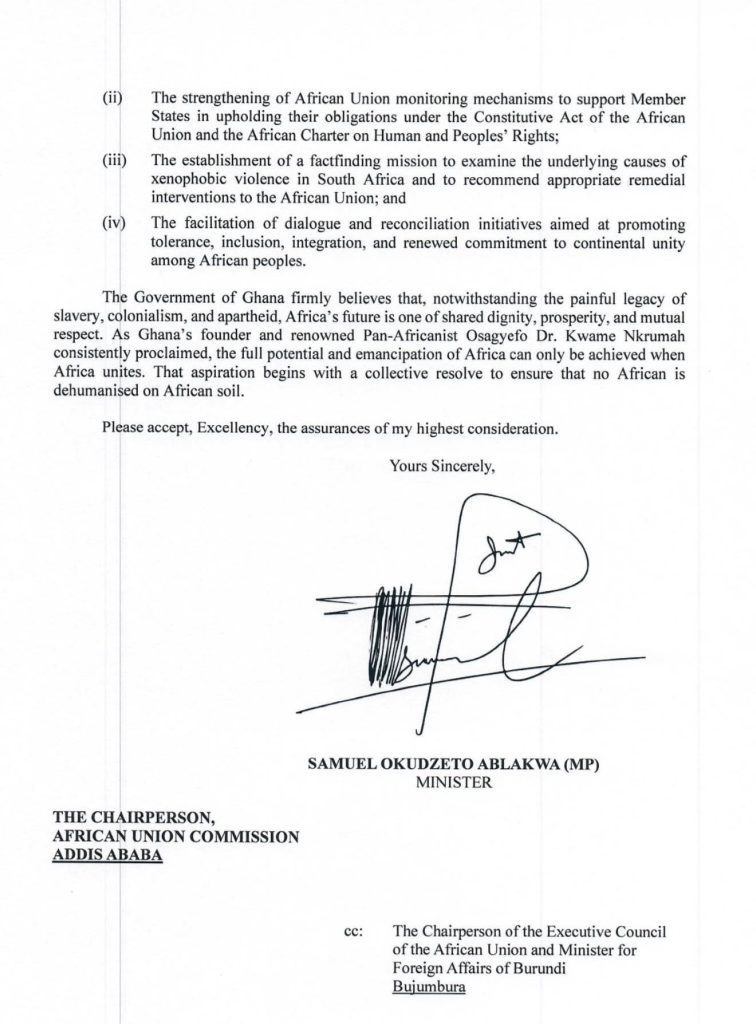
As part of its proposals, Ghana requests that the AU strengthen monitoring mechanisms to ensure member states uphold their obligations under the AU Constitutive Act and the African Charter on Human and Peoples’ Rights.
The government also calls for the establishment of a fact-finding mission to investigate the root causes of xenophobic violence in South Africa and recommend appropriate remedial actions to the AU.
Additionally, Ghana proposes dialogue and reconciliation initiatives to promote tolerance, inclusion, integration, and a renewed commitment to continental unity among African peoples.
The letter emphasises that despite Africa’s painful history of slavery, colonialism, and apartheid, the continent’s future must be built on shared dignity, prosperity, and mutual respect.
Citing Ghana’s first President and Pan-Africanist, Kwame Nkrumah, the government asserts that Africa’s full emancipation and potential can only be realised through unity and by ensuring that no African is dehumanised on African soil.