
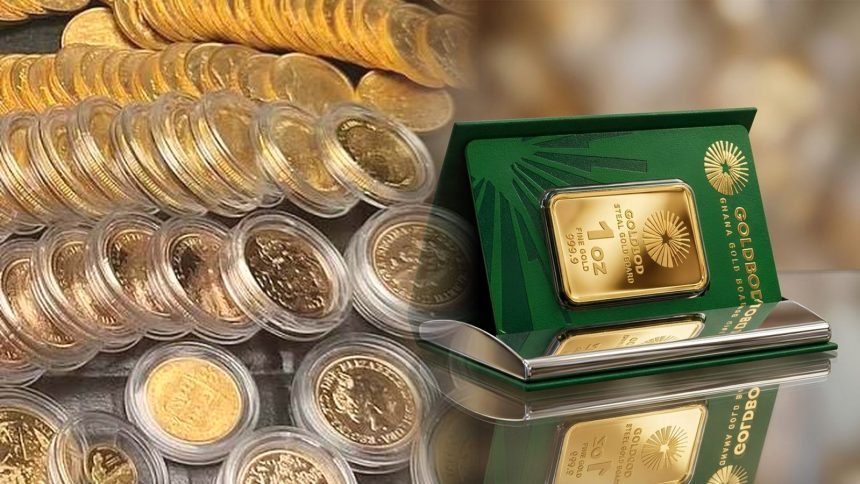
Ghana has done something worth applauding. Through GoldBod Jewellery, the Ghana Gold Board has made it possible for ordinary Ghanaians to buy real, investment-grade gold in tablets as small as one gram — putting physical gold ownership within reach of people who could never have afforded a full bar or ounce before. It’s a genuine step forward for financial inclusion.
But there’s a design flaw in how the product is priced, and it’s worth taking a second look at it: Ghana is charging VAT and other consumption taxes on gold the same way it would on a television or a bag of rice.
How the Price Is Built
GoldBod’s own pricing breakdown shows what goes into a Gold Tablet’s price tag: the international gold price, refining and fabrication costs, packaging and certification, distribution, and — statutory taxes, VAT included. That formula makes sense for something manufactured for everyday use. It makes less sense for something bought to be locked away and held for years.
The numbers tell the story. A one-gram tablet currently retails above GH₵2,000, a ten-gram tablet is around GH₵20,000, and a one-ounce (31-gram) tablet goes for more than GH₵60,000 — premiums of roughly 29 to 32 percent over the raw international gold price. Some of that markup is fair: refining, minting, certification and running a nationwide retail network, all cost money. But a chunk of it is straightforward consumption tax, applied to a product nobody is going to “consume.”
There’s a second, quieter cost buried in that same pricing model: what happens on the way out. If a holder needs to resell a tablet back to GoldBod, the buyback would logically be pegged to the prevailing international (LBMA) gold price at that moment, stripped of everything that inflated the buying price in the first place — refining, fabrication, distribution, and VAT. GoldBod compounds this further by applying a 10 percent discount on any tablet an investor sells back within the first twelve months of purchase — a penalty that stacks directly on top of the entry-side tax and mark-up the investor has already absorbed. Together, these two features mean the investor bears the full weight of the tax and premium going in, and gives up even more coming out early.
This is exactly why buyback terms matter as much as the sale price, and why they shouldn’t be left implicit. Some established bullion dealers elsewhere publish both figures — the selling price and the buyback price — side by side on their websites, precisely because a buyer’s confidence in the exit price is, for many, as important as the entry price in deciding whether to invest at all. GoldBod would do well to state its buyback policy just as plainly and prominently as it states its selling price, rather than leaving investors to discover the gap between the two only when they try to cash out.
Gold Moves Slowly — Taxing It Like a Fast-Moving Good Doesn’t Add Up
This is the heart of the problem. Gold is not a fast asset. Looking back over roughly the last 50 years of price history, gold has typically taken twelve to eighteen months to gain about 10 percent, and three to five years to gain around 30 percent — with occasional faster or slower stretches, but that’s the general pattern. If someone pays a near-30-percent premium upfront, they may need several years of ordinary price growth just to break even. Adding VAT on top only stretches that recovery period further, for an asset whose whole purpose is long-term wealth preservation, not quick turnover.
Ghana’s own gold market already hints at this distinction. The Bank of Ghana’s Ghana Gold Coin, launched in November 2024 and priced off international London benchmarks, was built specifically as a savings and liquidity tool rather than a retail commodity — a tacit acknowledgment that gold held for saving isn’t quite the same thing as gold bought for ornament.
What Other Countries Do
Global practice backs this up clearly. Since January 2000, the United Kingdom has exempted investment-grade gold bullion — bars at least 99.5 percent pure, plus coins like the Sovereign and Britannia — from VAT entirely. That followed an EU-wide decision in 1999 to remove VAT from investment gold across member states, specifically so that gold would be “treated for tax purposes the same way as shares and other investments,” rather than as merchandise.
Switzerland exempts qualifying investment gold from VAT outright under its own tax rules. Australia does the same for bullion of at least 99.5 percent purity under its GST law. Even China — which does tax gold jewellery at its standard rate — carves out investment-grade gold bars and coins from VAT, reserving the tax specifically for gold bought to wear or display rather than gold bought to hold.
In VAT-exempt markets, a standard one-ounce gold bar typically trades just 1 to 3 percent above the international spot price, and even a premium sovereign coin rarely exceeds 4 to 8 percent over spot. A GoldBod Jewellery Tablet, by contrast, carries a premium of roughly 29 to 32 percent over the same benchmark. Some of that gap reflects Ghana’s smaller retail scale and higher local distribution costs — but a premium several multiples wider than what tax-exempt markets charge for a comparable product points to VAT as a significant part of the difference.
The pattern is the same everywhere: jewellery, bought for adornment, stays taxed. Bullion, bought to preserve wealth, doesn’t. Nobody taxes a Treasury bill or a unit trust as if it were a consumer good — the same logic simply gets extended to investment gold once it meets an investment-grade purity standard.
Why This Matters for Ghana
Ghana is Africa’s biggest gold producer, and it has put real money behind GoldBod — reportedly around $279 million in seed capital — to strengthen its role in the global gold trade. Taxing the very product meant to get ordinary people saving in gold works against that ambition. It makes the entry price higher for exactly the everyday savers the tablets were designed for, and it leaves Ghana’s product less competitive than bullion sold in markets that have already scrapped VAT on investment-grade gold.
A targeted VAT exemption — for certified, investment-grade GoldBod tablets specifically, while still taxing gold jewellery normally, just as every country cited above does — probably wouldn’t cost the government much, since this is still a small, young market. But it would bring Ghana’s tax policy in line with something the rest of the gold-trading world figured out over twenty years ago: gold you save for the future isn’t the same thing as gold you buy to spend today.