
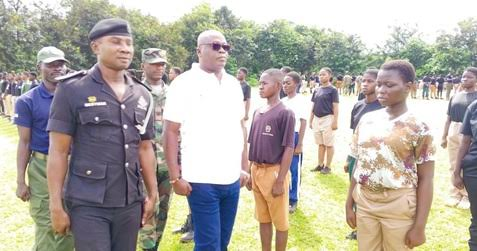
More than 500 young cadets from schools across 11 regions recently gathered at Yamfo in the Ahafo Region for a national leadership training camp aimed at redefining cadet development in the contemporary world.
For two days, September 6–7, 2026, the MISORNU Safety Center, in partnership with the National Cadet Corps, delivered soft-skills training to male and female Senior High School (SHS) students participating in the programme at the Anglican SHS, Yamfo.
The training moved beyond the traditional emphasis on drills, marching and ceremonial discipline to expose cadets to practical skills in emotional intelligence, peer mediation, conflict resolution, crime prevention, leadership, security and safety awareness.
The programme reflected an important reality: many threats young people face in schools and communities do not begin as major incidents. They often start with disagreements, bullying, threats, fear, social exclusion, unresolved grievances, unsafe behaviour or warning signs that are overlooked or not reported.This makes prevention critical.
The National Cadet Corps’ 2026 Leadership Training Camp was organised around the theme: “Truth and Honesty”, reinforcing the importance of integrity, discipline, teamwork, responsibility and good citizenship among young people.
A Daily Graphic report published on September 10, 2026, with the headline, “Cadets trained to detect and prevent conflicts”, also highlighted the growing emphasis on equipping cadets with practical skills to identify warning signs and help prevent conflict before it escalates.
That approach deserves wider national attention.
From ceremonial cadets to preventive leaders
Cadet training has traditionally been associated with discipline, uniformed drills and ceremonial activities. These remain important, but Ghana can derive greater value from school cadet structures by deliberately developing cadets as preventive leaders.
A young leader who can manage his or her emotions, recognise emerging conflict, communicate respectfully, identify safety and security risks and report concerns responsibly is better equipped to influence peers positively.
Emotional intelligence is particularly important. Many conflicts involving young people escalate because of anger, humiliation, peer pressure, misunderstanding or an inability to manage emotions.
Teaching young people to recognise emotional triggers, listen carefully and respond rather than react can help prevent disagreements from becoming violent.
Peer mediation provides another valuable tool. Students often become aware of disagreements, threats or tensions among their peers before teachers or school authorities do.
Properly trained peer mediators can help de-escalate minor conflicts, encourage dialogue and refer serious matters to responsible adults.
However, cadets must not be turned into school police officers. Their role should be preventive and supportive. They should observe, recognise risks, promote peaceful behaviour and know when and how to report concerns to the appropriate authorities.
Schools need safe ways for students to speak
The Yamfo training also raises a broader question for Ghanaian schools: Do students have safe and trusted ways to report concerns before those concerns become crises?
A student may notice bullying, intimidation, threats, unusual behaviour, planned violence, unsafe areas within a school, possession of dangerous items or a colleague experiencing serious emotional distress.
A student may also observe a teacher, headmaster, housemaster or other school workers engaging in potentially dangerous conduct, but remain afraid to report because there are no trusted or anonymous systems to receive and process such information for early and lawful intervention.
Many young people remain silent because they fear retaliation or embarrassment, being labelled as informants, or simply believe that adults will not listen.
Schools therefore need structured and confidential reporting systems.
Every SHS should consider establishing a safe and, where appropriate, anonymous mechanism through which students can report safety and security concerns.
This could include confidential information boxes at accessible locations, designated trusted teachers, anonymous digital reporting channels or periodic student safety forums.
Such mechanisms must not become channels for gossip, punishment or victimisation. Schools need clear procedures for receiving, assessing and responding to information while protecting students who raise genuine concerns.
The objective is early intervention
A concern raised today may prevent a fight tomorrow. A report about persistent threats may prevent serious violence. An observation about an unsafe area may prevent an accident.
A student who feels listened to may also be less likely to resort to aggression or retaliation.
Schools should therefore treat student observations as an important component of their safety and conflict-prevention systems.
Listening must be matched by response
Reporting mechanisms will only work when students trust them. School authorities must demonstrate that concerns are taken seriously and handled fairly.
Teachers, counsellors, housemasters, school administrators and security personnel should receive basic training in conflict-sensitive communication, confidentiality, referral procedures and behavioural warning signs.
Students should also be taught what kinds of information should be reported, whom they can approach and what happens after a report is made.
The Ghana Education Service could support schools to establish minimum standards for student safety-reporting mechanisms as part of broader school safety and violence-prevention arrangements.
Learning must continue beyond the training camp
A short training session can introduce important ideas, but behavioural change requires continuous reinforcement.
The EveryDay Lens – Cadet Edition
For this reason, MISORNU used the Yamfo programme to launch the maiden EveryDay Lens – Cadet Edition, an online preventive safety and security newsletter developed specifically for cadets and other young people.
The newsletter is intended to transform real Ghanaian safety and security experiences into practical learning. Through evidence-based cases and expert guidance, students will be encouraged to recognise warning signs, manage disagreements peacefully, make responsible decisions, communicate effectively and contribute to safer schools and communities.
The principle is simple: read, reflect, discuss, practise and apply.
The Ministry of Education and the Ghana Education Service should consider adopting and supporting the EveryDay Lens – Cadet Edition as a complementary learning resource for schools.
Such support would not require the newsletter to replace existing curricula. Rather, it could serve as a practical preventive-learning tool to strengthen youth resilience, crime-prevention awareness, conflict-resolution skills, responsible leadership and safety consciousness.
Its online format also provides an opportunity for continuous learning beyond occasional workshops and training camps.
A national opportunity
Ghana already has a valuable youth leadership structure in the National Cadet Corps. The opportunity now is to broaden its preventive role.
Cadets can become ambassadors for peaceful conflict resolution, safety awareness, responsible citizenship and early reporting within their schools and communities.
Schools can support this by creating trusted reporting channels. Teachers and administrators can strengthen their capacity to recognise and respond to early warning signs. The Ministry of Education and the GES can institutionalise preventive learning resources that reinforce these skills over time.
The task of creating safer schools cannot rest on security agencies and disciplinary codes alone. It requires students who can recognise danger, adults who are prepared to listen and institutions that respond before concerns escalate into violence or harm.
The Yamfo experience offers a useful model
When young people are taught to manage emotions, resolve disagreements peacefully, recognise risks and speak up responsibly, cadet training becomes more than discipline and parade.
It becomes an investment in preventive leadership – the kind of leadership Ghana’s schools and communities increasingly need.
(DCOP David Senanu Eklu (Rtd) is a former Director-General, Police Public Affairs, and the Executive Director of MISORNU Safety Centre, a public-service organisation).