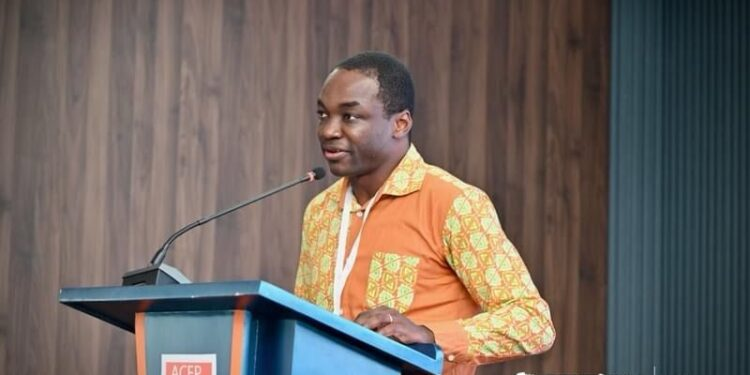
Dr. Charles Ofori, the Policy Lead, Climate Change and Energy Transition at Africa Centre for Energy Policy (ACEP), says methane accounted for about 17 per cent of Green House Gases (GHGs) with agriculture being the most significant source of anthropogenic methane in the country.
Ghana rice systems ( irrigated and rain fed lowlands) remained flooded for long periods creating ideal conditions for methane formation, the expert noted.
Dr. Ofori revealed this at a learning session on methane organized by Friends of the Nation ( FoN) with support of Africa Centre for Energy Policy (ACEP) and Oxfam on the theme: “Consolidating the gains from contributions of government, civil society and the private sector.”
Meanwhile, the Agric sector contributed about 21 per cent of Gross Domestic Product (GDP) and employed about 10 per cent of the total workforce with 60 per cent in the rural sector.
He indicated that sources of methane emissions globally were 40 per cent natural and 60 per cent human activities.
He suggested solutions, including, sustainable rice cultivation (Alternate Wetting and Drying), improved livestock feed and herd management, improved manure management, water and land management in rice valleys and rotational cropping.
Ghana’s methane emissions, driven largely by energy, waste, and land-use activities, had increased by over 260 per cent since 1990 according to ACEP-Africa report.
The situation, he noted, required coordinated action, as these trends threatened climate resilience, public health, and food security, particularly for coastal and vulnerable communities.
Mr. Donkris Mevuta, the Executive Director of Friends of the Nation (FoN), said the International Energy Agency further emphasised that reducing methane was among the fastest and most cost-effective actions available to slow near-term climate change.
The 2025 Global Methane Status Report showed that methane accounted for nearly one-third of the warming the world was experiencing.
“While Ghana had made progress across multiple sectors, we still lack a unified national methane-management strategy. Efforts remain fragmented, and challenges persist in monitoring systems, data accuracy, enforcement, financing, and public awareness, “he added.
Mr. Mevuta recalled that Ghana signed the Global Methane (GMP) in 2021 with a commitment to support collective global efforts to reduce methane emissions by 30 per cent from 2020 levels by 2030, an action that could help avoid more than 0.2°C of warming by 2050.
However, Mr Mevuta said, being a signatory did not automatically mean Ghana was on track to meet this ambition hence, the FON event was very important to serve as building blocks for Ghana’s meaningful contribution to the Global Methane Pledge.
He said, “Our theme for today’s learning event, reminds us that real progress depends on all actors; government institutions providing leadership and regulation, civil society strengthening awareness and accountability, the private sector driving innovation, and academia offering evidence and practical solutions.”
Mr Mevuta stressed that progress depended on everyone and that, “together, we can turn today’s gains into meaningful national action.”
He stated that “I, therefore, encourage everyone here to participate fully: share knowledge and discussions must be shaped by practical recommendations, for an inclusive, science-driven National Methane Management Strategy that reflects Ghana’s realities and ambitions”.
“Together, we can turn today’s dialogue into a collective step toward a cleaner, safer, and more climate-resilient future for all,” he said.