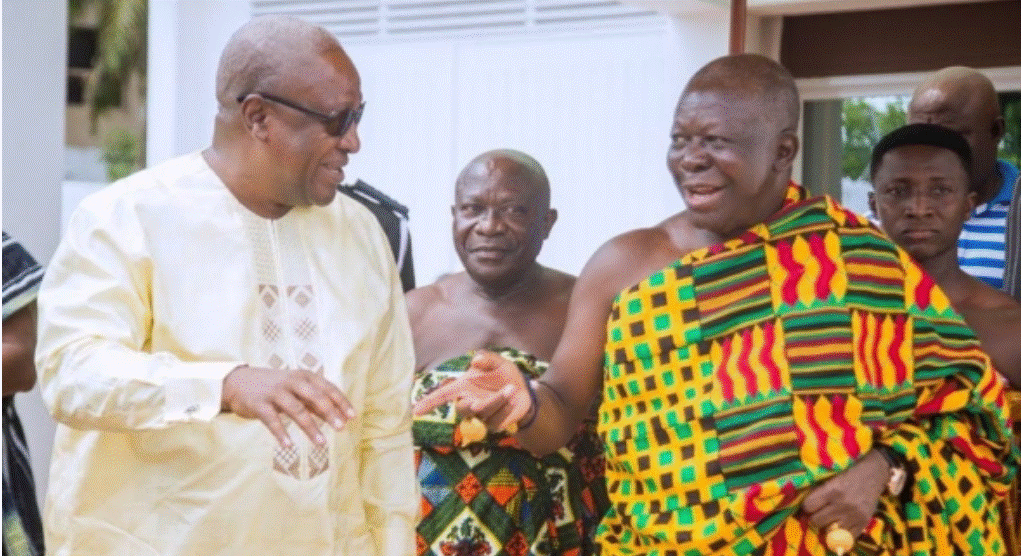
The Asantehene, Otumfuo Osei Tutu II, has presented a mediation report to President John Dramani Mahama outlining steps he says are needed to end the long-running conflict in Bawku, with a central emphasis on enforcing the existing legal position on who is recognised as Bawku Naba.
At a ceremony at Jubilee House on Tuesday, Otumfuo said the process was mediation rather than arbitration, insisting he had not come to declare “winners” and “losers” but to place the facts before the state and the parties to support reconciliation. He also argued that the report’s findings should be treated as binding by all sides if peace is to hold.
A major recommendation, reported by local media, is that government should “decisively enforce” the laws and court decisions that recognise Zugraan Naba Asigri Abugrago Azoka II as the legitimate chief of Bawku and head of the Kusasi Traditional Area. Otumfuo’s argument is that the matter is not simply a political or customary compromise but one grounded in Ghana’s constitutional order and the Supreme Court’s determination of the dispute.
The report also addresses the question of a rival installation linked to the Mamprusi side. It recommends that Seidu Abagre should be recalled to Nalerigu by the Nayiri and reassigned to another traditional role, with the reassignment to be “assisted by the state”. As an alternative, the report says he may remain in Bawku only as a private citizen, and not present himself as Bawku Naba.
Beyond the specific chieftaincy questions, President Mahama said the government would study the report and announce its definitive position within 24 hours, while calling for the next phase to focus on direct reconciliation involving the National Peace Council, the houses of chiefs and religious bodies.
The presentation of the Asantehene’s peace plan follows renewed security measures in Bawku, including an extended curfew and restrictions on arms, as authorities try to contain recurring violence while the government considers how to implement the recommendations.
The violence and tension in Bawku are rooted in a long-standing dispute over traditional authority that stretches back to the colonial era. The conflict centres on the paramountcy of the Bawku skin, a chieftaincy symbol that carries significant influence over land, local governance, and social order. Historically, two neighbouring ethnic groups, the Kusasi and the Mamprusi, have both claimed legitimacy over the position.
Under British colonial rule, indirect governance structures elevated centralized authority even in areas traditionally governed through less formal systems, contributing to overlapping claims of authority. After independence in 1957, the dispute intensified when early committees and government decisions alternately recognised candidates from each side. These oscillating determinations entrenched grievances and periodic outbreaks of violence.
In the decades since, repeated clashes have led to cycles of killings, displacement, and prolonged insecurity, punctuated by local and national efforts at resolution. Renewed escalations in the 21st century, particularly from 2021 onward, saw hundreds of fatalities and recurring curfews, prompting both state and traditional actors to seek durable peace.
At the heart of the Asantehene’s peace plan is an emphasis on legal clarity and respect for established judicial decisions. A central recommendation is that the government should firmly enforce existing court decisions that recognise Zugraan Naba Asigri Abugrago Azoka II as the rightful Bawku Naba, the paramount chief of the Kusasi traditional area. This follows previous judicial determinations affirming the status of the Bawku skin and seeks to reduce ambiguity that has fuelled periodic disputes.
The plan also addresses competing claims, including a recommendation that Seidu Abagre, a figure associated with rival claims linked to the Mamprusi side, should be recalled to Nalerigu by the Nayiri (the Mamprusi overlord) and reassigned to a different traditional role, with state support. If that is not feasible, the report suggests he could remain in Bawku as a private citizen rather than as a claimants to the Bawku skin.
Beyond specific leadership issues, Otumfuo’s report stresses that the mediation was facilitated with the aim of reconciliation rather than adjudication. He has urged all parties to embrace the outcomes and work together, framing peace not only as a legal outcome but as a communal and cultural imperative.
President Mahama has pledged that the government will carefully review the report and announce a definitive position within 24 hours, signalling an accelerated state commitment to implementing the recommendations and reinforcing security measures where needed. He also highlighted the importance of coordination with the National Peace Council, regional traditional authorities, and religious bodies to support grassroots reconciliation.
Security officials continue to maintain heightened vigilance in the Bawku area, where curfews and restricted movements have been periodically imposed as part of efforts to quell violence.
The formal delivery of the peace plan represents the culmination of sustained mediation that began earlier in 2025, with meetings at the Manhyia Palace and engagements across the contending communities. Otumfuo has framed his role as one of mediation and dialogue, seeking to transform deep-seated mistrust into a shared commitment to peace.
For observers and residents alike, the focus now shifts to implementation and reconciliation on the ground. The success of the plan will depend not just on legal and administrative decisions in Accra and Kumasi, but on how traditional authorities, civil society, youth groups, and local institutions work together to rebuild trust and social cohesion in Bawku.