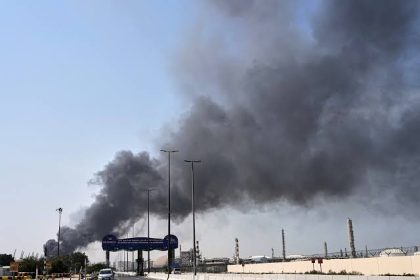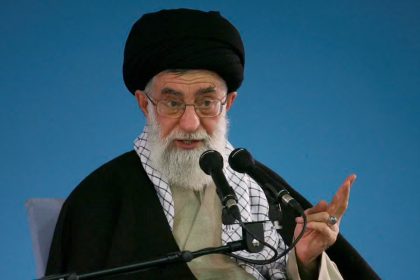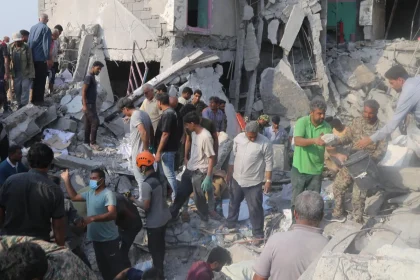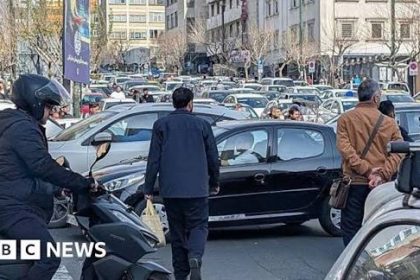
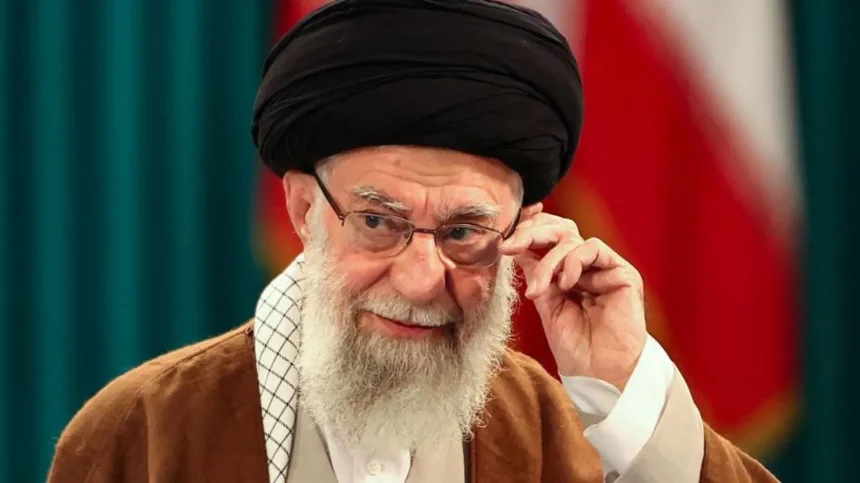
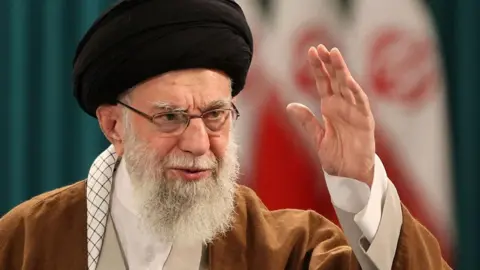
Ayatollah Ali Khamenei has been killed on the first day of massive US and Israeli air strikes on Iran, US President Donald Trump has announced.
The death of the 86-year-old ruler of the past three decades – one of the longest in the world – was later confirmed on Iranian state TV.
Iran has had only two supreme leaders since the 1979 Islamic Revolution.
It’s an all-powerful office – the supreme leader is head of state and commander-in-chief of the armed forces, including the elite Revolutionary Guards.
Khamenei is not quite a dictator, positioned in the middle of a complex web of competing power centres, able to veto any matter of public policy and hand pick candidates for public office.
Young Iranians have never experienced life without him in charge.
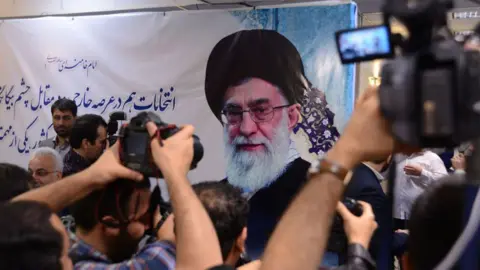
State television has covered Khamenei’s every move. His image is plastered on billboards in public spaces and his photograph is ubiquitous in shops.
Abroad, successive Iranian presidents have often hogged the limelight. But, at home, it was Khamenei who pulled the strings.
His death, in such violent circumstances, heralds a new and uncertain future, both in Iran and the wider region.
Ali Khamenei was born in the city of Mashhad, in north-eastern Iran, in 1939.
The second of eight children in a religious family, his father was a mid-ranking cleric from the Shia branch of Islam, the dominant sect in Iran.
Khamenei would later romanticise his “poor but pious” childhood, saying he frequently ate nothing but “bread and raisins”.
His education was dominated by the study of the Quran, and he qualified as a cleric by the age of 11. But, in common with many religious leaders of the time, his work was as much political as spiritual.
An effective orator, Khamenei joined the critics of the Shah of Iran: the monarch who was eventually overthrown by the Islamic revolution.
For years, he lived underground or festered in jail. He was arrested six times by the Shah’s secret police, suffering torture and internal exile.
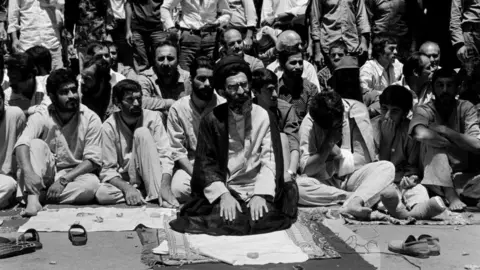
After the Islamic revolution, its leader Ayatollah Ruhollah Khomeini appointed him Friday prayer leader of the capital, Tehran.
Every week, his political sermons were broadcast throughout the country. It firmly established Khamenei as part of the new leadership of the country.
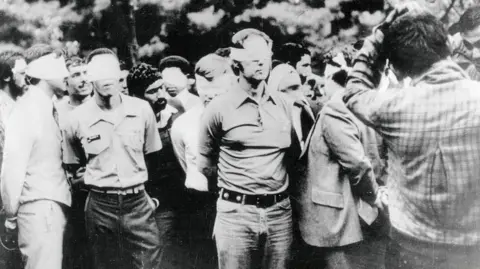
In the tumultuous first months after the revolution, a group of militant university students loyal to Khomeini occupied the US embassy. Dozens of diplomats and embassy staff were taken hostage.
Iran’s revolutionary leaders – including Khamenei – supported the students, who were protesting against America’s decision to give sanctuary to the deposed Shah.
The hostage-taking lasted for 444 days.
It helped destroy the Carter administration in the United States and set Iran on the anti-American and anti-Western path that came to define the revolution.
The episode also marked the beginning of decades of international isolation for Iran.
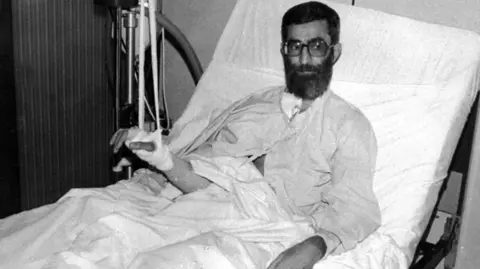
Shortly after the crisis, Khamenei was fortunate to survive an assassination attempt.
In June 1981, a dissident group hid a bomb inside a tape recorder. It exploded as he delivered a lecture.
He was badly injured. His lungs took months to recover, and he permanently lost the use of his right arm.
Later that year, President Mohammad-Ali Rajai was assassinated and Khamenei stood in the ensuing election to succeed him in the largely ceremonial role.
With Khomeini controlling who had the right to stand, the outcome was never in doubt. Khamenei won with 97% of the vote.
His inaugural address set the tone for his presidency, with him condemning “deviation, liberalism, and American-influenced leftists”.
In office, Khamenei became a wartime leader.
Months earlier, the country’s neighbour, Iraq, had invaded. Saddam Hussein, Iraq’s president, feared that Khomeini’s Islamic revolution would spread abroad and undermine his own regime.
It was a vicious and bloody war that lasted for eight years, with hundreds of thousands of deaths on both sides.
Khamenei spent months at a time on the front lines, where many of the commanders
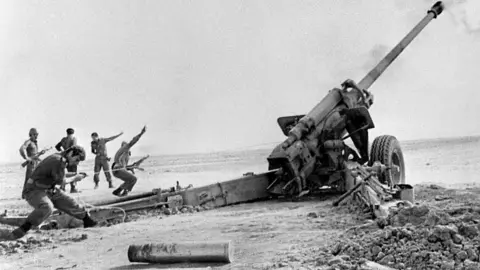
The Iraqi army used chemical weapons against border villages in Iran and bombarded far-flung cities, including the capital, Tehran, with missiles.
Iran, for its part, relied on human waves to break Iraqi lines, made up of devout youngsters, some barely of fighting age. There were huge casualties.
The war solidified Khamenei’s deep distrust of the US and the West – which had backed Saddam Hussein’s invasion.
In 1989, Khamenei was selected by the Assembly of Experts, a council of clerics, as the successor to Khomeini, who had died at the age of 86.
The new supreme leader was chosen despite what was seen as a weak record of achievement in religious scholarship.
“I am an individual with many faults and shortcomings and truly a minor seminarian,” he admitted in his first speech in office.
“However, a responsibility has been placed on my shoulders and I will use all my capabilities and all my faith in the almighty in order to be able to bear this heavy responsibility.”
The Iraqi army used chemical weapons against border villages in Iran and bombarded far-flung cities, including the capital, Tehran, with missiles.
Iran, for its part, relied on human waves to break Iraqi lines, made up of devout youngsters, some barely of fighting age. There were huge casualties.
The war solidified Khamenei’s deep distrust of the US and the West – which had backed Saddam Hussein’s invasion.
In 1989, Khamenei was selected by the Assembly of Experts, a council of clerics, as the successor to Khomeini, who had died at the age of 86.
The new supreme leader was chosen despite what was seen as a weak record of achievement in religious scholarship.
“I am an individual with many faults and shortcomings and truly a minor seminarian,” he admitted in his first speech in office.
“However, a responsibility has been placed on my shoulders and I will use all my capabilities and all my faith in the almighty in order to be able to bear this heavy responsibility.”
At home, he crushed opposition.
In 1999, student protests were a moment of peril, but they were put down.
A decade later, a revolt against an allegedly rigged presidential election saw demonstrators pepper-sprayed, beaten, and shot.
In 2019, when spiralling fuel prices resulted in street protests, Khamenei shut down the internet for days to prevent illegal marches. According to Amnesty International, the police then shot protesters dead with machine gun fire.
He did remove his predecessor’s barriers to the education of women. But Khamenei was no believer in gender equality.
Women who campaigned against the wearing of the hijab were arrested, tortured and held in solitary confinement. Those who supported them were also targeted. One human rights lawyer was given 38 years in prison and 148 lashes.
And, in 2022, the one of the biggest challenges to the Islamic revolution followed the death in police custody of Mahsa Amini, a 22-year-old woman who was accused of failing to wear her hijab properly.
Human rights groups said more than 550 people were killed and 20,000 detained by security forces during the protests following her death.
Abroad, Khamenei has been widely accused of leading a pariah state. After the 11 September 2001 attacks on the US, President George W Bush included Iran as part of his “Axis of Evil” – alongside Iraq and North Korea.
Iran has used Hezbollah – the armed Shia group in Lebanon – as a Khamenei proxy in a semi-permanent conflict with Israel.
But, although he has bathed his people in a “Death to America” rhetoric, his foreign policy was carefully crafted to be neither accommodation nor direct confrontation with Washington.
The area of greatest friction was nuclear weapons.
Twenty years ago, Khamenei declared they were un-Islamic and issued a fatwa banning their development.
But, under his rule, Israel and the West became convinced that Iran had sought to secretly develop a nuclear weapons capability.
The sanctions imposed by world powers in response helped impoverish a country that was once one of world’s biggest exporters of oil – and high unemployment led to widespread discontent.
Khamenei did not oppose a nuclear deal agreed in 2015, which placed limits on Iran’s nuclear activities in return for sanctions relief, but he expressed doubt that the US would uphold it in the long term.
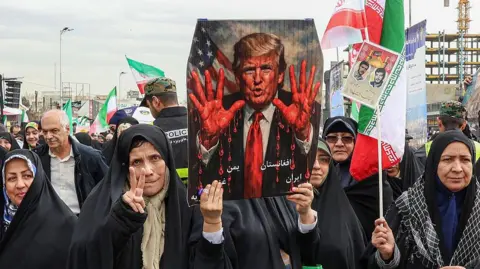
In 2018, Trump abandoned the nuclear deal and reinstated sanctions on Iran to compel it to negotiate a replacement.
Two years later, the president ordered the assassination in Iraq of Qasem Soleimani – a top Revolutionary Guards general close to the supreme leader – Khamenei swore revenge and aligned more closely with Russia and China.
In June 2025, when Israeli forces attacked Iran, targeting its nuclear programme, ballistic missile arsenal and top military commanders, the country launched barrages of missiles towards Israeli cities.
When the Americans joined the war, striking three key Iranian nuclear facilities, Khamenei vowed never to surrender. But, for the first time in years, he looked weak.
In January 2026, Khamenei’s regime faced a wave of street protests that were sparked by the failure of the Iranian economy. It responded with a brutal crackdown, which human rights groups said left at least 6,488 protesters dead and another 53,700 in detention.
In the following weeks, Trump ordered a US military build-up in the region and threatened to strike Iran if it did not agree a new deal on its nuclear programme and give up what he called its “sinister nuclear ambitions”.
But Khamenei refused to abandon uranium enrichment.
“The Americans should know that if they start a war, this time it will be a regional war,” he warned at the end of January 2026.
Khamenei has kept a firm and often brutal hand on the levers of power in Iran.
At times, the supreme leader has presented himself as almost above politics – looking down on the squabbling between Iran’s reformists and conservatives. But rarely did Ayatollah Khamenei allow dissent to grow too loud or policies he disapproved off to develop.
Life in Iran is currently governed by the laws he laid down. Few can say with certainty who will succeed him, and – therefore – what changes might come.