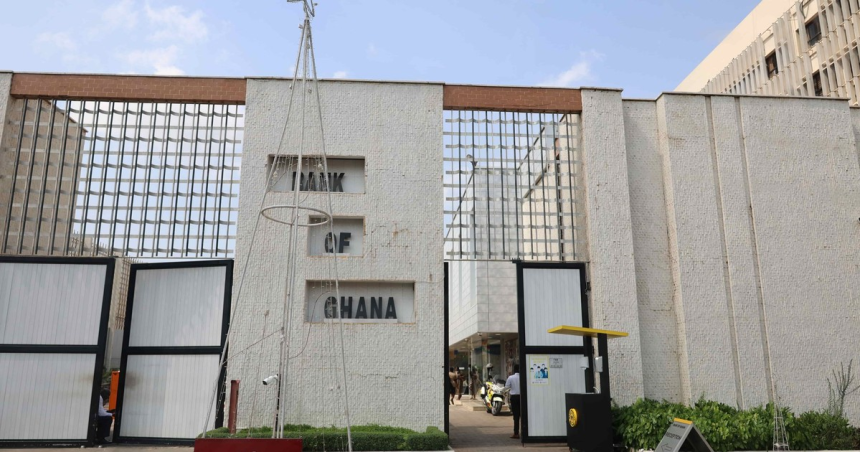
The Bank of Ghana has reportedly pumped about US$10 billion into Ghana’s forex market between January 2025 and the first week of December, as part of a broad strategy to meet dollar demand and support the stability of the cedi.
This intervention, described as “dollar supply support,” involved selling foreign currency to commercial banks and businesses in order to satisfy dollar-denominated demand — rather than as a one-off attempt to sustain a particular exchange-rate level.
According to official sources, the funds for the forex sales largely stem from windfall gains generated under the BoG’s Domestic Gold Purchase Programme — a policy that sees the central bank buying gold from local producers and using proceeds to build foreign-currency reserves or support the forex market.
Despite the scale of the intervention, the BoG’s international reserves have reportedly remained solid. Reserve levels are said to have increased from about US$9.1 billion at the end of 2024 to roughly US$11.4 billion by October 2025 — with some analysts expecting reserves to close the year above US$12 billion if inflows from gold exports and other sources hold steady.
That resilience suggests the central bank’s injections may not have eroded the cushion needed to meet external obligations — a key concern often raised when central banks aggressively sell foreign currency.
Observers say the forex interventions have coincided with a marked strengthening of the cedi. For example, in October 2025 alone, the BoG sold about US$1.15 billion under its FX Intermediation Programme — one of the largest monthly injections — which helped drive a sharp appreciation in the cedi’s value.
According to bank data cited by local media, this influx of hard currency and improved supply helped reduce volatility and contributed to more stable exchange-rate expectations among businesses, importers and ordinary citizens.
Additionally, the BoG’s move to formalise its operations through a new Foreign Exchange Operations Framework signals a shift toward more structured and transparent market interventions — aimed at smoothing disorderly market conditions without unduly influencing exchange-rate levels.
Ghana has faced repeated pressure on the cedi in recent years — driven by external debt obligations, import demand, energy-sector payments, and global economic uncertainty. Against that background, the BoG’s ability to marshal resources (through gold-based dollar generation, among others) and provide ample foreign-exchange supply may help cushion the economy from sharp currency shocks, mitigate inflationary pressures, and support import-dependent businesses.
By combining FX interventions with reserve accumulation and structural reforms (e.g., clearer frameworks for market operations), the BoG appears to be trying to restore confidence in the currency while preserving macroeconomic stability.
Though the interventions have helped stabilise the cedi, some economists caution that heavy reliance on central-bank FX sales may be unsustainable if the fundamentals behind the forex inflows — notably high gold prices, strong exports, and remittances — reverse. Past heavy interventions in emerging markets have sometimes masked underlying weaknesses, leaving currencies vulnerable once support fades.
Further, external shocks — such as sudden drops in global commodity prices or sharp reversals in capital flows — could erode reserves quickly. Critics warn excessive intervention may also reduce incentives for exporters to hedge currency risk or discourage long-term investment in export sectors.
Finally, central-bank interventions, even when transparent and market-neutral, may not fully substitute for broader economic reforms needed to rebuild export competitiveness, improve fiscal discipline, and diversify the economy.