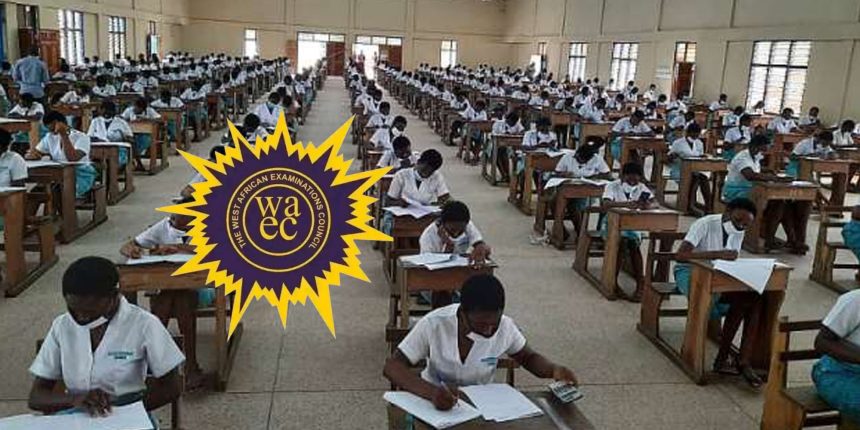
The Chief Examiner’s report on this year’s West African Senior School Certificate Examination (WASSCE) offers a sweeping and troubling account of why tens of thousands of Ghanaian candidates failed the core subjects needed to enter tertiary institutions.
The findings point to deep gaps in comprehension, application of knowledge, and basic literacy and numeracy skills across Mathematics, Social Studies, Integrated Science and English.
According to the summary released so far, the problems cut across every stage of the exam process. Candidates did not only struggle with recalling facts; many could not interpret questions, convert information into usable forms, or apply what they had learned to real-life problems. The consequences were reflected in the results: failure rates in Mathematics and Social Studies more than tripled and quadrupled in some cases, while English and Integrated Science also recorded a sharp rise in F9s.
In Core Mathematics, the Chief Examiner describes a pattern of weak foundational skills. Many candidates were unable to represent mathematical information in diagrams, translate word problems into mathematical expressions, handle questions involving simple interest or construct and interpret cumulative frequency tables.
They also struggled with real-life application questions, a core requirement of the revised mathematics curriculum. More than a quarter of all candidates failed mathematics outright, the worst outcome in years. Mathematics educators say the roots of the problem lie deeper, linking the poor performance to weak English comprehension. Students first need to understand the language in which questions are set before they can translate them into mathematical processes. Teachers have also raised concerns about limited classroom practice and a tendency among some students to read mathematics rather than work through problems systematically.
The story in Social Studies was equally grim. Examiners found that many candidates could not connect knowledge to Ghana’s civic and development realities. A significant number could not explain how lavish funerals affect national development, describe government policies aimed at improving citizens’ welfare, or outline the forms of cooperation between Ghana and United Nations agencies. Candidates appeared more comfortable when reproducing familiar content such as Maslow’s Hierarchy of Needs or the influence of Western education. But when asked to analyse policy implications or think critically about social and economic issues, many faltered. More than a quarter of all candidates failed Social Studies with F9.
Integrated Science revealed another set of gaps, ranging from definitions and interpretation to simple practical knowledge. Candidates were unable to define relative atomic mass accurately, draw a bar magnet and its lines of force, handle basic graph work, spell common scientific terms or identify standard reagents used in food tests. Many struggled to describe post-harvest handling practices such as winnowing and shelling, and a large number could not draw basic genetic diagrams. The weaknesses spanned core elements of the syllabus. Although candidates performed better in topics like energy transformation, water treatment and the mole concept, the overall results still showed a significant number in the lower grades, with a considerable proportion failing.
English Language, often considered the most accessible core subject, also reflected a decline. While a majority of candidates earned grades between A1 and C6, a much higher number than last year failed outright. Examiners observed persistent difficulties with vocabulary, comprehension and the increasing use of social media slang and non-standard expressions in scripts. These issues fed directly into the comprehension challenges that contributed to weak performance in other subjects, especially Mathematics and Social Studies.
WAEC officials have linked this year’s results to broader systemic issues. The council notes that many candidates relied heavily on rote learning and were unprepared for questions requiring analysis, explanation and the application of knowledge. Officials also acknowledge that stricter supervision during the exams reduced opportunities for unauthorised assistance. With tighter invigilation and increased monitoring by the Ministry of Education and the Ghana Education Service, many students were forced to rely solely on their own abilities, exposing weaknesses that had been masked in previous exam cycles.
The crackdown on malpractice was significant. Thousands of candidates had their subject results cancelled for bringing foreign materials into exam halls. Hundreds lost their entire results for using mobile phones, and results from nearly two hundred schools remain under investigation for alleged collusion. Dozens of teachers and invigilators are facing sanctions.
Education policy analysts say the Chief Examiner’s report should trigger urgent reforms. The scale and speed of the decline, they argue, cannot be dismissed as a one-off setback. Think tanks and education researchers have called for a thorough inquiry into teaching quality, supervision, curriculum delivery and learning conditions. Many believe the report confirms longstanding concerns that Ghana’s pre-tertiary system has struggled to shift from memorisation to competence-based learning, leaving candidates unprepared for the analytical demands of the current syllabus.
WAEC has promised a more detailed report in the coming weeks, but the picture painted so far is unambiguous. This year’s mass failures were driven by fundamental weaknesses in reading, comprehension and the ability to translate knowledge into clear, coherent answers. For many in the education sector, the findings represent not just an exam-year anomaly but a warning about the health of the entire system.