
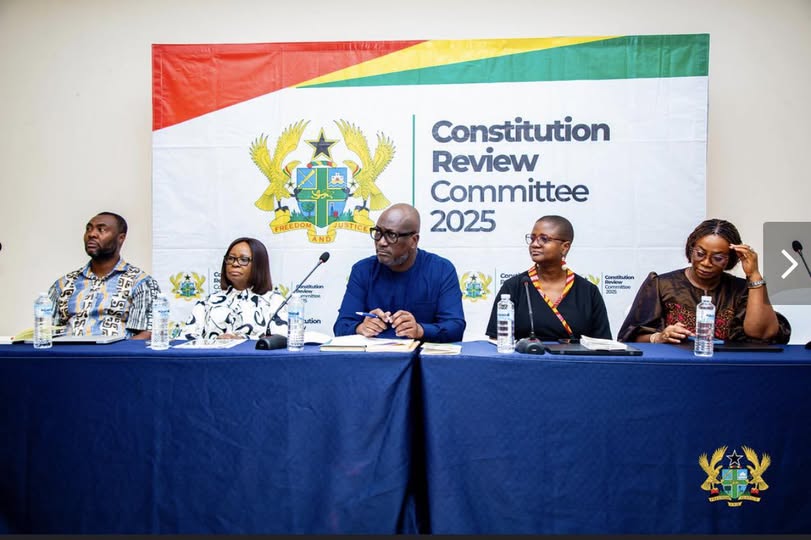
President John Dramani Mahama has received the final report of the Constitution Review Committee (CRC), marking a significant moment in Ghana’s ongoing effort to reform the 1992 Constitution.
The report lays out a broad range of proposed amendments aimed at strengthening democratic governance, improving institutional accountability, and modernising the country’s constitutional framework.
The eight-member committee, chaired by Professor Henry Kwasi Prempeh, submitted its findings after several months of nationwide consultations, expert analysis, and targeted stakeholder engagements.
The committee’s work reflects contributions from civil society groups, public institutions, and ordinary Ghanaians.
Among the key recommendations is a proposal to extend the presidential term of office from four years to five years.
The committee argues that a longer term would allow elected governments adequate time to design, implement, and consolidate long-term policies without the distraction of frequent election cycles.
While the proposal has drawn attention, the committee stressed that it did not recommend introducing a third term for presidents, noting that there was no constitutional need or public demand for such a change and affirming that President Mahama himself did not support it.
Another central recommendation seeks to clarify and reform the relationship between the executive and legislature by removing the current hybrid system in which ministers are drawn from Parliament.
Under this proposal, Parliament and the Executive would function with clearer constitutional separation, a move proponents say could strengthen checks and balances and reduce political conflicts of interest.
The CRC also proposed shifting the date of presidential elections from December to November. This adjustment is intended to extend the transitional period between administrations from one month to two, thereby providing a more structured handover process and reducing administrative disruption.
Proposals also address local governance structures. The committee recommended reforms that would allow for the phased introduction of direct elections for Metropolitan, Municipal, and District Chief Executives (MMDCEs).
The establishment of a Devolution Commission is suggested to oversee a gradual and benchmark-driven transition toward local elections, in place of an abrupt nationwide change.
A significant set of recommendations focuses on depoliticising key state institutions. The CRC suggested restructuring the Council of State to align it more closely with its original 1969 design, enhancing its role in advisory and co-guarantor functions, particularly with respect to presidential appointments. The intention is to strengthen the credibility and neutrality of appointment processes.
The report also proposes splitting the Commission on Human Rights and Administrative Justice (CHRAJ) into two separate bodies: one dedicated to human rights protection and another focused exclusively on anti-corruption matters. This change aims to sharpen institutional mandates and improve anti-corruption enforcement.
In a notable departure from existing provisions, the CRC recommended reducing the minimum age for presidential candidates from 40 to 30 years.
The committee argued that this amendment would expand political participation by aligning eligibility requirements with Ghana’s youthful demographic profile.
Additional proposed changes include subjecting the salaries, allowances, and facilities of holders of public office, including the president, to taxation and oversight by an Independent Public Emoluments Commission.
In his remarks following the submission, President Mahama described the report as timely and reflective of Ghana’s democratic aspirations.
He acknowledged that some of the recommendations are far-reaching and “revolutionary,” underscoring their potential to strengthen governance amid broader democratic challenges in the sub-region.
The president emphasised that his government will approach implementation in a bipartisan manner, working closely with all relevant stakeholders to advance the committee’s proposals.
Mahama also announced plans to establish an implementation committee in early 2026 to guide how the recommendations are translated into law and practice.
Some members of the review committee are expected to be part of this body to ensure continuity of institutional knowledge from the review process into the implementation phase.
The CRC’s report is now set to be published for public scrutiny, and its proposals will generate robust national debate.
Any constitutional amendments arising from the report must navigate legal requirements, including parliamentary supermajority thresholds and, for entrenched clauses, a national referendum with defined turnout and approval levels.