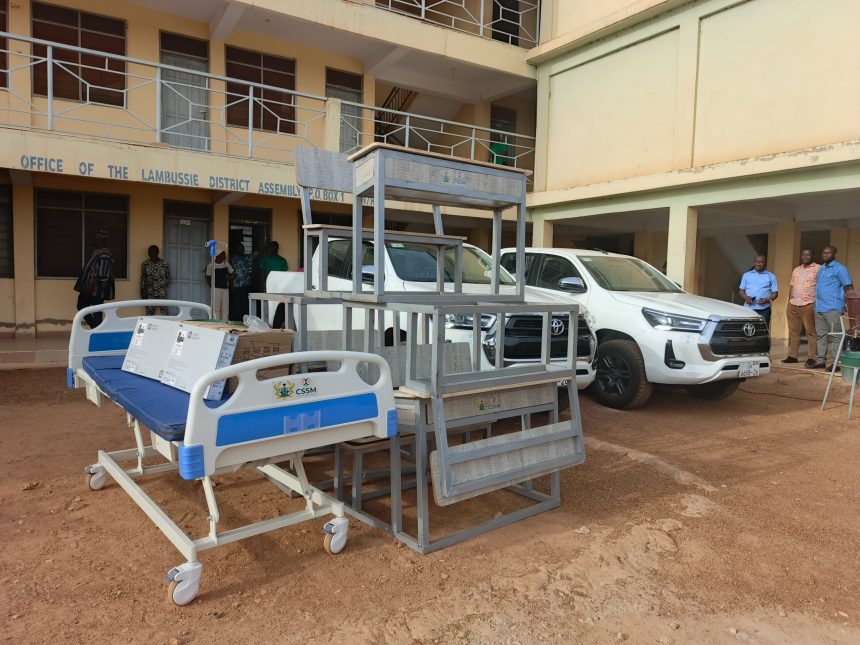
The Coastal States Stability Mechanism (CSSM), an initiative implemented by the International Migration Organization has supported the Lambussie District with vehicles, motorbikes and educational suppliers to strengthen security, health and improved education in the area.
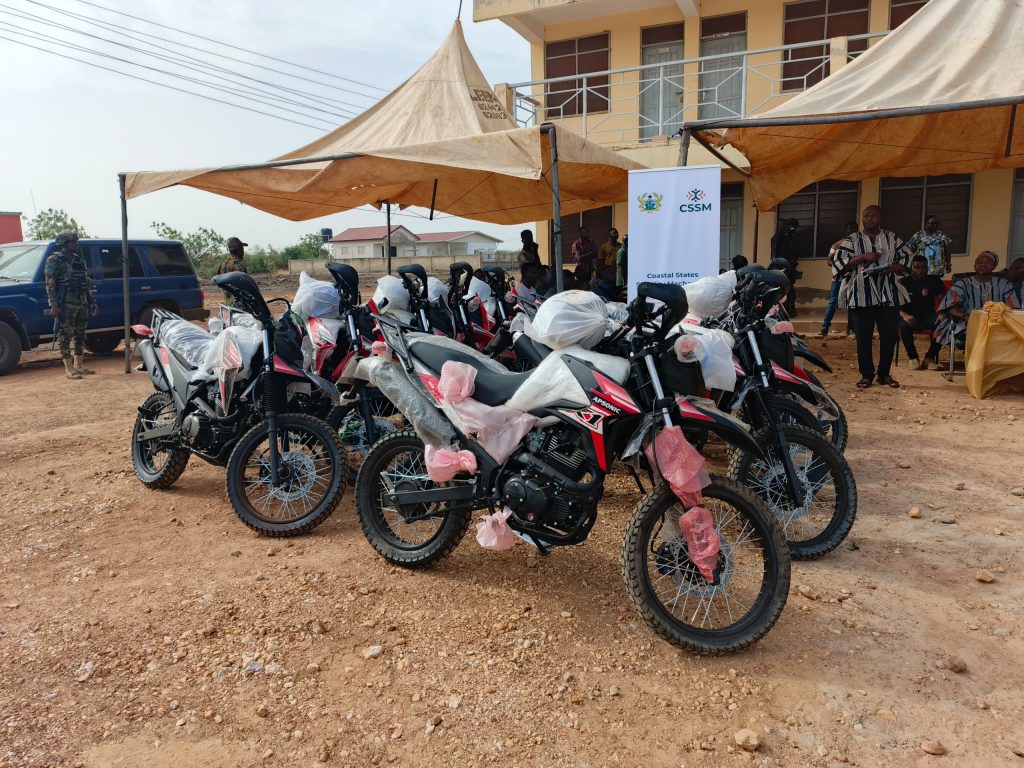
The CSSM donated two police patrol vehicles, ten Apsonic motorbikes, 680 dual desks, four laptop computers and some medical equipment for the Nabaala and Tapumu community-based Health Planning and Services (CHPS) compound.
The support reflected the leadership of the District Assembly’s commitment to strengthening state presence, improving service delivery, and responding to priority needs identified through community consultations.
The Coastal States Stability Mechanism (CSSM) is a $40 million U.S – German initiative (2023–2026) aimed at preventing the spread of violent extremism and fostering stability in northern Ghana, Benin, and Togo.
The German Federal Foreign Office, Netherlands Ministry of Foreign Affairs, and UK Foreign, Commonwealth and Development Office, funded the donation and implemented by the International Organization for Migration (IOM).
Mr Frederick Landshoeft, the German Ambassador to Ghana, who presented the equipment over to the Lambussie District said, under the Coastal States Stability Mechanism (CSSM) will make a real difference in the lives of residents.
Mr Landshoeft noted that the vehicles, motorbikes, and medical equipment meant mobility, access, and state presence.
He said: “When a health worker can reach a patient who was previously out of reach, that improves wellbeing. When a police officer can reach a remote community, that strengthens security and trust in the rule of law.”
He noted that results were already visible in the district, citing streetlights in Hamile and Suke that had improved night-time safety, desks supplied to schools, and health facilities being equipped to enhance quality healthcare delivery.
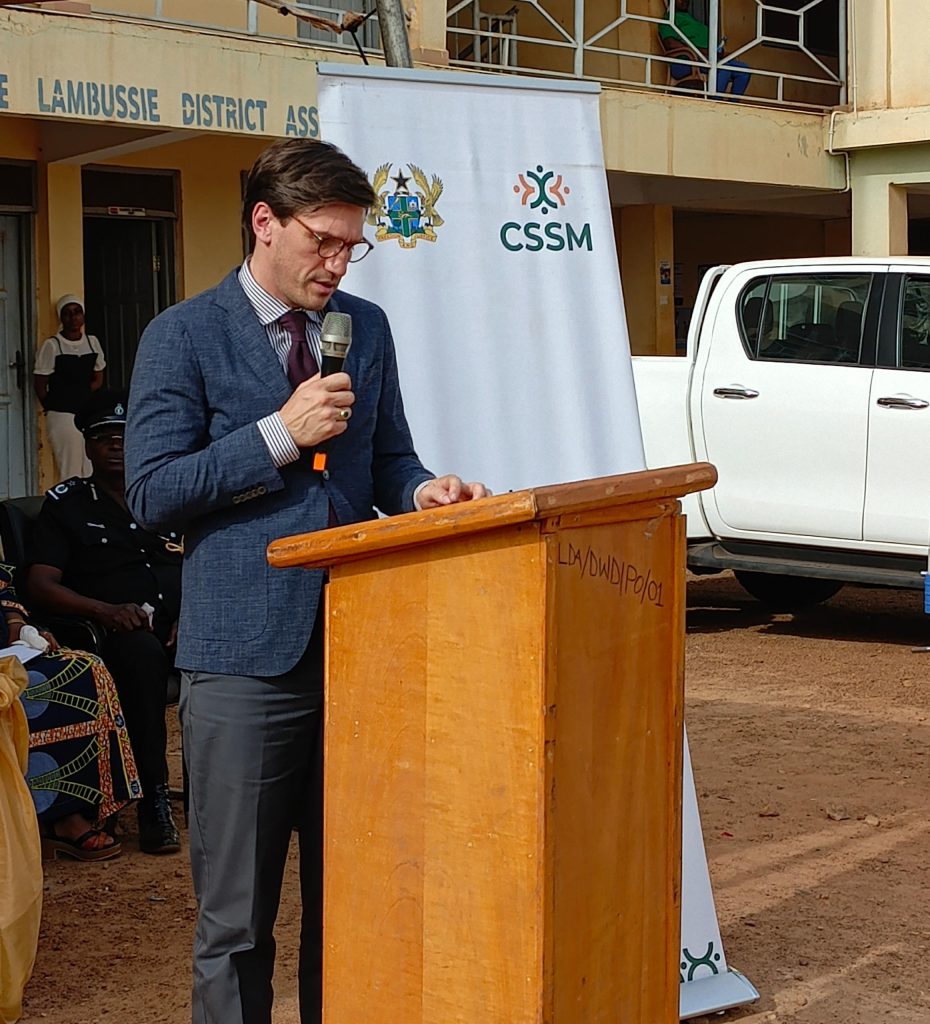
“These are tangible steps forward. They show that change is happening, not somewhere far away, but here, in people’s daily lives,” he added.
Mr Landshoeft stressed that resilience could not be delivered from the outside but must be built from within through communities, local and regional authorities, dialogue, and cooperation.
“What we see here today is not just delivery. It is the result of careful listening, joint planning, and building trust step by step,” he said.
He commended the CSSM for working closely with local and regional authorities and communities saying, “Germany is proud to support the effort with its partners”.
“This is not about bringing ready-made solutions. It is about working with you to strengthen what is already here,” he stated.
The Ambassador said stability in district like Lambussie-Karni was practical and depended on whether services reached people, institutions were visible, and cooperation worked.
Mr Landshoeft said Germany and Ghana shared a common interest in ensuring the region remained stable and resilient, with opportunities for livelihoods and the next generation.
“Today’s handover is one step in that direction. Not the first, and certainly not the last,” he said.
Mr Charles Lwanga Puozuing, the Upper West Regional Minister, described the handover as a reflection of partnership and shared vision to strengthen institutions and improve service delivery.
He said e CSSM had shown that development thrives where collaboration is strong, targeted, and responsive to real needs on the ground.
“Our partnership with CSSM has been deliberate and strategic, focusing on peacebuilding, institutional capacity, and community resilience,” he said.
He, therefore, charged the District Assembly to use the items strictly for their intended purpose, adding, “they are not ceremonial assets. They are tools for development, service delivery, and public good.”
Mr Naawulle Ireneous Basingbie, the Lambussie District Chief Executive, thanked the German Ambassador and the CSSM for the gesture, which demonstrated commitment to peace, stability, and development in the Region and the District.
He noted that the police vehicles would enhance patrols coverage and response capacity in hard-to-reach border communities, particularly Koro and Hamile, while the motorbikes would support District Assembly field supervision, revenue monitoring, and routine community engagement.
He emphasised that the 680 dual desks would also address critical furniture shortages in basic schools across the district, contributing to improved learning conditions and increased enrolment and retention.
Mr Basingbie, therefore, lauded the German Ambassador and the CSSM and assured them that the Assembly would monitor the use and maintenance of the items to ensure that the investment yielded positive results.
The CSSM is a multi-donor stabilisation initiative that works with governments and communities to reinforce locally accepted state presence in conflict-prone and border areas vulnerable to violent extremist influence.
Through targeted support, CSSM strengthens civilian security provision, improves basic service delivery, and supports community-led efforts to enhance resilience against violent extremism.
GNA