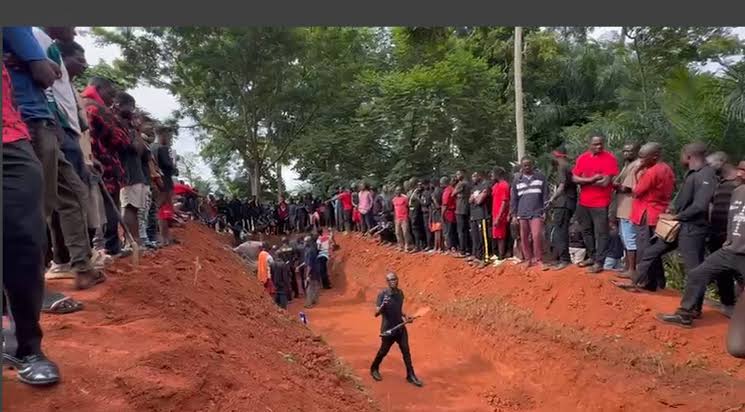
On Thursday, July 31, 2024, the usually lively town of Obogu, located in the Asante Akyem North Municipality of the Ashanti Region, stood still.
From the break of dawn, red and black cloths flooded the streets, dirges replaced laughter, and the air itself seemed heavy with grief.
Thousands gathered not for celebration, but to confront an unbearable reality; 16 young lives (youngest was 15 years old, and oldest was 25 years old), full of promise, had been wiped out in a single moment on Ghana’s roads.
They were sons and daughters, and church members returning from an annual event of their church; Saviour Church of Ghana, from the Eastern Region.
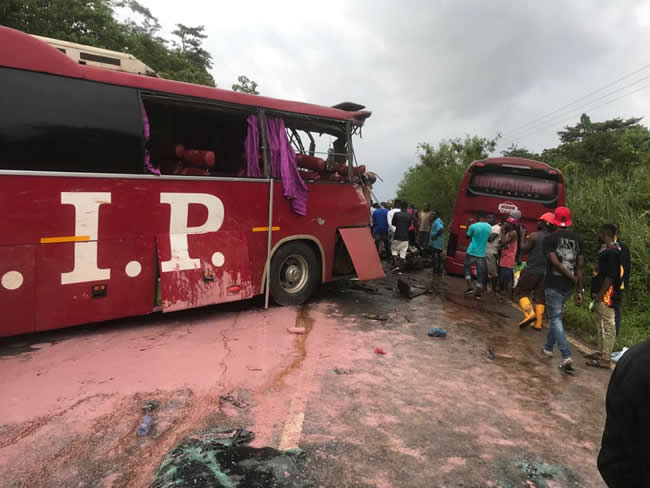
Instead, a collision between their bus and a fuel tanker on the Atwedie stretch of the Kumasi-Accra Highway near Juaso on Monday, July 28, 2025, ended their journey forever.
As the white-draped caskets were lowered side by side into the grave, parents collapsed, classmates wailed, and an entire community mourned not only the dead but the future that died with them.
A nation bleeding quietly on its roads
How many more young lives must Ghana bury before road safety becomes a national emergency? The tragedy at Obogu is not an isolated incident; it is part of a national crisis unfolding almost daily.
By November, this year, the National Road Safety Authority (NRSA) reported that an estimated 2,400 people had lost their lives through road crashes in the country.
Thousands more sustained life-altering injuries. These figures, often reduced statistics in official reports, represented broken homes, orphaned children, and communities stripped of their most productive members.
Each crash is a story like Obogu’s; sudden, violent and final. Despite the regularity of such tragedies, the country continues to treat road safety as a routine concern rather than a national emergency demanding urgent and systemic action.
The real cost beyond the numbers
The true cost of road crashes goes far beyond fatalities. Economically, Ghana loses millions of cedis annually through medical bills, emergency response, loss of productivity and long-term care for survivors with disabilities.
Socially, families are plunged into poverty when breadwinners die or are incapacitated. Children drop out of school.
Communities lose skilled youth and future leaders. Psychologically, survivors and bereaved families carry trauma that lingers for decades.
When an elder at Obogu, during the burial of the 16 young lives lost, lamented that “We have lost not just our children, but the very future of this town”, he captured the truth that applies to the entire nation.
Causes, clichés, and a cycle of inaction
Investigations into major crashes in Ghana often reveal familiar causes: speeding above required limits, poor vehicle maintenance, reckless driving, fatigue, overloading, weak enforcement of traffic laws and poorly designed or maintained roads.
Yet the official response rarely changes. After every major accident, duty-bearers repeat the same refrains; “drivers must be cautious”, “we urge road users to be disciplined”, “investigations are ongoing.”
These statements may offer momentary comfort, but they do not save lives. Ghana once showed ambition through the launch of the Traffitech initiative in 2023.
The Traffitech initiative, a collaboration between the Motor Traffic and Transport Department (MTTD) of the Ghana Police Service and the NRSA, was designed to use technology such as speed cameras, automatic ticketing and real-time monitoring to enforce road traffic laws.
During one of the regional sensitisation fora on the initiative in Bolgatanga in September 2023, Chief Superintendent Alexander Kwaku Obeng, Director in-charge of Education, Research and Training at the MTTD of the Ghana Police Service, said the Traffitech initiative would find the antidote to the increasing preventable crashes in the country.
Today, the Traffitech initiative appears to be stalled, buried under bureaucracy, resistance and lack of political will even as lives continue to be lost.
Chief Superintendent Obeng, in an interview with the Ghana News Agency on November 21, this year in Tamale on the status of the Traffitech initiative, said it would soon be rolled out.
Learning from Rwanda’s success
Rwanda offers a compelling contrast. Through its Automated Speed Enforcement System, which involves the strategic use of technology (static and mobile speed cameras) to detect speeding beyond allowable limits and spot fines for offenders, the country has drastically reduced road crashes and fatalities by over 30 per cent monthly.
Speed cameras, red-light enforcement systems, automatic fines, mandatory road safety education and a culture of accountability have transformed driver behaviour in Rwanda.
Enforcement is consistent, but not selective. Technology removes human discretion and corruption from the process. Ghana’s Trafitech initiative envisioned a similar system, one that aligns perfectly with Rwanda’s model.
If the Traffitech initiative is implemented effectively, it could curb speeding, deter reckless driving, improve compliance with traffic laws, and ultimately save thousands of lives annually.
A call beyond mourning
Obogu will never forget July 31, 2025. The pain etched into its memory is now part of the country’s broader road safety narrative.
However, remembrance alone is not enough. Ghana must move beyond condolences and rhetoric to decisive action.
Implementing the Trafitech initiative fully and transparently, backed by strong political commitment and public education, is no longer optional; it is moral imperative. Rwanda has shown that road deaths are preventable, but not inevitable. If Ghana truly values her youth, her future, and the lives of her citizens, then the time to act is now before the next town is plunged into mourning and the next 16 coffins are lowered into the ground