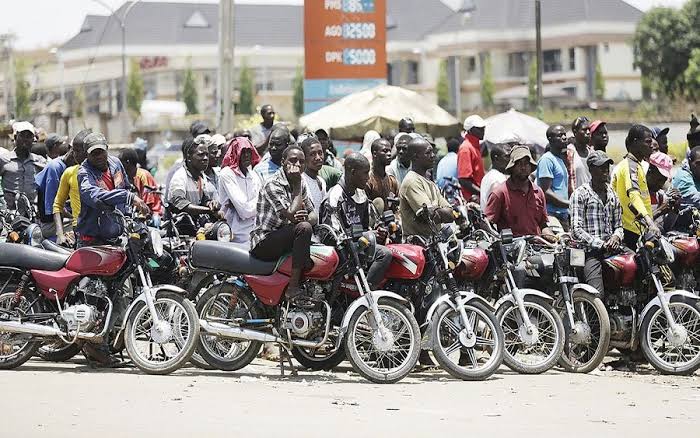
Ghana has legalized the commercial use of motorcycles, known as okada, after Parliament approved the Road Traffic Amendment Bill 2025. The decision marks a major shift in transport policy and brings an end to years of prohibitions that pushed the sector into a legal grey zone.
The new law formally recognises motorcycles, tricycles and quadricycles as commercial passenger vehicles. Government officials say this will allow the state to regulate an already booming sector, improve safety standards and create predictable rules for both riders and passengers.
The licensing and regulation of okada operations will be overseen by the Driver and Vehicle Licensing Authority. Although detailed regulations will be issued in stages, officials have outlined the core requirements.
Firstly, riders will need a specific class of licence permitting them to operate a motorcycle for commercial transport. This is expected to involve mandatory training, written tests on road traffic laws and a practical riding assessment.
Motorcycles used for passenger transport will have to be registered as commercial vehicles. This includes displaying distinct number plates and identification markings so passengers and regulators can easily verify them.
Riders will be required to use protective gear such as numbered helmets, reflective vests and proper lights. Passengers must also be provided with approved helmets.
Commercial motorcycles will need enhanced insurance to cover passengers, similar to what trotro and taxi operators already carry.
Riders will be subject to regular inspections to ensure roadworthiness, adherence to speed limits and compliance with traffic rules. The law also stiffens penalties for drunk riding and other high-risk behaviour.
Officials say enforcement will be phased to allow riders to adjust, but the long-term aim is a fully regulated system similar to other transport modes.
Ghana’s decision places it among a growing number of African countries attempting to formalise motorcycle taxis rather than ban them.
Nigeria offers a mixed picture. Some states such as Lagos have imposed outright bans or heavy restrictions on okada due to safety concerns, congestion and crime. Others have regulated them with licensing, identification jackets and union oversight. Ghana’s nationwide legalisation contrasts with Nigeria’s state-by-state patchwork.
Rwanda is often cited as a model for regulating motorcycle taxis. Riders must undergo training, carry passenger insurance and use helmets with visible identification numbers. The country also uses digital meters to standardise fares. Ghana’s framework is broadly similar, though less technologically driven at this stage.
Kenya legalised boda bodas years ago but has faced persistent problems with enforcement. Despite a licensing regime, many riders operate informally. Ghanaian officials believe their phased introduction of training, licensing and strict penalties will avoid Kenya’s enforcement gaps.
Uganda relies heavily on motorcycle taxis. Attempts to regulate them have had mixed success, with safety concerns still high. The country’s experience highlights the challenge Ghana will face: writing rules is straightforward; consistent enforcement is not.
Sierra Leone and Liberia
Both countries have legalised motorcycle taxis but continue to struggle with accidents and inadequate enforcement. Their approach underscores the importance of training and reliable record-keeping, which Ghana hopes to strengthen through DVLA oversight.
The amended law now awaits presidential assent before implementation begins. The government says licensing, training and inspections will roll out gradually to reduce disruption for riders who have long depended on okada work for income.
Supporters see legalisation as an economic and social win that brings order to a key transport sector. Critics argue that success will depend entirely on enforcement, given the high rate of motorcycle injuries and deaths recorded in recent years.
Ghana’s approach is aimed at balancing safety with economic opportunity. Whether the new system achieves that balance will depend on how rigorously authorities regulate an industry that, for many years, operated outside the law.