
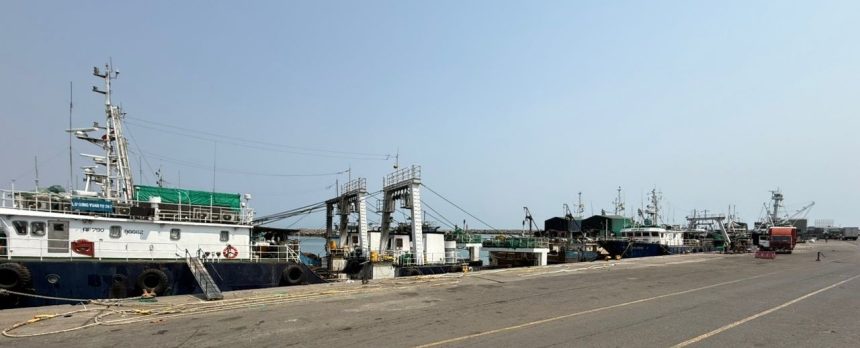
Mr. Richster Amarh Amarfio, the Vice President of the National Fisheries Association of Ghana (NAFAG), has warned that Ghana’s industrial fisheries sector faces an imminent collapse due to the interpretation and implementation of the expansion of the Inshore Exclusive Zone (IEZ).
Mr. Amarfio told the Ghana News Agency (GNA) that the current interpretation of the Fisheries and Aquaculture Act, 2025 (Act 1126), had effectively halted industrial fishing operations, particularly trawl vessels, many of which are now laid up at the ports and unable to fish.
He explained that under the new interpretation, Ghanaian-flagged industrial vessels were restricted beyond the 12 nautical mile zone, making it practically impossible for them to operate within Ghanaian territorial waters.
“By operational definition, Ghana’s territorial waters extend only to 12 nautical miles under the United Nations Convention on the Law of the Sea. The area beyond that, up to 200 nautical miles, is the Exclusive Economic Zone (EEZ), not territorial waters,” he stated.
Mr. Amarfio said legislating Ghanaian-flagged vessels outside the 12 nautical mile limit effectively barred them from legally operating in Ghanaian waters, thereby crippling the industrial fisheries sector.
He noted that Ghana’s industrial fisheries sector comprised two main segments: the tuna industry and industrial trawl fisheries.
He said: “Ghana currently operates 17 purse seiners and 20 pole-and-line tuna vessels, making the country one of the leading contracting parties in tuna fishing within the Atlantic Ocean.”
Additionally, Ghana has about 45 active Ghanaian-flagged industrial trawl vessels owned by Ghanaian companies, which collectively provide significant employment and contribute to the national economy.
Mr Amarfio said the controversy arose following the introduction of Act 1126 late last year, where Section 40 was interpreted to designate an Inshore Exclusive Zone of 12 nautical miles without following the procedural requirements set out in the law.
He explained that the Act required the Minister, upon advice from the Fisheries Commission and in consultation with relevant stakeholders, to designate the IEZ through a gazette after due process, including scientific assessment.
However, he said the law went further to unilaterally designate the 12-nautical-mile zone without fulfilling those conditions.
The industrial sector, he said, raised issues about the new IEZ, which was then six nautical miles, citing comparable IEZs in other West African countries and the absence of scientific justification for the expansion.
Mr Amarfio said several petitions were submitted to Parliament and the Presidency, warning of the potential economic and operational implications of the new IEZ, especially since it was not supported by scientific research.
He disclosed that because of the current situation, all industrial trawl vessels were now laid up at the Tema port, unable to fish in the designated areas, while 19 out of the 20 pole-and-line tuna vessels had completely collapsed and ceased operations.