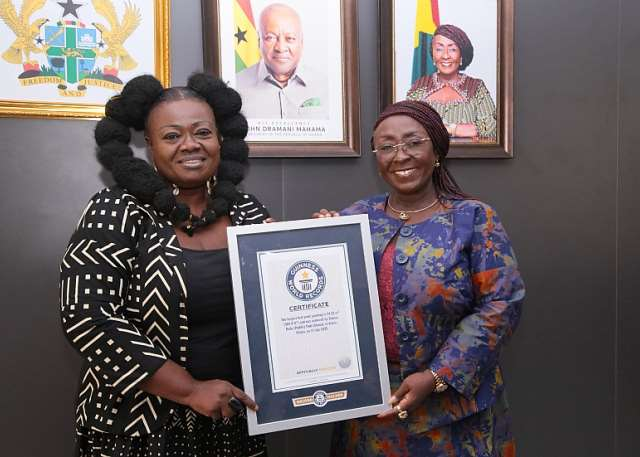
Guinness World Record holder and visual artist, Ms Sharon Dede Padi, on Friday presented her certificate for the largest leaf-print painting to Madam Abla Dzifa Gomashie, the Minister of Tourism, Culture and Creative Arts.
Ms Padi earned the global record after creating a 54.33 square-metre leaf-print painting of the Ghana Flag within 33 hours.
She used natural leaves sourced across the country, including cocoyam, plantain, cassava, cocoa, coffee, shea, orange, and lemon.
She said the achievement followed an unsuccessful attempt at a painting marathon in March 2024, after which she pursued and secured approval for the leaf-print category.
Ms Padi said in July 2025, she submitted evidence of the completed work and received official confirmation on December 9, becoming the first person in the world to hold the title.
She revealed that plans were underway for a press conference on February 19, an exhibition integrating leaf-print art with Ghanaian culture, poetry, and music, the production of a coffee-table booklet for tourism facilities, and a miniature version of the artwork.
She appealed for the Ministry’s support to explore mounting the piece as a national monument at a suitable tourist site, expressing her willingness to donate it to the nation.
Madam Gomashie congratulated the artist for the feat and praised the choice of the Ghana Flag as the central motive, describing it as a unifying national symbol.
She commended the project’s strong conceptual foundation and its role in preserving indigenous knowledge on food systems, medicine, and biodiversity, noting that many traditional edible and medicinal leaves were gradually disappearing from public use.
The Minister encouraged Ms Padi to document and categorize the leaves into; edible, medicinal, ornamental, or unknown, highlighting the economic potential for gastronomy, cultural enterprise, and sustainable development.
She advised that preservation should guide decisions on public display, recommending indoor venues or carefully selected tourist sites to protect the artwork from weather damage.
Madam Gomashie urged Ms Padi to submit a written proposal outlining possible areas of collaboration, with the assurance that while the Ministry focused on policy, it worked closely with relevant agencies and partners to achieve its objectives.
Guinness World Record holder and visual artist, Ms Sharon Dede Padi, on Friday presented her certificate for the largest leaf-print painting to Madam Abla Dzifa Gomashie, the Minister of Tourism, Culture and Creative Arts.
Ms Padi earned the global record after creating a 54.33 square-metre leaf-print painting of the Ghana Flag within 33 hours.
She used natural leaves sourced across the country, including cocoyam, plantain, cassava, cocoa, coffee, shea, orange, and lemon.
She said the achievement followed an unsuccessful attempt at a painting marathon in March 2024, after which she pursued and secured approval for the leaf-print category.
Ms Padi said in July 2025, she submitted evidence of the completed work and received official confirmation on December 9, becoming the first person in the world to hold the title.
She revealed that plans were underway for a press conference on February 19, an exhibition integrating leaf-print art with Ghanaian culture, poetry, and music, the production of a coffee-table booklet for tourism facilities, and a miniature version of the artwork.
She appealed for the Ministry’s support to explore mounting the piece as a national monument at a suitable tourist site, expressing her willingness to donate it to the nation.
Madam Gomashie congratulated the artist for the feat and praised the choice of the Ghana Flag as the central motive, describing it as a unifying national symbol.
She commended the project’s strong conceptual foundation and its role in preserving indigenous knowledge on food systems, medicine, and biodiversity, noting that many traditional edible and medicinal leaves were gradually disappearing from public use.
The Minister encouraged Ms Padi to document and categorize the leaves into; edible, medicinal, ornamental, or unknown, highlighting the economic potential for gastronomy, cultural enterprise, and sustainable development.
She advised that preservation should guide decisions on public display, recommending indoor venues or carefully selected tourist sites to protect the artwork from weather damage.
Madam Gomashie urged Ms Padi to submit a written proposal outlining possible areas of collaboration, with the assurance that while the Ministry focused on policy, it worked closely with relevant agencies and partners to achieve its objectives.