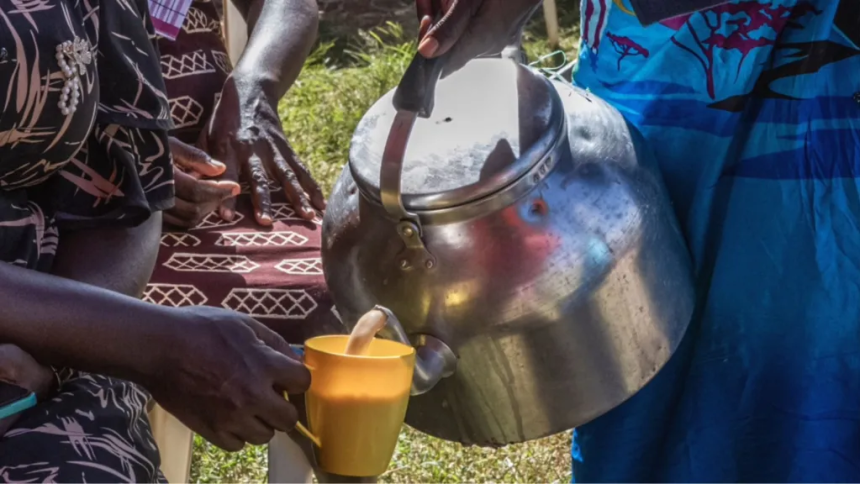
Kenyans love their milky tea, or chai, but some are facing the worrying possibility of doing without as the country has been hit by a milk shortage.
A breakfast here is often incomplete without a cup of chai, made by boiling tea in generous amounts of milk, sometimes flavoured with ginger and spices. It is often served at meetings and during social visits, with many people taking the hot brew several times a day.
But now some may have to do without as supermarket chilled sections are nearly empty. Retailers have upped the price and are limiting how much shoppers can take home.
The government has put the dearth of milk in recent months down to drought, which has significantly reduced pasture and hampered production.
But the recent shortages are unusual, with the country’s industry regulator itself admitting to “supply constraints” and “low stock levels” across the country.
Muthoni Macharia, who runs a restaurant in the capital, Nairobi, usually buys more than 70 packets of fresh milk – and is desperate and puzzled by the scarcity.
“Where has the milk gone?” she asked when the BBC spoke to her as she was out searching for at least a few packets to quench her customers thirst for chai.

Macharia says there have been shortages for about a week – and it was especially affecting her morning rush hour. Her regulars are not happy: some opting to take their tea black – but many will not.
“If they come in groups, and there’s no milk tea, you see that’s a loss for me,” she said.
Kenya is one of the leading milk producers on the continent.
A long-established commercial dairy industry has led to pasteurised milk being very popular, particularly in urban areas, with Kenyans ranked among Africa’s highest consumers, according to industry data.
Raw and fermented milk is more widely drunk in rural areas.
The milk shortage has sparked widespread public concern with some people promoting unfounded conspiracy theories about supermarkets deliberately trying to profit.
According to the Kenya Dairy Board (KDB), the government body that oversees the dairy sector, formal milk deliveries to processors fell by 3.7% from 84.4 million litres in June to 81.3 million litres in July, while preliminary investigations suggest deliveries declined further in August.
The Consumer Federation of Kenya (Cofek) says there has been a downward trend of supply since the beginning of the year.
It attributes this to a delay in the seasonal rains, which has reduced the grazing ground available, coupled with a 45% rise in the cost of animal feed.
Cofek has expressed concern over the rationing as well as the increasing cost, saying fresh milk prices have risen from 70 to 80 Kenyan shillings ($0.54 to $0.62; £0.40 to £0.46) a litre.
“This shortage was foreseeable, and in material part, avoidable,” it says.

The consumer body says dairy processor New KCC, a state-owned company, and the KDB did not adequately absorb the milk surplus last year, adding that powder processed from the excess milk would have helped resolve the current crisis.
Some of the milk processors in Kenya often reconvert the powder into the more-preferred liquid milk during dry seasons when the supply of fresh milk goes down.
“Had these buffers been in place, today’s supply shock would have been substantially cushioned,” Cofek says.
It has demanded a recovery plan to include fodder and subsidy support for farmers.
This would include waiving of taxes on animal feed inputs, as well as “active retail price monitoring to deter opportunity price gouging and rationing”.
In response to media enquiries, the dairy board’s managing director William Maritim assured that despite the “temporary supply constraint”, milk continued to be available.
Fresh pasteurised milk, which has a shorter shelf life, had been more affected than the more long-life UHT milk, he said.

Customers at Nairobi supermarkets on the hunt for milk told the BBC they were worried about rising costs.
“Sometimes when I go to the supermarket I find there is none. When I do find some, the price has gone up. Today it is this price, tomorrow it has gone up again,” said Bernard Abok, who does his shopping after finishing work.
Patricia Gathoni said if the prices kept going up she would have to rethink what she gave her children, saying she had resorted to adding water to the milk that she managed to buy.
On Thursday, agriculture ministry officials held a meeting with the association of dairy processors about the problem, with the ministry committing to support farmers, stabilise milk supply and protect consumers.
The ministry’s top official in charge of livestock development, Jonathan Mueke, said the immediate focus was to get more feed for farmers, including through duty-free importation of yellow maize.
He said they were also looking at longer-term solutions that would manage stability across periods when there was surplus milk and when there were shortages.
Reports of milk going to waste are not uncommon during periods of a dairy glut. Farmers have often complained about how little they are paid for their perishable produce at such times – but they have few options because of limited processing or storage capacity.
According to Mueke, the government is considering setting up a fund to help support the preservation of milk during such periods.
In the meantime, the government is also considering temporarily importing milk from the neighbouring countries to ease the shortage.
For the devoted Kenyan chai lover, that may offer some respite.