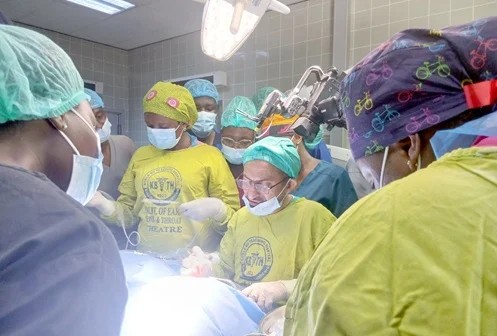
The Ear, Nose, and Throat (ENT) department at Korle Bu Teaching Hospital has successfully performed a series of rare surgeries aimed at restoring hearing for five individuals ranging in age from seven months to 20 years.
The procedure, known as cochlear implant surgery, involves the placement of an electronic device designed to restore sound perception in individuals with severe-to-profound hearing loss.
Once the implant is in place, an external device enables hearing in the affected ear. Though groundbreaking, the surgery remains relatively uncommon in Ghana.
The total cost of the procedures and devices, estimated at $22,000 per patient, was fully covered by Qatar Charity Ghana.
The organisation also facilitated the visit of the lead surgeon, Professor Abdulkareem K. Al-Balasi, a renowned Senior ENT and Cochlear Implant Consultant at the Faculty of Medicine, Dhamar University in Yemen.
Professor Al-Balasi worked alongside a multidisciplinary team from Korle Bu, including otologists, audiologists, speech and language therapists, ENT and theatre nurses, and anesthesiologists.
Speaking to journalists following one of the successful surgeries last Tuesday, Jemima Fynn, Chief Audiologist at the hospital’s Hearing Assessment Centre, emphasised the profound impact of hearing loss in children.
“It is more debilitating because it hinders optimal development, affecting language acquisition, psychological growth, and social and economic potential,” she said.
Fynn explained that hearing loss in children can result from complications at birth, trauma, infections, or neonatal jaundice.
Early detection is crucial for timely intervention, but she noted that Ghana faces challenges due to a lack of diagnostic equipment.
“Most of the time, by the time children are brought in, they are about three or four years old. They’ve already lost critical time, and the impact is severe,” she added.
According to Fynn, cochlear implant surgeries began in Ghana in 2021, and the hospital has since treated about 22 patients.
She noted that patients typically bear the cost themselves, often through private fundraising or out-of-pocket payments, since all equipment must be imported.
She expressed gratitude to Qatar Charity Ghana for sponsoring the five patients, all of whom are from Tamale.
Dr. Abubakar Inusah Hudu, Health Project Coordinator for Qatar Charity Ghana, said the organisation has supported various health initiatives, including heart and eye screenings, as well as cataract surgeries for about 100 patients at Madina Polyclinic.
“Islam encourages supporting the underprivileged. By helping these children, we are fulfilling that calling,” he said.
Professor Al-Balasi, internationally recognised for his expertise in cochlear implant surgery, noted that the device would be activated by an audiologist one month after the procedure.
He stressed that the success of the implant heavily depends on postoperative rehabilitation, including ongoing therapy with speech and language specialists and audiologists.
“This follow-up care is essential for patients to gain the maximum benefit from the device,” he explained.