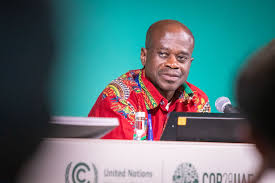
From the corridors of global climate negotiations to the policy rooms shaping Ghana’s adaptation agenda, Nana Dr Antwi-Boasiako Amoah, Director in charge of Climate Vulnerability and Adaptation at Climate Change Department, Environmental Protection Authority (EPA), emerges as one of Africa’s most experienced and influential climate policy figures.
Now, he carries one of the continent’s most strategic responsibilities: leading Africa’s coordination in international climate change negotiations.
In line with the African Group of Negotiators’ (AGN) sub-regional rotational mandate, Ghana assumed the Chairmanship of the AGN from January 2026 to December 2027, placing the country at the centre of Africa’s climate diplomacy.
At the helm is Nana Dr Amoah, whose career has been shaped by nearly two decades of service in climate policy, diplomacy, and youth capacity development.
The AGN is the formal platform through which African countries coordinate and advance a unified position under the United Nations Framework Convention on Climate Change (UNFCCC). Established to strengthen Africa’s collective bargaining power, the AGN plays a critical role in shaping negotiation strategies on issues such as adaptation, climate finance, loss and damage, technology transfer, capacity building and transparency.
The group ensures that Africa’s priorities are not fragmented across multiple national delegations, but aligned into a single continental voice, particularly in negotiations where major global decisions are made.
In practice, the AGN provides technical guidance, convenes coordination meetings, develops common positions and briefs African ministers and heads of state ahead of key climate summits.
Leading the AGN is therefore not only a position of prestige, but one of strategic influence, requiring technical depth, political tact, and continental credibility.
Dr Amoah’s selection reflects Ghana’s growing stature in multilateral climate processes and his own longstanding engagement in climate negotiations.
Dr Amoah provides strategic oversight for national adaptation planning, policy integration, and implementation. His work has placed him at the heart of Ghana’s climate resilience agenda, ensuring that national policies reflect the country’s commitments under the Paris Agreement and other international frameworks.
He is a key coordinator of Ghana’s National Adaptation Plan (NAP), one of the most important instruments for helping countries identify climate vulnerabilities and implement long-term resilience strategies.
His leadership has ensured that adaptation planning is not treated as an isolated technical exercise, but as a core development priority tied to livelihoods, agriculture, health, and infrastructure.
In global negotiations, Dr Amoah has been a leading voice on adaptation. He has served as a Lead Negotiator for the G77 and China on National Adaptation Plans within the UNFCCC process, coordinating one of the largest groupings of developing countries. That role has required balancing diverse national interests while advancing shared demands for fairness and climate justice.
His work also extends into Ghana’s Nationally Determined Contributions (NDC) implementation, National Communications, and Biennial Transparency Reports (BTRs), key reporting and accountability tools under the UNFCCC system.
These processes demand both technical competence and institutional coordination, reinforcing Dr Amoah’s reputation as a climate policy professional who combines scientific grounding with governance expertise.
Academically, Dr Amoah’s career reflects strong international and local training. He holds a Doctor of Philosophy (PhD) degree from the University of Ghana and a Master of Science in Environmental Science from Lund University in Sweden. He also earned an Executive Master of Business Administration (EMBA) from the University of Ghana Business School, strengthening his capacity to engage the economic and governance dimensions of climate policy.
Beyond national work, Dr Amoah has become a recognised authority in climate governance and multilateral financing.
He currently serves on the Board of the Green Climate Fund (GCF), one of the world’s most important climate finance institutions supporting developing countries to implement mitigation and adaptation projects.
His leadership is also anchored in mentorship and education. Since 2019, he has served as a part-time lecturer at the Centre for Climate Change and Sustainability Studies at the University of Ghana, teaching and supervising graduate research.
Colleagues describe him as a passionate believer in youth development, particularly in preparing the next generation of African climate negotiators.
Yet, Dr Amoah’s identity is shaped not only by institutions and global platforms. He is also a traditional leader. He is legally enstooled as the Dwoamin Nifahene of the Kokofu Traditional Council, with the stool name Nana Antwi-Boasiako Amoah. This dual role as a technocrat and a chief, gives him a unique cultural grounding, connecting the global climate agenda to the realities of local communities.
As Chair of the AGN, Dr Amoah is expected to steer Africa’s negotiation strategy ahead of major UN climate milestones, including upcoming Subsidiary Body sessions and COP31.
With climate impacts intensifying across the continent and demands for climate finance and implementation growing louder, his chairmanship places Ghana at the forefront of Africa’s efforts to secure a fairer and more accountable global response.
For Dr Amoah, the task ahead is not simply diplomatic representation. It is about ensuring that Africa’s voice is coordinated, technically grounded, and politically heard — and that the decisions made in international negotiating halls translate into real resilience for African communities.