
Oil prices have fallen after US President Donald Trump said negotiations to end the war were progressing, while Iran said “non-hostile” vessels could pass through the Strait of Hormuz.
Brent crude fell by 5% to just under $100 (£74.62) a barrel on Wednesday.
Trump said on Tuesday that talks to end the war were happening “now” and that the people the US were in discussions with “want to make a deal so badly” – a claim disputed by Iranian officials.
Tehran officials dismissed claims of such talks as “fake news”, with a Foreign Ministry spokesman saying on Tuesday that “no one can trust US diplomacy.”
The spokesman, Esmail Baghaei, said in an interview with India Today: “Can anyone believe their claims of diplomacy or mediation are credible when they started this war and continue attacking us?”
Officials in Tehran on Monday said that claims of talks between the US and Iran as “fake news”, as strikes between Israel and Iran continued to be exchanged.
Trump said Vice President JD Vance and Secretary of State Marco Rubio were involved in the discussions to end the war.
The president added that the US-Israeli strikes on Tehran have led to “regime change”, repeating his claim that Iranian leaders have agreed that they will never have a nuclear weapon.
But Tehran has previously rejected claims that it had been in contact with the US, calling it an attempt to manipulate markets.
The New York Times, Reuters news agency and Israel’s Channel 12 have reported that the US has handed over a 15-point plan to Iran, citing unnamed sources.
Channel 12 said the US’ demands included the Strait of Hormuz being opened and that it would be recognised as a free maritime zone.
It also detailed what Iran would receive if it accepted the plan, including the removal of sanctions, according to Channel 12.
The BBC has not seen the document and is working to verify the reports.
In a message posted by its mission to the United Nations (UN), Iran said “non-hostile vessels” will be allowed to pass through the Strait of Hormuz, provided they coordinate with “the competent Iranian authorities”.
The statement came after some countries appeared to have negotiated safe passage for their vessels despite Tehran threatening to target ships that tried to use the channel.
The Iranian UN mission said on X that ships could have safe passage “provided that they neither participate in nor support acts of aggression against Iran and fully comply with the declared safety and security regulations”.
Meanwhile, Iran and Israel continue to exchange missile strikes across the Middle East.
Major stock exchanges in the Asia Pacific gained in morning trade as investors weighed developments in the Middle East.
Japan’s Nikkei 225 and South Korea’s Kospi indexes each rose by more than 2%. Both countries are heavily reliant on oil that passes through the Strait of Hormuz.
Australia’s ASX 200 index was up by more 1.8%.
Hong Kong’s Hang Seng exchange and Shanghai’s composite each gained by around 1%.
In the UK, the FTSE 100 traded more than 1% up after opening while Germany’s Dax climbed around 1.5%.
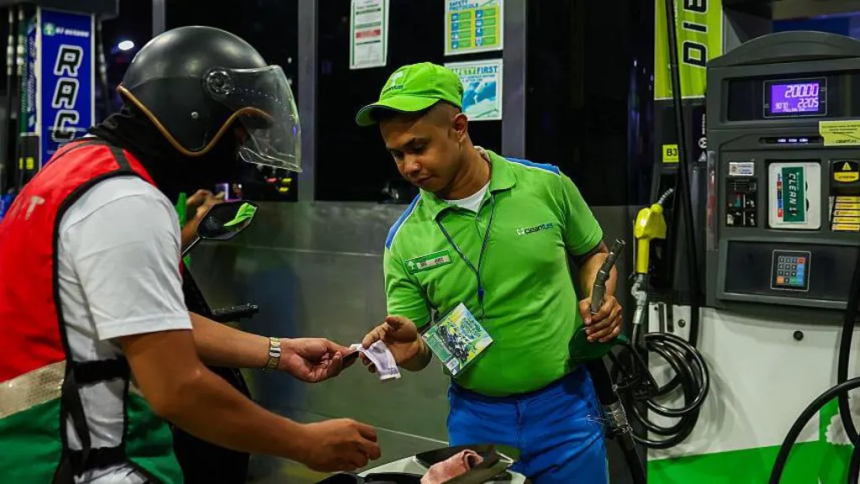
Energyprices have soared since the war started, as Iran has effectively blocked the Strait of Hormuz, a narrow waterway which usually sees about 20% of the world’s oil and liquefied natural gas pass through each day.
Even after the latest falls, oil prices remain much higher than before the US and Israel launched attacks on Iran on 28 February.
Governmentsaround the world have announced measures aimed at easing the impact of rising oil priceson their economies, while the heads of some of the world’s biggest companies have warned about the potential implications of the war.
On Tuesday, the boss of energy giant Shell said oil shortages could hit Europe next month.
Wael Sawan, chief executive of Shell, told an energy industry conference in Houston: “South Asia was first to get that brunt. That’s moved to South East Asia, North East Asia and then more so into Europe as we get into April.”
Larry Fink, the boss of US financial giant BlackRock, told the BBC that a global recession could be triggered if the price of oil hits $150 a barrel.