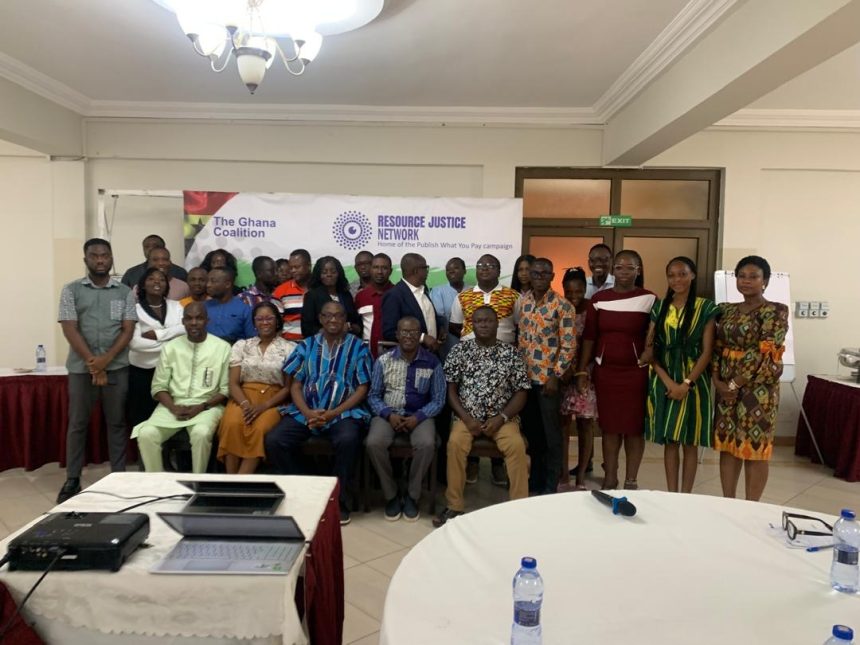
Members of the Resource Justice Network (RJN)–Ghana have convened a national annual workshop, aimed at prioritising the Network’s 2026 annual advocacy programmes in natural resource governance and enhancing marginalised groups’ share in Ghana’s oil revenues.
The meeting, held in Accra, brought together RJN–Ghana members to deliberate on the goals of the Network’s campaign in Ghana and to validate a research report examining Gender Equity and Social Inclusion (GESI) in the application of Ghana’s Annual Budget Funding Amount (ABFA).
The workshop also sought to discuss and prioritise a clear country-level focus for RJN–Ghana, while reviewing policy gaps related to resource exploitation and equitable distribution of benefits.
Key discussions during the workshop focused on the governance of extractive resources, gender equity and social inclusion in the utilisation of oil revenues, and the need for stronger community participation and accountability mechanisms.
A major highlight of the convening was the validation of the GESI–ABFA research report, which assessed how Ghana’s oil revenues are being allocated and whether they adequately address gender and social inclusion concerns.
Mr Sam Danse, the Executive Director of the Integrated Social Development Centre (ISODEC), thanked participants for honouring the invitation and outlined the objectives of the RJN-Ghana validation workshop.
Mr Danse explained that the research sought to examine gaps in policy and practice related to Gender Equality and Social Inclusion (GESI) in the allocation and disbursement of the Annual Budget Funding Amount (ABFA).
He emphasised that equity and social inclusion were essential to addressing persistent inequalities in the management of natural resource revenues, particularly oil revenues, over the years.
Mr Danse said “GESI principles are central and should be used to benchmark and track disbursement allocations …” adding that the report provided a platform for members of the RJN- Ghana to amplify their voices, to ensure accountability of MMDA, and use DACF to implement initiatives that were gender and social protection-inclusive.
He encouraged the network members to peruse the research and its findings and ensure that the six policy prescriptions or recommendations become an integral part of their work in 2026 going forward.
Mr Benard Anaba, coordinator of RJN-Ghana, observed that despite Ghana’s natural resource wealth, poverty and inequality remain high.
Weak governance and limited attention to gender equality and social inclusion reduced the development impact of resource revenues, he said.
Mr Anaba was worried that environmental degradation from extractive activities continued to harm communities, while oil and mineral revenues did not sufficiently address social inequalities.
He added that the meeting was to further strengthen collaboration among network members to advance advocacy efforts for resource justice.
He anticipated enhanced community participation and greater accountability in the management and utilisation of Ghana’s natural resources.
Contributing to the discussion, Dr Eben Anuwa- Amarh, Technical Advisor for the District Assemblies Common Fund (DACF), stated that President John Dramani Mahama has issued specific directives aimed at strengthening the management, allocation, and timely release of the District Assemblies Common Fund (DACF).
Mr Anaba said these directives were intended to improve transparency, efficiency, and accountability in the disbursement process, ensuring that funds reach the various Metropolitan, Municipal, and District Assemblies without unnecessary delays.
He further explained that the President’s instructions were focused on streamlining administrative procedures and ensuring that allocations were distributed fairly and in accordance with established guidelines.