Dr Dominic Ayine, the Attorney-General and Minister of Justice, says 16 dockets linked to the government’s Operation Recover All Loots (ORAL) initiative are under review.
He said no case under the programme had been compromised, contrary to reports in sections of the media.
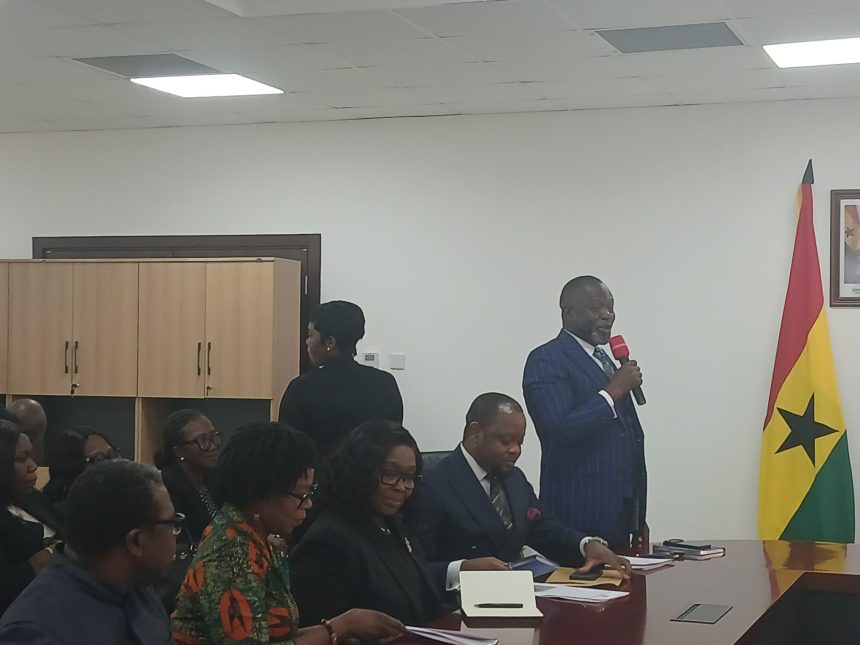
Speaking during a visit by Vice-President Professor Jane Naana Opoku-Agyemang to the Office of the Attorney-General and Ministry of Justice, Dr Ayine assured the public that his office had not entered into any plea negotiations or deals with persons implicated in ORAL-related offences.
“No docket has come here that has been compromised in any way. No deal, no plea arrangement has been entered into with anybody who has committed an offence that comes within the ambit of ORAL,” he stated.
Dr Ayine said the dockets were undergoing critical scrutiny and that investigative bodies would be directed to provide additional evidence where gaps were identified.
He cited the ongoing National Service prosecution as an example of that approach.
“When we notice loopholes in the investigations, we will tell the investigative authorities to bring us more evidence,” he said, adding that accountability under the ORAL programme remained non-negotiable.
The Attorney-General said that although his office engaged in plea bargaining in certain criminal cases, such as murder or manslaughter, that did not apply to ORAL cases, despite public speculation.
The visit formed part of efforts to strengthen collaboration between the Executive and key justice institutions as the government intensified its accountability and asset recovery agenda.
Dr Ayine also expressed concern about what he described as a “tsunami” of land compensation claims against the State, some amounting to hundreds of millions of Ghana cedis.
“The figures are mind-blowing. We are looking at billions of Ghana cedis in land compensation claims,” he warned, noting that many were based on colonial-era documents.
He said claimants often relied on old archival records to argue that compensation had not been paid for compulsorily acquired lands.
Dr Ayine said such cases frequently succeeded in the courts, sometimes reaching the Supreme Court, thereby increasing the financial exposure of the State.
He said he had directed the Solicitor-General to prepare a detailed brief for the President on the scale of the problem and its implications for public finances, describing it as a major challenge requiring urgent attention.
Dr Ayine disclosed that 10 international arbitration cases were currently pending against the State.
“We inherited about nine of them when we came into office,” he said, adding that “one was just filed last year against the government of Ghana by a company known as Blue Gold, and that is the only arbitration that has come, but the antecedents or actions that triggered arbitration occurred before we assumed office.
“So we take responsibility technically, but we were not the ones who took the actions that triggered the arbitration, but we are handling it as if we did, because we have a responsibility to the state as our only client to defend the interests of the state as much as possible,” he said.
Dr Ayine also highlighted staffing and funding challenges at the Ministry, particularly within the Legislative Drafting Division.
“They are overworked and underpaid,” he said, calling for urgent investment in training additional legislative drafters.
To boost internal revenue generation, Dr Ayine announced plans to introduce a Criminal Proceeds Recovery Bill to allow the Attorney-General’s Office to confiscate assets linked to criminal activity through criminal and civil processes.
Professor Opoku-Agyemang commended the Attorney-General and his team for their work and pledged government support.
“We want to assure you that we have your back,” she said, urging enhanced public education to counter misinformation, particularly on ORAL and plea bargaining.
She also urged State agencies to act responsibly to curb the growing incidence of international arbitrations against the country.
“Regardless of who initiated the international arbitrations we are facing, it is ultimately about the country. Going forward, all state agencies must be careful to do the right things at all times, so that we do not leave behind actions and legacies that expose the state to avoidable international arbitration.”