
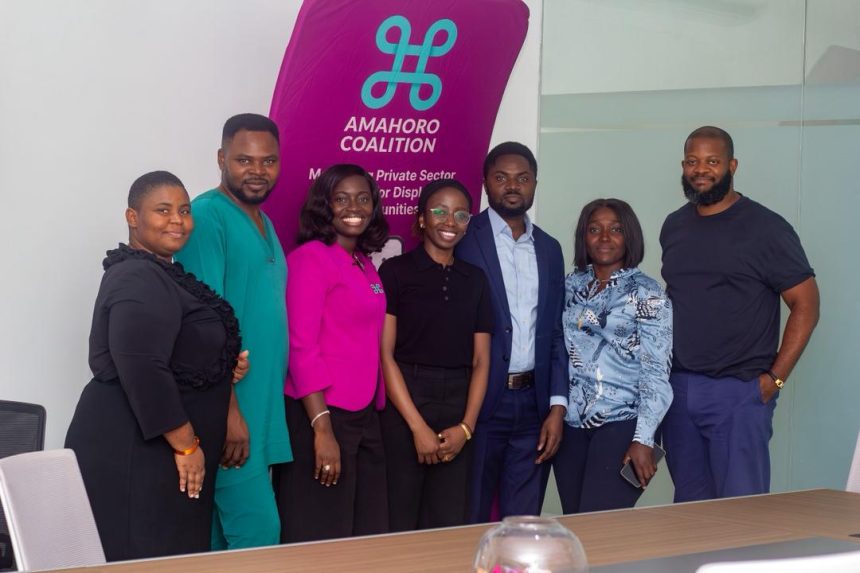
Ghana has a significant economic opportunity by aligning its administrative systems with its progressive refugee policies, according to a new report presented at a media roundtable in Accra.
The findings from the Amahoro Coalition’s Pathways to Employment country report on Ghana reveal that persistent bureaucratic gaps are preventing refugees from formally joining the workforce, despite their legal right to work under the 1992 Refugee Act.
“The evidence shows that the problem is not hostility or lack of policy intent. It is the failure of systems to align, which turns documentation and procedure into unintended barriers to employment,” said Mercy Kusiwaa Frimpong, Strategy Custodian for Communications at Amahoro Coalition, who presented the research.
The study highlights a critical “circular dependency”: refugees must obtain a work permit before securing formal employment, but the permit application requires a letter of commitment from an employer, who often hesitates to provide one without confirmed work authorization.
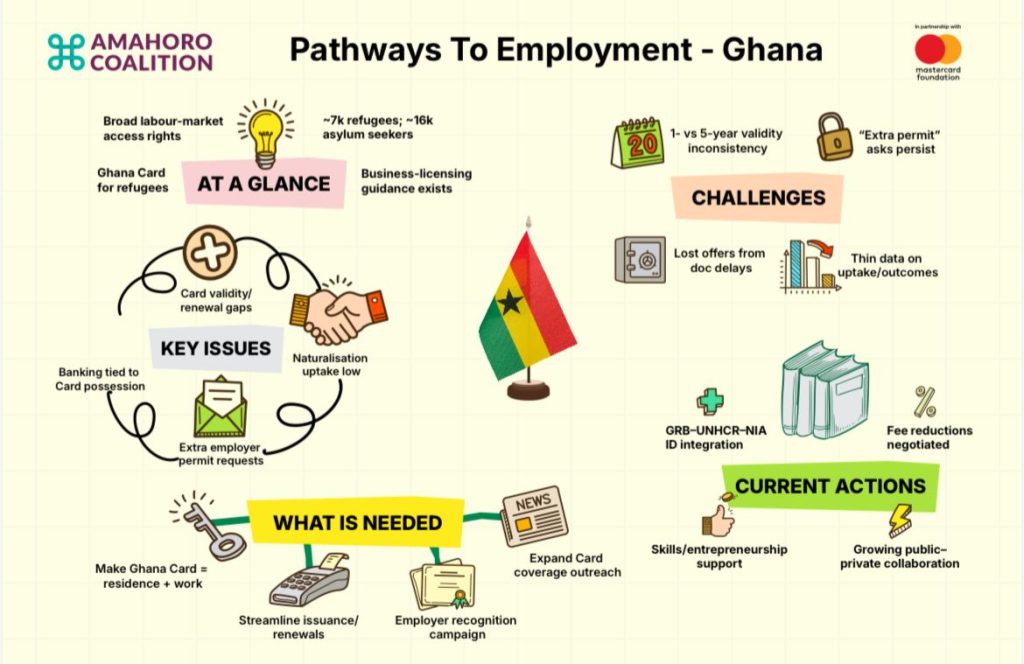
Officially, week-long processing delays often stretch to months, causing refugees to lose job offers.
Opening the engagement, Fred Mawuli Deegbe Jr., Amahoro Coalition’s Private Sector Partnerships Lead for West Africa, framed refugee employment as a labour market imperative.
“Jobs do not happen in policy documents; they happen when businesses are confident enough to hire,” Deegbe stated. “If we reduce uncertainty for employers and focus on skills, refugees move from being seen as a challenge to being recognised as contributors to economic growth.”
Key findings for Ghana indicated that the Ghana Card, intended to provide refugees with national identification, faces renewal challenges that block access to banking, employment, and services.
Most refugees, despite their qualifications, work informally in sectors such as agriculture and petty trade due to formal sector barriers.
Healthcare facilities and international schools successfully employ refugee nurses, doctors, and French teachers where acute skills gaps exist.
Refugees face systematic disadvantage in accessing mandatory National Service placements, crucial for civil service careers.
Bathsheba Asati, Principal Strategy Custodian for Growth at Amahoro Coalition, argued for viewing displacement through the lens of regional labour mobility under frameworks like ECOWAS and the African Continental Free Trade Area (AfCFTA).
“Displacement is not a temporary issue for Africa, and neither is labour mobility. The question is whether existing systems can be adjusted to turn exclusion into opportunity,” Asati said.
The report proposes actionable reforms, such as merging the Ghana Card into a combined residence and work permit to reduce bureaucracy, removing the employer letter requirement from the initial work permit application stage, and launching targeted awareness campaigns, job fairs, and employer forums to unlock the country’s economic potential.
In addition, provide microfinance, business training, and simplified licensing for refugee-owned businesses and establish a Refugee Employment Task Force with the Ghana Refugee Board, Immigration Service, UNHCR, and the private sector.
Stakeholders noted that with approximately 12,200 registered refugees, a manageable number compared to regional peers, targeted reforms in Ghana could yield outsized economic and social returns, positioning the country as a regional model.
“With the right alignment, Ghana could position itself as a regional reference point for employment-led refugee integration at a time of growing displacement across Africa,” the report concludes.
Discussions also highlighted the need to address resource constraints at the Ghana Refugee Board, where limited infrastructure affects documentation processing and integration support.
The Pathways to Employment Ghana country report is part of a 15-country analysis by the Amahoro Coalition examining barriers to formal employment for forcibly displaced persons across Africa.