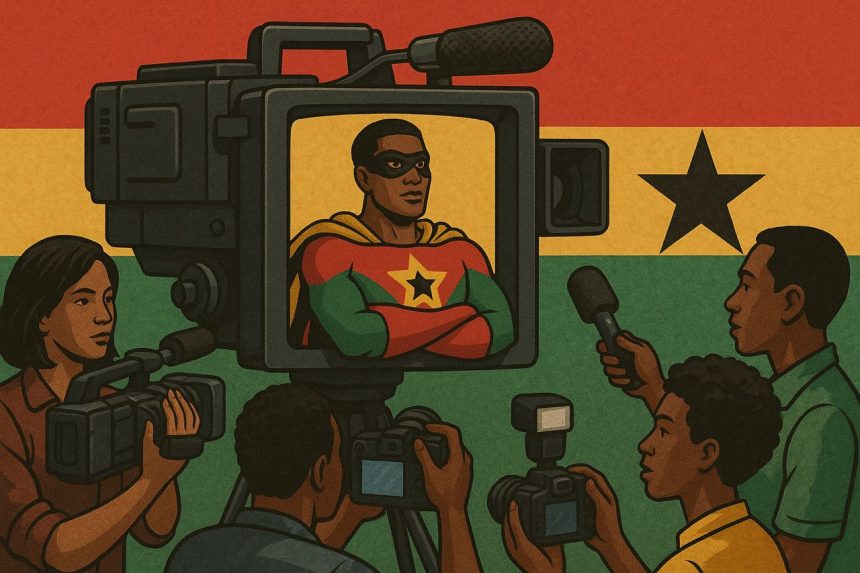
There are days when Ghana feels like a stage built on quicksand — every headline a performance, every scandal a scene change, every “hero” a character hastily drafted into a script someone else is directing. Today, as I sifted through old clippings and new broadcasts, I felt the weight of a strange realization: our media does not merely report heroes; it manufactures them, packages them, and releases them into the public imagination like antidotes to a sickness it rarely diagnoses.
I kept asking myself why these faces — masked reporters, stubborn whistleblowers, lone activists — loom so large in our national psyche. Maybe it is because we are conditioned to crave singular figures who stand upright where institutions have crumbled. Or maybe, more truthfully, the media finds it easier to tell stories through bodies than through systems.
Let me say agenda-setting determines our priorities, as if national conscience is a playlist curated by talk show hosts and headline writers. And perhaps it is. A single exposé becomes the nation’s obsession because cameras linger long enough for outrage to harden into certainty. I see it in the way an undercover journalist becomes the oracle of truth for a week, then a martyr for years. The media crowns him because the narrative is irresistible: one man against a rotten machine. Ghana loves that story. The media loves it even more.
But I’m beginning to see the machinery behind the myth-making.
Some outlets celebrate a hero not because the individual is inherently virtuous, but because his actions embarrass the “correct” enemy. Others silence the same person with surgical precision when the revelations endanger political allies. The same whistleblower who is a “saviour of the republic” on one frequency becomes a “disgruntled saboteur” on another. We pretend these contradictions don’t destabilize us, but they do. They leave a residue — confusion that slowly ferments into cynicism.
As I reflected, I remembered how we responded to the judges’ scandal. One masked man and his camera became the fulcrum on which the entire judiciary was judged. The public raged, institutions scrambled, and the media turned the investigation into a morality play — villainous judges, a lone sentinel of righteousness, and a nation holding its breath as the script unfolded. The tragedy was not the exposé. It was that we learned nothing about the machinery that enabled the rot; only about the heroes and villains the media showcased.
It dawned on me today that our democracy is learning the wrong lessons from its loudest stories.
Heroes appear, are applauded fiercely, then abandoned just as quickly. Institutions absorb the blow, perform contrition, and return to old habits. Meanwhile, the public oscillates between reverence and resignation — “Look at the brave man who exposed them” quickly turns into “They are all the same.”
Where does that leave the rest of us? Somewhere between hope and exhaustion.
Still, I can’t deny the power these figures hold. They embody something we desperately want to believe: that integrity is not extinct. That one person can force the state to remember its own laws. That even in a country where patronage and media alliances distort reality, truth can still erupt through the cracks.
But the more I watch this cycle, the more I feel we are being trained to admire individuals instead of demanding functioning systems. We celebrate whistleblowers, but we rarely interrogate the procurement loopholes, weak oversight committees, or political interference that produced the scandals in the first place. Our media turns heroes into bright torches, but forgets that torches only matter because the room is dark.
Writing this entry, I wish for something different — a press that still honours courage but refuses to let the nation outsource accountability to a handful of brave souls. A public that respects heroes without worshipping them. Institutions that reform not because a journalist forced their hand, but because that is their reason for existing.
But until that day arrives, perhaps the real lesson is this:
Heroism in Ghana is not merely about bravery.
It is also about timing, narrative control, and who holds the microphone.
And in the heat of this afternoon, with the radio off and the headlines folded away, I am left with a final unsettling thought:
Maybe the heroes we see are not mirrors of who we are —
but projections of what our media wants us to believe.
And that, more than anything, should keep us awake.
Finis coronat opus.