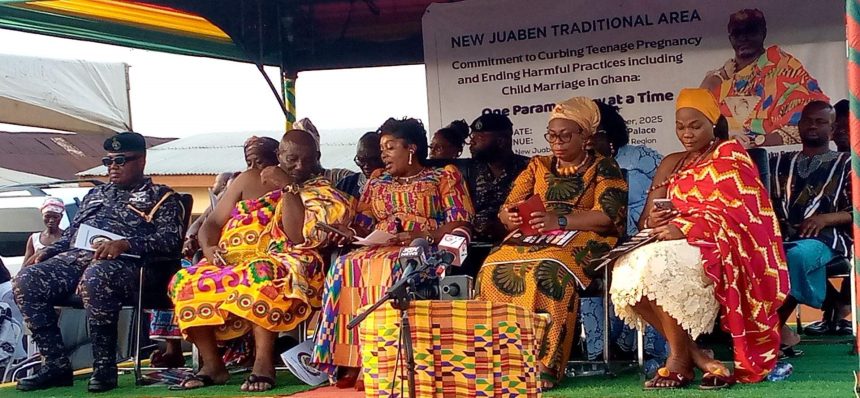
The New Juaben Traditional Council has organised a durbar on “Akwasidae Kese ” at Yiadom-Hewdie Palace in Koforidua, with a call on parents, institutions and community leaders to help combat harmful practices that retard development of societies.
The celebration of ” Akwasidae Kese ” was under the theme: ” Commitment to Curbing Teenage Pregnancy and Ending Harmful Practices including Child Marriage in Ghana: One Paramountcy at a Time.”
The Day is observed in every six weeks on Sunday, to reinforce cultural identity, honour ancestors, and allow chiefs to pay homeage in their adorned in traditional regalia such as Kente.
At the festivity, Daasebre Boateng III, the Paramount Chief of the New Juaben Traditional Area, sat in state to receive prayers and felicitations from guests, chiefs, and government officials.
Addressing his people, he acknowledged the United Nations Population Fund (UNFPA), and Obaapa Development Foundation (ODF) for the capacity building workshop organised for traditional leaders on advocacy to end Gender-Based Violence and child marriage.
He, together with his Chiefs and Queenmothers, solemnly declared that they would actively promote awareness, education, and community-led initiatives that protect the rights, dignity, and well-being of our girls and all children.
Daasebre Boateng said, “Together, we shall build communities where every child is safe, empowered, and free to fulfill their full potential, where the rights and welfare of our children are upheld and respected. ”
On behalf of the UNFPA Resident Representative, Dr Doris Aglobitse, the Programme Specialist, Sexual and Reproductive Health and Gender Team Lead at the UNFPA, said the identified harmful practices such as child marriage, denied young girls the opportunity to fulfill their life dreams and kept the legacy left by “our ancestors thriving.”
She said this was not merely a development issue, but a moral, cultural, and generational one that needed the intervention of our traditional leaders.
“It is a powerful demonstration that culture, when guided by compassion and foresight, becomes a force for transformation,” she said.
She said at the national level, significant progress had been made in providing primary education for both boys and girls and improving access to education, particularly at the secondary level.
Ghana is advancing gender equality by strengthening legal and policy frameworks, the Adolescent Health and Development (ADHD) Programme also offered adolescent healthcare guidance.
Despite these interventions, discrimination against girls persists. Poverty, geography, and gender norms exacerbate the disadvantage, making them vulnerable in Ghana.
Dr Aglobitse said, “It is for this reason that the UNFPA and partners with support from Canadian Government is implementing the UNFPA/UNICEF Adolescent Girls Programme known as the AGP, which focuses on adolescent girls with the aim of ensuring adolescent girls experience healthier, safer and more empowered life transitions into adulthood. ”
Nana Hemaa Adwoa Awindor, Executive Director of Obaapa Development Foundation, said, “Child marriage and teenage pregnancy are not customs to be defended; they are injustices to be ended.
“When a girl is forced into marriage or early motherhood, she is robbed of her education, her health, her future and our society is weakened.”
She said the End Child Marraige Declaration must therefore live beyond today.
Let it guide decisions in our palaces, inform judgments in our councils and shape conversations in our homes, churches, mosques and markets, she said.
Nana Hemaa Awindor entreated that ” let us speak boldly with one voice: no child in New Juaben Traditional Area, shall be married before adulthood; no child shall be denied her right to grow, learn and thrive. ”