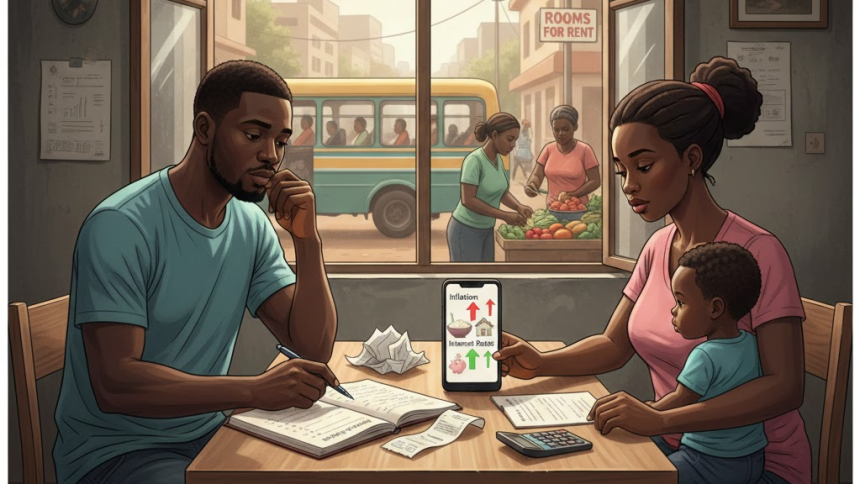
Interest rates and inflation are often discussed in abstract terms, usually by economists, bankers or politicians. For many Ghanaians, they sound like distant policy concepts that belong in Bank of Ghana press conferences, not in homes, markets or offices.
Yet few forces shape everyday financial life in Ghana more powerfully. They determine how far salaries stretch, whether savings grow or shrink, how expensive loans become, and why prices seem to rise even when income does not.
Understanding how interest rates and inflation interact is not just an academic exercise. It is essential for anyone trying to protect their money in Ghana’s volatile economic environment.
What inflation really means in daily Ghanaian life
Inflation is commonly defined as a general rise in prices over time. In simple terms, it means that the same amount of money buys fewer goods and services than before.
For Ghanaian households, inflation is felt most sharply in everyday essentials. Food prices rise at the market. Transport fares increase without warning. Rent goes up at renewal time. Utility bills climb. Even small items like sachet water or cooking oil become more expensive.
When inflation is high, money loses purchasing power. A salary that once covered monthly expenses comfortably may suddenly feel inadequate, even if the amount on paper has not changed.
This is why many Ghanaians feel poorer even when they are earning the same or slightly more than before.
Interest rates: the price of money
Interest rates represent the cost of borrowing money and the reward for saving or investing it. In Ghana, the most influential rate is the Bank of Ghana’s policy rate. This serves as a benchmark for commercial banks when setting lending and deposit rates.
When interest rates are high, borrowing becomes expensive. Loan repayments rise, mobile loans become more punishing, and businesses face higher costs of financing operations.
At the same time, higher interest rates can benefit savers and investors. Returns on treasury bills, bonds and some fixed-income investments tend to increase when rates are elevated.
Interest rates, therefore, cut both ways. They punish borrowers but can reward those who lend money to banks or the government.
Why inflation and interest rates move together
Inflation and interest rates are closely linked. When inflation rises sharply, central banks typically increase interest rates to slow down spending and borrowing. The goal is to reduce excess demand in the economy and stabilise prices.
In Ghana, periods of high inflation have often been followed by aggressive interest rate hikes. While these measures aim to restore economic balance, they also create short-term pain for households and businesses.
Higher interest rates may help tame inflation eventually, but they also make credit less accessible and slow economic activity in the meantime.
The silent damage inflation does to savings
One of the most misunderstood effects of inflation is how it erodes savings.
If you save money in an account that earns five percent interest while inflation is running at twenty percent, your money is technically growing — but in real terms, it is losing value. The interest earned cannot keep up with rising prices.
This is why many Ghanaians feel frustrated after saving consistently, only to discover that their money does not stretch much further than before.
Understanding this gap between nominal returns and real returns is critical. What matters is not just how much interest you earn, but whether that interest beats inflation.
Borrowing becomes more dangerous in high-interest environments
When interest rates rise, debt becomes significantly more expensive. This is particularly dangerous in Ghana, where mobile loans and short-term credit are widely used.
A loan taken to manage a temporary cash shortfall can quickly spiral into a long-term burden when interest compounds rapidly. Many households find themselves servicing debt rather than building savings or investing.
In high-interest environments, borrowing for consumption — rather than productive activity — carries serious risk.
How inflation reshapes investment decisions
Inflation forces investors to think differently. Holding large amounts of cash becomes unattractive because its value erodes over time. As a result, people look for ways to protect or grow their money.
In Ghana, this often pushes individuals toward treasury bills, bonds, mutual funds, real estate or foreign currency holdings. Each option carries its own risks and trade-offs.
High inflation also shortens planning horizons. People prioritise short-term investments or quick returns because long-term projections feel uncertain.
Why salaries struggle to keep up
One of the most painful aspects of inflation is that wages rarely adjust as quickly as prices. Employers face their own rising costs — utilities, raw materials, financing — and cannot always increase salaries at the same pace.
This creates a gap between income growth and cost-of-living increases. Workers are forced to cut back, take on side jobs or dip into savings just to maintain basic standards of living.
For young professionals and fixed-income earners, this squeeze is particularly intense.
What this means for ordinary financial decisions
Understanding inflation and interest rates changes how people approach everyday financial choices.
It explains why saving under a mattress or in a low-interest account is risky over time.
It clarifies why borrowing should be approached cautiously, especially for non-essential spending.
It highlights why investing is not about chasing high returns, but about preserving value.
Most importantly, it helps people make peace with the fact that financial pressure is often structural, not personal failure.
Navigating money in a high-inflation economy
No individual can control inflation or interest rates. But understanding them allows people to adapt intelligently.
This might mean prioritising emergency funds, seeking investments that at least partially hedge against inflation, avoiding unnecessary debt, and being realistic about lifestyle choices.
It also means recognising that financial stability in Ghana requires constant adjustment rather than fixed plans.
Why economic literacy matters more than ever
In an economy as volatile as Ghana’s, financial survival increasingly depends on understanding the forces at play. Interest rates and inflation are not distant economic jargon; they are active forces shaping daily life.
For households, small businesses and young professionals alike, economic literacy has become a form of protection.
Those who understand how inflation eats away at money and how interest rates shape opportunity are better equipped to plan, adapt and endure.
In today’s Ghana, that understanding may be as valuable as income itself.