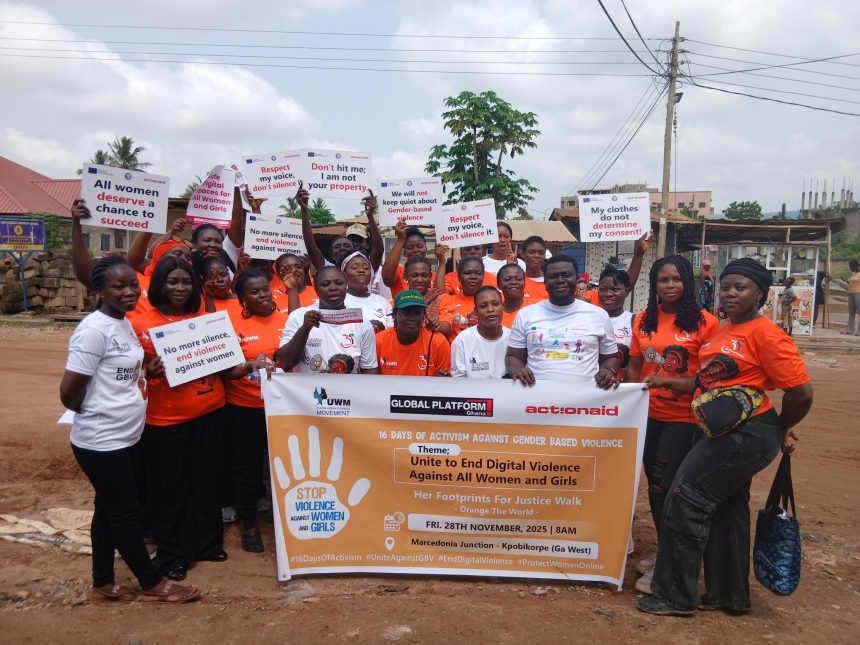
The Young Urban Women’s Movement (YUWM) has called for stricter enforcement of gender-related laws and policies to curb rising cases of gender-based violence (GBV) in the country.
It also called for stronger women representation in Parliament to champion the course of women and to protect their rights.
Madam Hawa Tasala Gariba, National Chairperson of the Movement, made the call in an interview with the Ghana News Agency (GNA), during a walk to mark this year’s 16 Days Global Activism, at Kpobikorpe, near Amasaman in the Ga West Municipality of the Greater Accra Region.
The 16 Days of Activism against GBV is an annual global campaign that takes place from November 25 (International Day for the Elimination of Violence against Women) to 10 December (Human Rights Day).
The walk aimed at educating community members on identifying GBV, understanding reporting mechanisms, and knowing the appropriate institutions and individuals to contact when cases arose.
It was organised in collaboration with the Global Platform, an ActionAid’s youth empowerment and activism hub.
Recent reports and data from the Ghana Statistical Service (GSS) and the Domestic Violence and Victims Support Unit (DOVVSU) indicated that approximately 24.4 per cent of women in Ghana, aged 15-49, have experienced intimate partner physical and/or sexual violence at least once in their lifetime.
Additionally, 27.7 per cent of Ghanaian women have experienced at least one type of domestic violence.
Alarmingly, 38.2 per cent of adolescent girls aged 15-19 have experienced sexual violence with girls in this age bracket reportedly four times more likely to experience violence than those over 19.
Madam Gariba said the figures indicated that Ghana had not done enough to eradicate the canker, questioning the significant number of GBV cases despite the passage of numerous gender-related laws to deal with the matter.
She attributed the situation to the slow implementation of existing laws, including the Affirmative Action Bill, which she said had been passed and signed but was yet to be effectively enforced.
“If enough had been done, we should be recording zero abuse. But we are still getting reports every day,” she said.
“We still need to see more of the fight against violence,” she told the GNA.
Madam Gariba urged strict enforcement of all gender-related laws to deal with canker to protect women and girls.
She also emphasised the need for increased female representation in Parliament, arguing that women understood the lived realities of GBV more deeply and could better advocate for responsive policies.
“We want to see follow-ups and real implementation,” she stressed.
“These laws are there, but we don’t always see them working.”
Offering advice to young women, she urged them to work towards independence and avoid relying entirely on their partners, emphasising that empowerment was crucial in reducing vulnerability to abuse.
“Do not hide yourselves. You can be anything—a painter, a mason, a tiler. There is no restriction,” she said.
She expressed the Movement’s commitment to advocating for the rights of women, especially survivors of GBV, to ensure it minimised the canker, if not eradicated.
“We’ve noticed defilement cases, rape cases, incest cases and even relationship abuse within our communities,” she stated.
“Our goal is to ensure people understand the importance of reporting such cases and receiving the support they need.”
Mrs Darfline Abena Nartey, the Ga West Municipal Director, Commission on Human Right and Administrative Justice (CHRAJ), urged women to work towards independence and avoid relying entirely on their partners, emphasizing that empowerment is crucial in reducing vulnerability to abuse.
While urging survivors to speak up, Mrs Nartey also appealed to the community to support survivors of such acts, stressing that community support was critical in eradicating GBV.
“Eliminating Gender-Based Violence is a shared responsibility,” she said.
She also called for a more fair society, questioning when some women had to give something before they gained employment.
Mr. Jeffrey Osei Adusei, Senior Social Devt Office, Social Welfare, Ga West Municipal Assembly, urged survivors of GBV to report their perpetrators to the appropriate authorities, cautioning traditional authorities to desist from interfering in such cases and allow the law to take its full course.
He also warned perpetrators of GBV that the laws of the country was willing and ready to prosecute them when found culpable.
He cautioned young girls to be circumspect in the kind of videos and pictures they disseminated online to avoid falling prey to online scammers.
The Young Urban Women’s Movement founded in 2016 operates across multiple regions,
It works under three thematic areas: bodily integrity, burden of care, and economic security.
In Accra alone, the movement has recorded and followed up on over 10 cases of abuse, some of which have progressed to court, resulting in justice for survivors.