
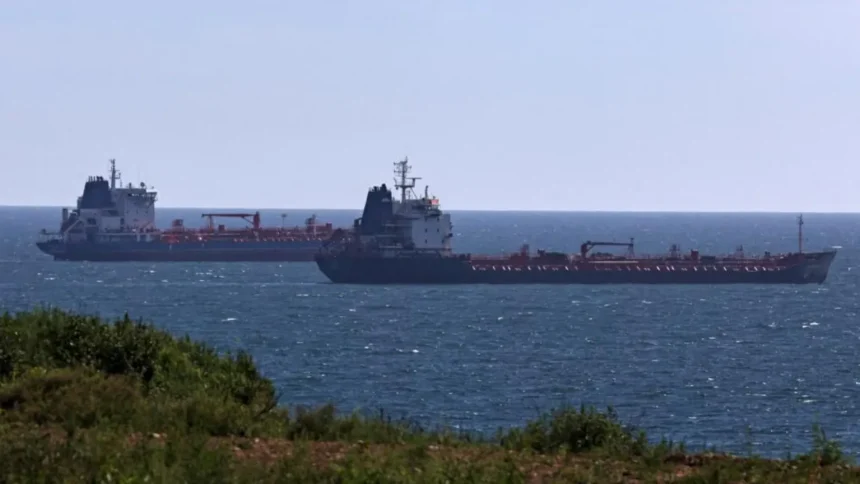
The US has loosened sanctions on other countries buying Russian oil and petroleum already loaded on vessels at sea to curb the economic impact of the US-Israel war with Iran.
US Treasury Secretary Scott Bessent said the temporary waiver was aimed at promoting “stability in global energy markets”. The “short-term measure” would “not provide significant financial benefit to the Russian government”, he cautioned.
Russia said it had about 100 million barrels of oil currently in transit.
Attacks on ships and energy infrastructure in the Gulf, as well as the effective closure of the Strait of Hormuz, have rocked global energy markets.
Oil prices climbed above $100 a barrel again on Thursday, while stock markets fell after three more cargo vessels were hit in the Gulf and Iran’s new supreme leader vowed to keep blocking the major waterway.
Around a fifth of the world’s oil usually passes through the Strait of Hormuz. Oil tankers stranded in the gulf, unable to traverse the narrow channel between Iran and Oman, has led to a growing supply crisis.
Bessent said the temporary waiver would last until 11 April and applied only to “permit countries”.
“The temporary increase in oil prices is a short-term and temporary disruption that will result in a massive benefit to our nation and economy in the long-term,” Bessent said.
The move comes after Washington announced it would be releasing 172 million barrels of oil from its strategic petroleum reserve on Wednesday.
Kirill Dmitriev, Russian President Vladimir Putin’s economic envoy, said the US was “effectively acknowledging the obvious: without Russian oil, the global energy market cannot remain stable”.
He added: “Amid the growing energy crisis, further easing of restrictions on Russian energy sources appears increasingly inevitable.”
But Bill Browder, a former Moscow-based financier who led a campaign to impose sanctions on top Russian officials accused of corruption, told the BBC that Trump’s move was “a terrible decision that will enrich Putin and prolong the war in Ukraine”.
Ukrainian President Volodymyr Zelensky has yet to comment on the latest announcement, but said on Tuesday that easing sanctions would be a “serious blow” for Ukraine and “concession” to Russia that would allow it to buy more weapons.
French President Emmanuel Macron, meanwhile, said that the Strait of Hormuz’s shutdown “in no way” justified lifting the sanctions on Russia.
He is due to meet Zelensky in Paris to discuss ways of increasing pressure on Moscow. The Elysee Palace said the two presidents would focus on how to help Kyiv defend itself, and also counter Russia’s shadow fleet of tankers used to transport sanctioned oil.
The UK will not follow the US in easing sanctions on Russian oil, energy minister Michael Shanks said on Friday.
He told BBC Radio 4’s Today programme: “What we absolutely can’t have is Putin sitting in the Kremlin seeing this as a chance to invest in the war machine.”
Foreign Secretary Yvette Cooper accused Russia and Iran of trying to “hijack the global economy”, pointing to links between the two countries.
“We’re seeing it in terms of technology, we see it in terms of the approach, we see it in terms of these kinds of tactics, and we see it in terms of the way these two states try to support each other and try to benefit together,” she said during a visit to Saudi Arabia.
However, she refrained from criticising the US decision to ease sanctions on Russian oil, describing it as a “specific, targeted issue”.
The jump in energy prices this week has led to action by several other authorities.
The International Energy Agency (IEA) said on Wednesday that it would release a record 400 million barrels of oil.
Colin Walker, transport lead at the Energy and Climate Intelligence Unit (ECIU) think tank, said the easing of sanctions was likely to have little impact on the price of oil and, in turn, petrol.
He told the BBC: “Even the release of 400 million barrels of reserves announced recently didn’t really put a dent in the oil price which is still up around $100 a barrel.
“Clearly Putin will benefit, but it’s less clear that this is going to put any real downward pressure on UK pump prices.”
Governments in Asia, which are major buyers of oil from the Gulf, have announced a slew of measures in response to the jump in oil prices.
The Philippines, for example, gets around 95% of its crude oil from the Middle East. The country’s president told public workers to switch to a four-day working week to save fuel.
Meanwhile, Japan, South Korea and Thailand have announced price caps on petrol.
Russia launched its full-scale invasion of Ukraine in 2022. There have been concerns that the conflict in the Middle East may distract international attention from bringing the war to a close, or serve to benefit Moscow.
Earlier, Bessent said the US government would start escorting vessels through the Strait of Hormuz “as soon as it is militarily possible”.
The possible need for a military escort “was always in our planning”, he told Sky News.
Pressed on whether that could start in the coming days, Bessent said “as soon as it is possible to ensure safe passage we will do it”.