
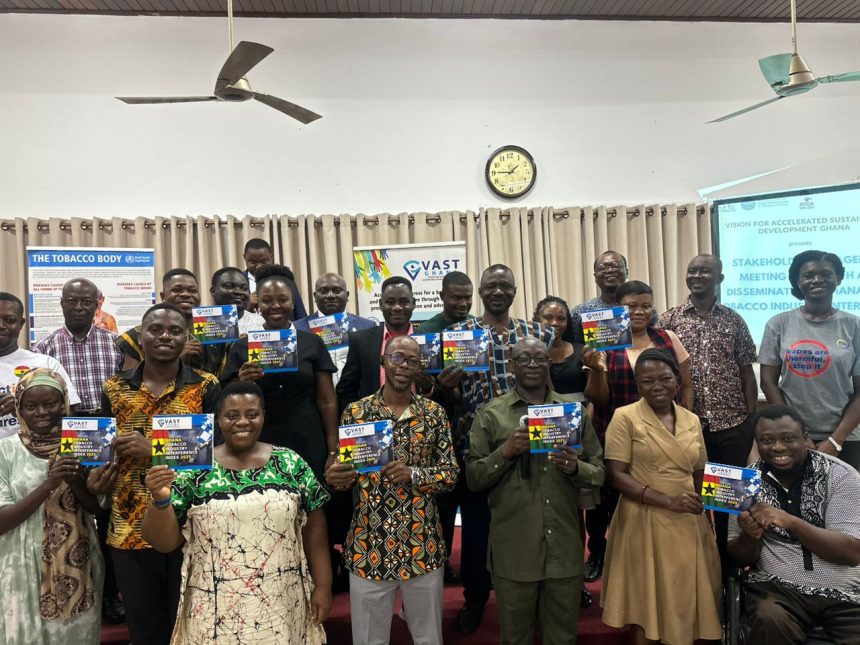
The Vision for Accelerated Sustainable Development, Ghana (VAST-Ghana) has officially launched and disseminated the findings of the Ghana 2025 Tobacco Industry Interference Index to help confront the tobacco menace in the country.
Some of the institutions that received the index report were the Ministry of Health, Ghana Health Service, Ghana Revenue Authority, Narcotics Control Authority, National Development Planning Commission, and Food and Drugs Authority
Mr Labram Musah, the Executive Director of VAST-Ghana in a welcoming address at the launch held in Accra, said tobacco remained a deadly epidemic that knows no borders.
“Globally and in Ghana, tobacco claims millions of lives each year through cancer, heart disease, respiratory illnesses, and other preventable conditions,” he stated.
He added, “In Ghana, tobacco use leads to the death of 6,700 premature deaths annually, burdens our healthcare system with avoidable costs, and perpetuates cycles of poverty through lost productivity and family hardship.”
Mr Musah noted that the alarming situation is the tobacco industry’s ruthless and calculated tactics to target children, young people, youth, the poor and other vulnerable populations.
“The tobacco industry deploys predatory strategies such as placing advertisements and positioning products at children’s eye level near schools and playgrounds, introducing flavoured and small affordable packs (pack of 10 sticks),” he stated.
He said the industry, through its retailers, offered cigarettes in single sticks, including candy-like, fruit, or menthol varieties. These strategies disguise tobacco as harmless and appeal directly to young people and children.
“These are not accidents; they are deliberate efforts to hook the next generation into lifelong addiction, ensuring profits at the expense of health and futures,” he stated.
He said in Africa, including contexts close to Ghana, companies have been documented using these ploys to exploit weaker regulations and create new smokers among school children and adolescents.
Mr Musah said in Ghana not much progress had been made with respect to the implementation of the WHO Framework Convention on Tobacco Control (FCTC) Article 5.3 and that CSOs’ recent shadow report had revealed a slow pace in the overall implementation.
“A primary concern raised in the report is the lack of transparency regarding interactions between public officials and the tobacco industry,” he pointed out, and that although Ghana is a signatory to the Convention, the report claimed that meetings with industry often occurred without public notice or disclosure, a key component of Article 5.3.
He said it was also highlighted in the report that there was no publicly accessible government repository detailing the activities or lobbying efforts of the tobacco industry.
“The shadow report recommends a Code of Conduct to guide public officials conduct and limit their interactions with the industry,” he said, adding, “We are aware that the FDA is currently developing one.”
“Ladies and gentlemen, we cannot stand idly while an industry profits from addicting our children, undermining our development goals, and eroding the gains we have made in public health,” Mr Musah stated.
He added, “Together, we can build a healthier, tobacco-free Ghana – a beacon of responsible governance and public health leadership in Africa.”
He expressed gratitude to Dr Mary Assunta of the Global Centre for Good Governance in Tobacco Control for her support throughout the process to expose the tobacco industry, while extending gratitude also to the Bloomberg Philanthropies for providing the financial support.