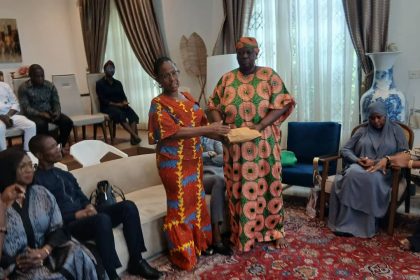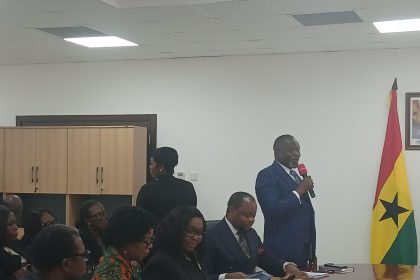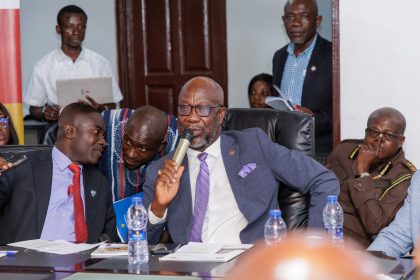
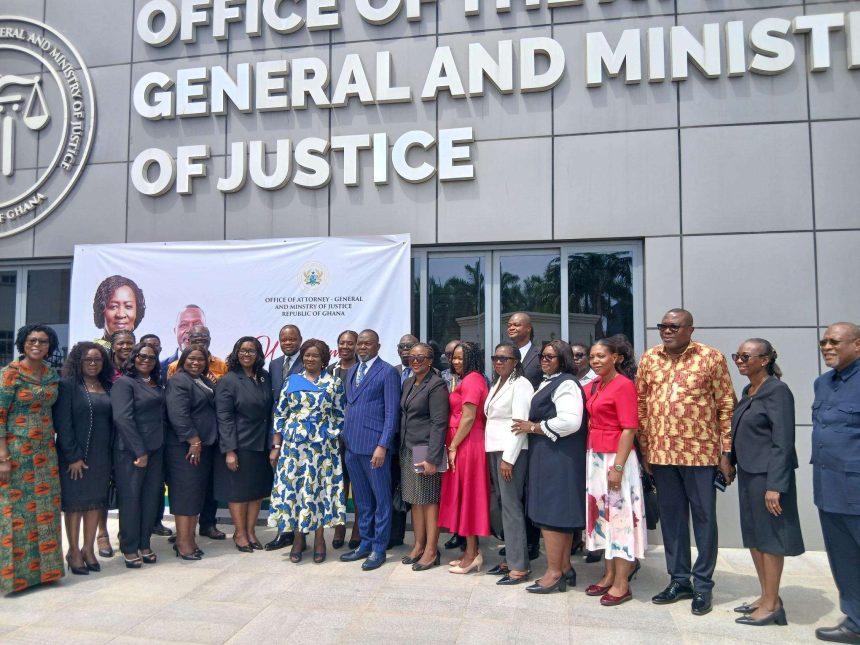
Vice President Professor Jane Naana Opoku‑Agyemang has urged state agencies to exercise caution and act prudently to avoid actions that could expose Ghana to costly international arbitration.
The caution follows the Attorney-General’s Office disclosure that ten international arbitration cases are currently pending against the state, most of which were inherited by the current administration.
Speaking during a working visit to the Office of the Attorney-General and Ministry of Justice on Thursday, Prof Opoku-Agyemang said due diligence must be exercised at all times to curb such occurrences.
“Regardless of who initiated the international arbitrations we are facing, it is ultimately about the country.
“Going forward, we all have to be careful to do the right things at all times, so that we do not leave legacies or examples that trouble the state,” she said.
The visit was aimed at closing perceived gaps between the Presidency and Ministries, Departments and Agencies, and to obtain first-hand information on the successes, challenges, and constraints facing the institutions.
Prof Opoku-Agyemang was accompanied by Mr Alex Segbefia, Chief of Staff at the Office of the Vice President; Dr Hamza Zakaria, Economic Advisor; Mr Ofosu Ampofo, Policy Adviser; Ms Amma Pratt, Spokesperson for the Vice President, among others.
She stressed that while the origins of some disputes may predate the current government, the responsibility to safeguard national interest rests with all public officials and institutions.
The Vice President commended the Attorney-General’s Office for its work and assured staff of government support, noting that collaboration across institutions was key to achieving national development goals.
“We are working for the country and representing the nameless and the faceless,” she said, adding that the welfare of Ghanaians must remain the guiding principle of public service.
Touching on other challenges raised by the Attorney-General, the Vice President expressed concern over the growing number of land compensation cases against the state, describing the financial claims as “mind-boggling.”
She called for practical and enduring solutions, including alternative compensation approaches, to address the issue.
Prof Opoku-Agyemang also acknowledged staffing and capacity constraints within the Ministry of Justice, particularly in legislative drafting, and encouraged greater investment in specialised legal training to strengthen local expertise.
Briefing the Vice President on ongoing cases, Dr Dominic Ayine, the Attorney-General and Minister of Justice, said 16 dockets linked to the government’s Operation Recover All Loots (ORAL) initiative were currently under review.
He said no case under the programme had been compromised, contrary to reports in sections of the media.
“No docket has come here that has been compromised in any way. No deal, no plea arrangement has been entered into with anybody who has committed an offence that comes within the ambit of ORAL,” he stated.
Dr Ayine explained that the dockets under review were undergoing critical scrutiny, and where gaps were identified, investigative bodies would be directed to provide additional evidence.
He also raised concern over what he described as a “tsunami” of land compensation claims against the state, some running into hundreds of millions of Ghana cedis.
“The figures are mind-blowing. We are looking at billions of Ghana cedis in land compensation claims,” he warned, noting that many cases were based on colonial-era documents.
Dr Ayine said claimants often retrieved old records from state archives and argued that the colonial government had failed to pay compensation for compulsorily acquired lands.
He said these cases often succeeded in the courts, sometimes progressing all the way to the Supreme Court, thereby increasing the financial exposure of the state.
The Attorney-General said he had directed the Solicitor-General to prepare a detailed brief for the President on the scale of the land compensation problem and its implications for public finances.
He also announced plans by the Attorney-General’s Office to introduce a Criminal Proceeds Recovery Bill, which would allow the office to confiscate assets linked to criminal activity through both criminal and civil processes and generate additional revenue for the Ministry.