Saving money sounds simple enough. In practice, it is one of the hardest financial habits for many Ghanaians to maintain. Even those who earn what seems like a comfortable income often reach the end of the month wondering where their money went. The struggle cuts across age, profession, and income level. But the reasons behind it are rooted in the way Ghana’s economy works, and in the social expectations that shape everyday life.
A closer look reveals that the issue is less about personal discipline and more about navigating a complex financial landscape that leaves little room for error.
The pressure of rising costs
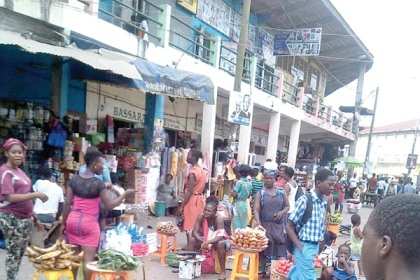
For the average Ghanaian household, the most immediate barrier to saving is the cost of living. Food, transport, rent, utilities, healthcare, and school expenses have risen steadily. In cities like Accra, monthly spending absorbs a significant portion of income long before luxuries come into play.
When a salary is stretched across multiple non-negotiable expenses, saving becomes less a priority and more a luxury reserved for months when nothing unexpected happens. With inflation driving prices up much faster than wages grow, many households feel as though they are constantly playing catch-up.
Unpredictable income makes planning difficult
A large share of Ghana’s workforce operates in the informal sector, where income varies from month to month. Even among salaried workers, allowances may arrive late, and overtime or side gigs are never guaranteed.
People who cannot predict their exact monthly income often cannot commit to a fixed savings plan. The instinct, understandably, is to save “when there’s something left.” Unfortunately, this approach usually results in irregular and minimal savings because expenses quickly expand to absorb whatever is available.
The weight of social and family obligations
Family responsibilities are a central part of Ghanaian life. Parents, siblings, extended relatives, church groups, and community associations all place demands on individuals’ finances. These demands are not only frequent; they carry cultural weight.
Ignoring them can strain relationships and attract social criticism. In many cases, supporting family members is not optional, and these contributions often consume funds that could have gone into savings.
This dynamic is even more pronounced among Ghanaians in the diaspora, who are viewed as having greater financial capacity and therefore face higher expectations.
Emergencies that arrive without warning
From unexpected health bills to sudden funerals, emergencies are a regular feature of life. Without an emergency fund, households often dip into whatever little savings they have or turn to loans. When this cycle repeats, savings quickly evaporate.
For many people, it feels pointless to save only for the money to disappear the moment a crisis hits. But the real issue is not emergencies themselves; it is the lack of a buffer to absorb them without wiping out progress.
Temptation in an increasingly cashless world
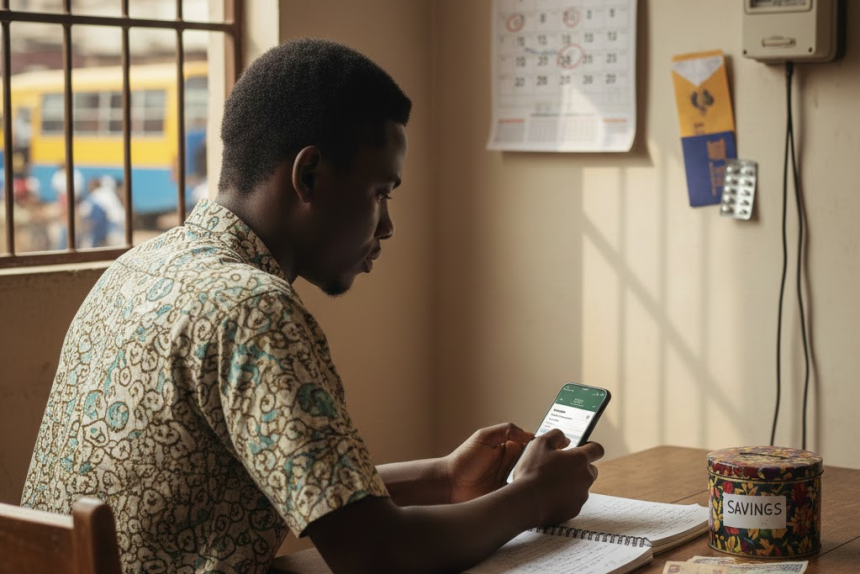
Digital wallets, mobile money, quick loans, and online shopping have made spending easier and more impulsive. With a few taps on a phone, money moves instantly. At the same time, the ease of accessing mobile loans has introduced a new layer of financial vulnerability.
What used to require deliberation now takes seconds, blurring the boundary between needs and wants. This behavioural shift reduces the friction that once helped people pause before spending.
Why traditional advice often fails
Generic advice such as “save 20 percent of your income” or “cut back on luxuries” does not always make sense in a Ghanaian context. Many people are not overspending on luxuries; they are navigating structural constraints.
To make saving realistic, the advice must reflect local realities.
What actually works for Ghanaian households
The first step is reframing how savings fit into daily life. The goal is not to save what remains after spending; it is to build savings into the budget ahead of time, even if the amount is small.
Use percentage-based or flexible savings
Individuals with unstable income can set a savings percentage instead of a fixed amount. This ensures that savings grow during good months without creating stress during slower periods.
Separate accounts for spending and saving
Keeping savings in an account that is not easily accessible through mobile money reduces impulsive withdrawals. Some people use susu groups, regulated investment apps, or bank savings accounts for this reason.
Budget specifically for family responsibilities
Instead of treating family needs as emergencies, allocating a monthly family-support budget helps prevent financial surprises. This creates boundaries while maintaining cultural obligations.
Build an emergency fund gradually
Even a small monthly contribution can create a cushion over time. The purpose of this fund is not to avoid emergencies but to avoid wiping out savings each time they occur.
Automate savings when possible
Automatic transfers—on payday or on a set date—remove the emotional burden of deciding whether to save.
Track spending to reveal hidden drains
Many households underestimate expenses like mobile data, fuel, food delivery, and spontaneous purchases. Tracking for even one month often exposes patterns that can be adjusted.
Saving as a cultural shift
Developing a savings habit in Ghana is not simply a financial behaviour; it is a cultural shift. It requires balancing personal goals with social expectations, resisting the pull of immediate consumption, and planning in an unpredictable economic climate.
Yet Ghanaians are already doing this—quietly and steadily. Some are saving small amounts daily through susu arrangements. Others are using investment apps to build long-term funds. Many are learning to negotiate boundaries around family support without undermining relationships.
Saving in Ghana may be challenging, but it is far from impossible. What works is not copying foreign methods but building a system that fits the rhythms, obligations, and realities of Ghanaian life.
In the end, the most successful savers are not the highest earners—they are the ones who build habits that respect both their finances and their context.