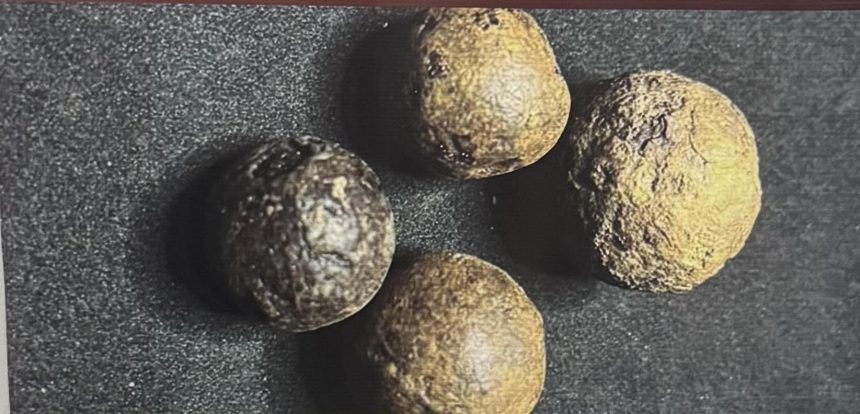
A team of researchers have discovered Ghana’s first-ever musket balls at a colonial Fort (Fort Tantumquery, Otuam) in the Central Region of Ghana.
A musket ball is a spherical lead projectile used in muzzle-loading firearms from the 14th to the mid-19th century. Typically cast from molten lead, these bullets were slightly smaller than the barrel diameter and often created large, slow, and highly destructive wounds upon impact.
Again, researchers using drone mapping, ground penetrating radar and electrical resistivity tomography uncovered signs of European occupation in terms of pottery, fragments of smoking pipes, door hinges and metals among others at the fort.
The research is a partnership between Kwame Nkrumah University of Science and Technology (KNUST) Department of Physics, the University of Ghana’s Department of Archaeology and Heritage Studies, the Ghana Museums and Monuments Board (GMMB).
It was funded by the German Ministry of Education and Research through UNESCO-TWAS.
Dr Cyril Dziedzorm Boateng, Principal Investigator, speaking at the Muskets & Megahertz exhibition in Kumasi, mentioned that for the geophysical aspect, the research team achieved 83.3 percent feature-detection accuracy while reducing excavation work by 95 percent compared with conventional methods.
He said in a lot of forts and castles, one only sees cannon balls but often not muskets balls, explaining that the approach by his team portrayed a major shift in investigating heritage sites in Ghana.
Dr Boateng who is also Lecturer at KNUST’s Department of Physics, pointed out that advanced geophysical technology could work effectively in Ghana’s local soil conditions, allowing the discovery of history without necessarily altering the sites.
Detailing the choice of study at Fort Tantumquery established in the 1720s, he said it had never been excavated or investigated, and the fort had been destroyed and researchers tended to explore the story behind the destruction and kind of relics that could be discovered.
According to him, the recovered musket balls were physical evidence of the fort’s military activity.
He pushed modern geophysical methods to be used to investigate archeological sites, especially forts and castles along the coast.
Professor Samuel Asare-Nkansah, Dean of the Faculty of Pharmacy and Pharmaceutical Sciences at KNUST, speaking on behalf of the Pro-Vice Chancellor, noted that the discovery of these artefacts could also help inform and guide conservation priorities.
It could inform tourism development with compelling narratives backed by solid archaeological evidence as well as creating employment for trained geophysicists and archaeologists.
He noted that this was applied research in the service of national development- “precisely what our universities should deliver” and a potential to document Ghana’s heritage sites before they are lost to time.
Mr. Kennedy Atsutse, Head of Museums, GMMB, Central Region, was hopeful that such collaborations continued to accurately document archeological sites in the country.
GNA