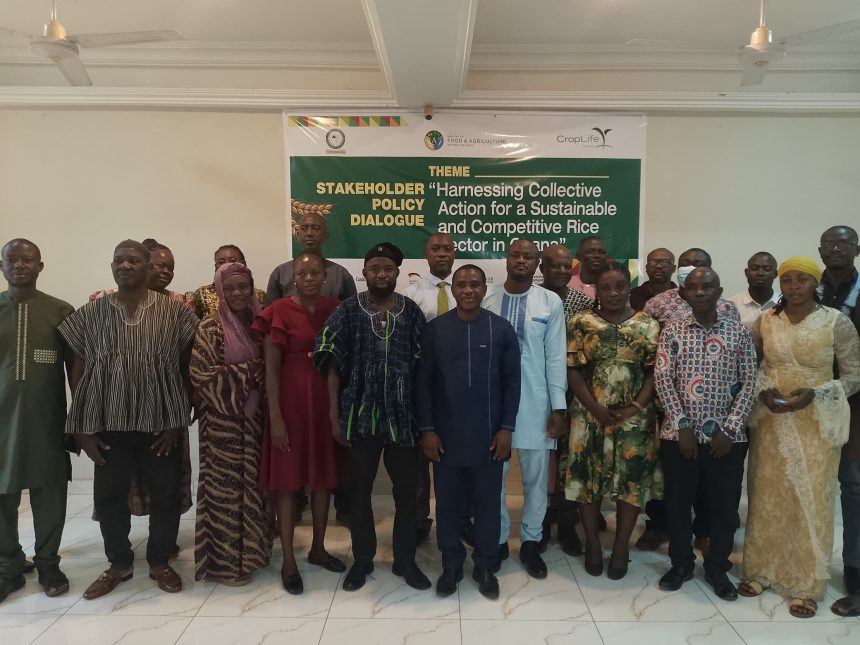
The Competitive African Rice Platform (CARP) Ghana has convened its maiden stakeholder policy dialogue in Tamale to promote coordinated efforts aimed at strengthening Ghana’s rice value chain.
The dialogue, held on the theme: “Harnessing Collective Action for a Sustainable and Competitive Rice Sector in Ghana,” brought together key actors to deliberate on strategies to improve productivity, quality, and sustainability in the rice sector.
The event focused on critical areas such as seed cleaning, improving uniformity and quality of paddy rice, and the development of accessible micro-loan schemes to support women and youth in the industry.
It also examined challenges hindering Ghana’s quest for rice self-sufficiency, including environmental safety practices in rice farming and weak linkages among stakeholders across the value chain.
It was organised with funding support from AGRA through the Bill & Melinda Gates Foundation.
Participants included representatives from the Ministry of Food and Agriculture, Environmental Protection Agency (EPA) Ghana, Council for Scientific and Industrial Research (CSIR), financial institutions, rice farmers, processors, and other industry players.
Mr Mohammed Habib Abdulai, National Coordinator of CARP Ghana, speaking during the event, said the platform sought to enhance policy coordination and collaboration among stakeholders to drive growth and self-sufficiency in the rice sector.
He explained that the initiative aimed at positioning CARP Ghana as a central coordinating body for rice sector development in the country.
He said “CARP Ghana basically works on the policy component of supporting rice sector stakeholders in Ghana, and this programme is to bring all actors together to establish strong linkages that can inform policy decisions both now and in the future.”
Mr Abdulai noted that the dialogue provided an opportunity for stakeholders to identify challenges and collectively develop practical solutions for them.
He emphasised the need for collaboration among farmers, processors, financial institutions, and regulatory bodies to enhance efficiency and improve market access.
He said “For us to achieve rice self-sufficiency, we must not work in silos. When our efforts are combined, we can build a stronger and more resilient rice sector. Collaboration will also ensure market linkages so that what is produced is effectively off-taken and consumed locally.”
Alhaji Dauda Abdul-Salam, Northern Regional Crop Officer at the Northern Regional Department of Agriculture, underscored the importance of a reliable and comprehensive database in planning a resilient rice sector.
He said accurate data on production, processing, and marketing was essential for informed decision-making and effective policy formulation.
Mr Krofa Ofosu, a Research Scientist at the CSIR-Savanna Agricultural Research Institute (CSIR-SARI), sensitised participants on strategies to improve seed quality, including effective seed-cleaning practices to ensure uniformity in paddy output.
He noted that improving seed quality and standardising production processes would significantly enhance the competitiveness of locally produced rice.
The dialogue also highlighted the need for tailored financial products, especially micro-loan schemes, to support women and youth engaged in the rice value chain, enabling them to scale up operations and improve livelihoods.