
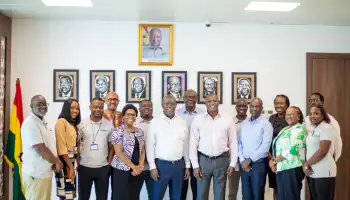
Ghana’s financial inclusion rate has reached 81 per cent, driven largely by mobile money agents and basic phone-based transactions, the Bank of Ghana has said.
The central bank said the achievement reflected how financial systems designed around existing infrastructure could significantly expand access to banking and digital services across developing economies.
Mrs Matilda Asante Asiedu, Second Deputy Governor of the Bank of Ghana, said this at the 2026 3i Africa Summit in Accra on Friday.
She said Ghana’s model demonstrated that large-scale financial inclusion was possible without reliance on smartphones or internet connectivity.
“Anyone and everyone can send money from a phone with no internet connection, no smartphone, no app, no data plan – just a basic phone and a USSD (Unstructured Supplementary Service Data) code,” she said.
Mrs Asiedu said the system, built on widespread mobile network access, had enabled millions of previously excluded people to participate in formal financial services, including payments, savings and insurance.
She cited World Bank data showing Ghana’s financial inclusion rate at 81 per cent, attributing the outcome to system design tailored to technologies already in use by the population.
Africa’s digital financial future, she noted, required deliberate investment in infrastructure that matched local conditions rather than imported models dependent on high-end devices.
Mrs Asiedu outlined three core elements from Ghana’s experience: the use of basic mobile networks for financial transactions, the expansion of mobile money agent networks, and interoperability across service providers.
She said the reliance on basic mobile networks enabled farmers, traders and rural households to access formal financial services without smartphones, while agent networks remained central to cash access across the country.
Mrs Asiedu said that interoperability between mobile money platforms had created a unified payments system, strengthening digital finance as national infrastructure.
On investment conditions, she said predictable payment systems, clear regulatory frameworks and strong consumer protections were essential to attract capital into Africa’s digital economy.
“To attract more investment into Africa’s digital economy, we must build the architecture that allows innovation to grow. That includes payment systems that are trusted, digital public infrastructure that supports identity and access, consumer protection that builds trust, and regulatory coordination that allows businesses to expand across the continent,” she stated.
Mrs Asiedu policymakers to prioritise implementation over policy formulation, stressing the need for functional digital infrastructure that enables large-scale participation in the economy.
She said Africa had strong potential for financial innovation but required deeper system integration across countries to unlock scale.
“Trust is at the heart of any financial transaction. Coordination and the discipline to build systems that are inclusive by design… That is what building on Africa’s terms looks like. And that’s the foundation on which our digital future must be built,” she said.