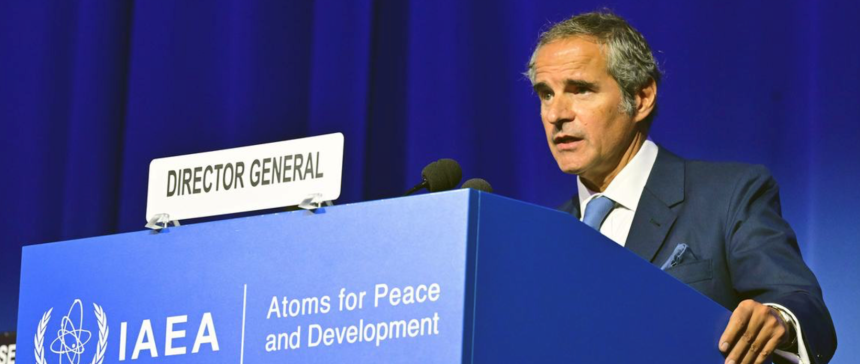
Mr Rafael Mariano Grossi, the Director General of the International Atomic Energy Agency (IAEA), says the lack of access to international finance to advance nuclear power programme, especially by developing countries, is improving.
He said the absence of financing support was not always due to technical limitations but influenced by long-standing restrictions and perceptions surrounding nuclear energy.
“One missing piece, a very important missing piece in nuclear, was the lack of international finance,” Mr Grossi said during a press briefing at the end of a weeklong training for journalists from both develop and developing countries.
He said major international financial institutions had historically remained cautious about supporting nuclear projects, limiting access to capital for countries interested in introducing the technology.
The Director General said efforts by the IAEA to engage development finance institutions had helped trigger a major policy shift.
He recounted the discussions held a few years ago with World Bank leadership, which eventually led to a new partnership between the two institutions, and further agreement signed last year in Paris.
As a result, Mr Grossi said the World Bank was now positioned to support financing for nuclear-related projects, describing the development as a significant breakthrough for countries exploring the technology.
He said the move had generated wider momentum across regional financial institutions.
The Director General said cooperation agreements had since been established with institutions including the Development Bank of Latin America (CAF), the Inter-American Development Bank and the Asian Development Bank, while engagement was ongoing with the African Development Bank.
Mr Grossi said the involvement of multilateral finance institutions was important not only for mobilising capital but also for reducing investment risks.
“Even private investors will not invest when they do not see international finance institutions and insurers getting into a project,” he added.
He described the change as creating a more enabling environment where governments, financial institutions and technical agencies worked together to support responsible nuclear deployment.
Under the emerging arrangement, he explained that countries seeking to develop nuclear energy infrastructure, including Small Modular Reactors (SMRs), could approach financing institutions while relying on the IAEA for independent assessments on safety, security and non-proliferation requirements.
“When a country goes to the World Bank and says we would like to introduce an SMR in five or six years, then the World Bank comes to us and asks what we think in terms of safety, security and non-proliferation,” he noted.
The Director General said early signs suggested the financing shift was already encouraging project pipelines in several regions, including Africa and Europe.
He expressed optimism that stronger coordination between development finance institutions and international nuclear regulators would accelerate access to cleaner and more reliable energy systems for countries pursuing long-term energy transformation.
GNA