Tumivole Awulae Kaku Aka II, Paramount Chief of the Nzema Kotoko Kingdom, has called for Ahanta and Nzema lands to be included in ongoing discussions on reparatory justice in Ghana and Africa.
He said the historical injustices suffered by the twin ethnic groups along Ghana’s western coast required urgent national attention.
“There cannot be reparatory justice in the whole of Africa and Ghana without Ahanta and Nzema lands,” he stated.
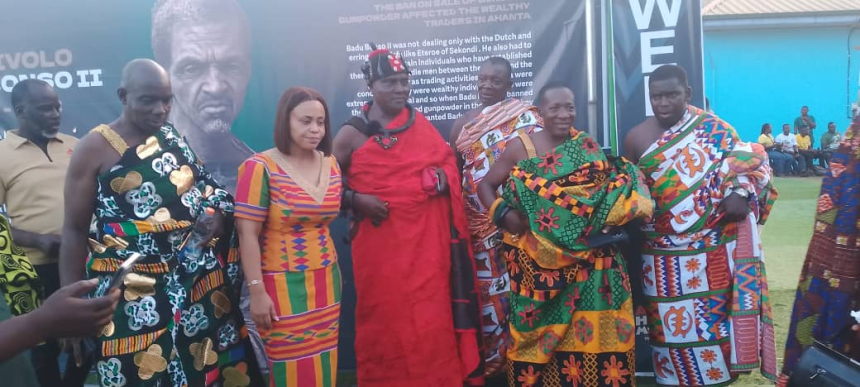
The Paramount Chief made the remarks at the launch of the maiden Ahanta Heritage Month celebration at Apowa in the Ahanta West Municipality of the Western Region.
The event, dubbed “The Untold Slave History of Ahanta,” was held on the theme: “Reparatory Justice: Healing, Unity and Cultural Renaissance.”
It was organised under the auspices of Madam Mavis Kuukua-Bissue, Member of Parliament for Ahanta West, and attracted traditional rulers, diplomats, government officials, high commissioners, ambassadors, and representatives from the diaspora and the Caribbean.
Among the dignitaries present were Nana Kobina Nketsia V, Paramount Chief of the Essikado Traditional Area and President of the Western Regional House of Chiefs, and Nana Kwesi Agyemang IX, Paramount Chief of Lower Dixcove and Vice-President of the House.
Awulae Kaku Aka III paid tribute to Tumivole Awulae Badu Bonso II, Overlord of the Ahanta Kingdom from 1826 to 1838, describing him as a symbol of resistance against colonial oppression.
He recalled that the Ahanta King was beheaded by Dutch colonial authorities in 1838 for resisting their rule.
The Paramount Chief also noted that his ancestor, Tumivole Awulae Kaku Aka I, was executed by British colonial authorities a decade later in 1848.
He commended Madam Kuukua-Bissue for initiating efforts to revive and preserve Ahanta heritage.
According to him, attempts were made in the past to erase the influence of the Anona (Nvavile) clan from the coastal areas of Ahanta and Nzema, but those efforts failed.
He expressed gratitude to the MP for creating a platform that would enable future generations to appreciate Ahanta’s historical contributions to Ghana’s development.
He added that the Nzema Kingdom would, in due course, celebrate the legacy of King Kaku Aka I.
Speaking on the theme, Madam Kuukua-Bissue lauded the courage and sacrifices of Tumivole Badu Bonso II and Tumivole Gyan Kwaw (John Conny), who ruled between 1708 and 1725 and resisted Dutch colonial domination.
“The time has come for Ahanta to speak for itself and for Ghana to recognize the full weight of Ahanta’s contribution to the nation’s story,” she said.
She described reparatory justice, healing, unity and cultural renaissance as a collective responsibility for Ahanta people both at home and abroad.
She said the initiative sought to reconnect people with their identity, confront historical truths and inspire future development.
“History is not nostalgia. History is direction. A people without history are robbed of identity, dignity and destiny, but a people who know their story can never be broken,” she added.
Madam Kuukua-Bissue said the heritage month “matters for Ahanta, Ghana, Africa and to every people who believe that no culture should be silenced, no legacy should be buried and no truth should be forgotten.
“Long before Ghana was drawn on a map and colonial borders divided the Ahanta land, the Ahanta Kingdom stood proud, organized and respected along the Western coast as a beacon of governance, order and strength. We were not waiting to be discovered. We were already governed with systems of leadership, justice and diplomacy,” she stated.
Nana Kwesi Agyemang IX praised the MP for championing the restoration of Ahanta’s heritage and pledged the support of the traditional council to sustain the annual celebration.
He also urged Ahanta citizens to take pride in their cultural identity.
Mr Anokye Frimpong, historian and lawyer, paid tribute to Chief John Conny for his humanitarian leadership and highlighted his role in advocating the return of the severed head of King Badu Bonso II to Ghana.
He argued that many divisions among traditional states in the Western region were the result of colonial arrangements designed to weaken indigenous authority structures.
Mr Frimpong further advocated stronger traditional leadership structures, citing the Asante Kingdom as an example of unified traditional governance.
GNA